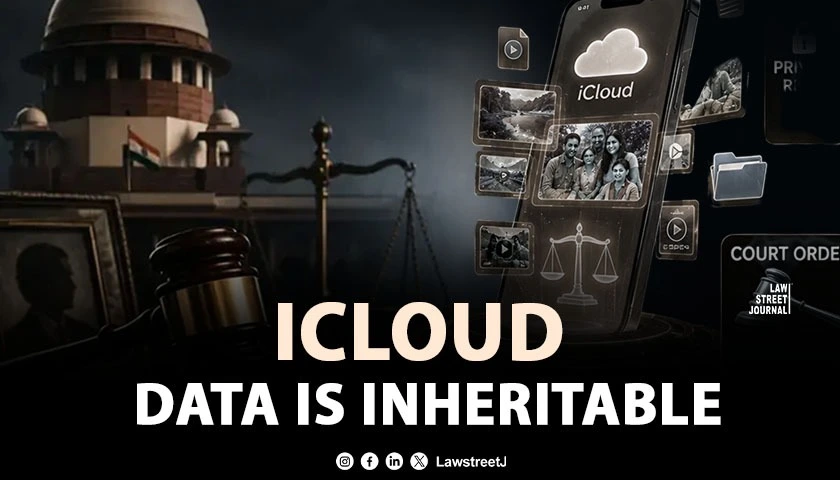
Gandhinagar: The 3rd Additional Senior Civil Judge at Gandhinagar, Gujarat, has ruled that digital data stored in a deceased person’s Apple iCloud account forms part of his estate and is capable of administration and inheritance under the Indian Succession Act, 1925. The Court granted Letters of Administration to the daughter of the deceased, authorising her to access and recover her late father’s iCloud account data.
The judgment was delivered by Judge Himanshu Choudhary in Civil Miscellaneous Application No. 17/2026, filed by Smt. Sadhna Shaishav Shah and Ms. Sur Shaishav Shah, the widow and daughter, respectively, of Late Shri Shaishav Dineshbhai Shah, who passed away intestate on 24 April 2025 at Gandhinagar.
The deceased had owned an Apple iPhone 13 Pro Max and an Apple iCloud account. His iCloud account contained photographs, videos, voice notes, documents, and contact lists of significant emotional and practical value to his family. When the petitioners approached Apple seeking access to the account, Apple responded that it could facilitate a password reset to allow access but required a specific court order appointing the requester as the legal personal representative of the deceased’s estate.
The petitioners filed the present application seeking Letters of Administration over the deceased’s digital estate. The widow filed a no-objection declaration consenting to her daughter, Ms. Sur Shaishav Shah, being appointed as the sole Administrator. A public notice was duly published in the newspaper Sandesh, and no objections were received from any quarter.
On the central legal question of whether digital data constitutes property, the Court held that the existing Indian legal framework is sufficiently broad to include it. It referred to the broad definition of “movable property” under the General Clauses Act, 1897, and the Bharatiya Nyaya Sanhita, 2023, the inclusive definition of “property” under the Prevention of Money Laundering Act, 2002, and the recognition of Virtual Digital Assets under the Income Tax Act, 1961. The Court also drew support from the Supreme Court’s expansive reading of “property” in Jilubhai Nanbhai Khachar v. State of Gujarat (1995) and State of West Bengal v. Subodh Gopal Bose (1953), which held that property encompasses everything subject to ownership, whether tangible or intangible.
On the question of privacy rights, the Court noted that the right to privacy, being a personal right, does not survive an individual’s death. Applying the maxim actio personalis moritur cum persona, it held that no privacy claim of the deceased could obstruct the legal heirs from administering his digital estate. The Court further observed that since the deceased had not appointed any nominee under Section 14 of the Digital Personal Data Protection Act, 2023, the rights relating to his digital data logically devolved upon the legal heirs, who step into the position of the data principal for the limited purpose of administering the estate.
The Court allowed the petition and granted intestate Letters of Administration in favour of Ms. Sur Shaishav Shah.
It also directed Apple Distribution International Limited and its affiliates to assist the Administrator in recovering the deceased’s data and to extend assistance, to the extent technically feasible, in recovering data stored on the physical device. The Administrator was directed to prepare an inventory within six months and render a true account within one year of the grant.
Case Title: Smt. Sadhna Shaishav Shah & Anr. v. Nil, Civil Miscellaneous Application No. 17/2026


![Why Have Rules Under Shariat Application Act Not Been Framed? SC Seeks Responses From Union And Uttar Pradesh [Read Order]](/secure/uploads/2026/02/lj_3915_Why_Have_Rules_Under_Shariat.webp)
![Suspicious Will: Witness Proof Alone Not Enough, Propounder Must Dispel Doubts: SC [Read Judgment]](/secure/uploads/2026/07/lj_6690_Suspicious_Will_Witness.webp)