New Delhi: The Delhi High Court has upheld a Labour Court award holding the termination of a workwoman, whom her employer claimed had retired on superannuation, to be illegal retrenchment. It held that an Aadhaar card is not by itself proof of date of birth, and that the employer, having itself given a different date of birth to the Employees’ State Insurance Corporation (ESIC) years earlier, could not rely on the Aadhaar entry to end her services a year early.
Justice Manoj Kumar Ohri was hearing a writ petition under Article 226 filed by M/s J.J. Electronics against an award of the Labour Court-IX, Rouse Avenue Courts, New Delhi, in LID No. 78/2018. The Labour Court had held that Smt. Rosamma Joy was illegally retrenched, and awarded her full back wages from 20.05.2017 to 20.05.2018 at Rs 14,698 per month, along with consequential benefits and 6% interest from the date of publication of the award.
The workwoman said she had worked as a ‘Finishing Man’ since 01.12.1981 and that her last drawn wages were Rs 10,500 per month. According to her, when she asked for the minimum wages revised by the Delhi Government on 03.03.2017, the management refused, and on 20.05.2017, when she demanded her April wages, it terminated her services in violation of Sections 25F and 25G of the Industrial Disputes Act, 1947. The management said she turned 58, the age of retirement in its factory, on 20.05.2017, as her Aadhaar card showed her date of birth as 20.05.1959, and that after cataract surgery in April 2017 she herself resigned and took her dues. It also said Sections 25F and 25G did not apply as it had fewer than 10 employees.
The Court noted that, under Section 2(oo)(b) of the Act, retirement on reaching the age of superannuation, where the contract provides for it, is not retrenchment. It held that the case turned on whether she was born on 20.05.1959 (retirement in 2017) or on 20.05.1960 (illegal retrenchment without Section 25F compliance). The management had set up the plea of superannuation, and the burden lay on it. It relied only on the Aadhaar card, received from the workwoman in March 2017, two months before her services ended.
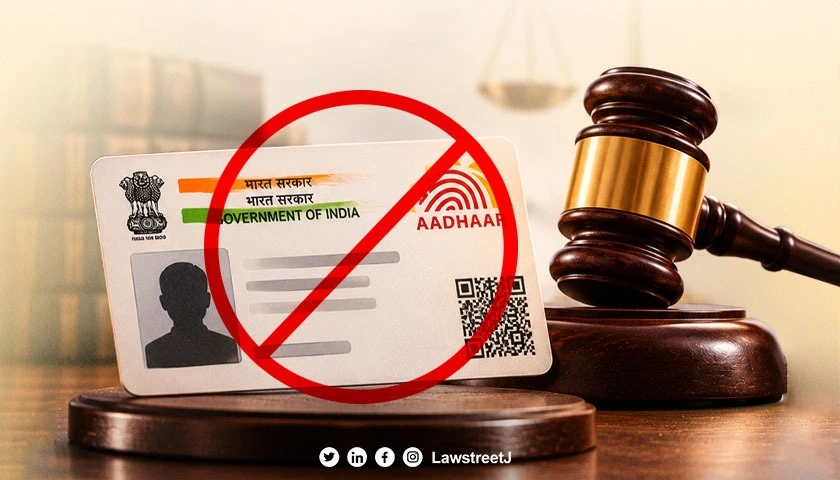
Relying on the UIDAI Office Memorandum of 20.12.2018, the Supreme Court’s decision in Saroj v. IFFCO-Tokio General Insurance Co. Ltd., 2024 INSC 816, and its own decisions in Mahender Yadav v. South Delhi Municipal Corporation and K. Murugan v. Delhi Building and Other Construction Workers Welfare Board, the Court held:
“An Aadhaar card is not, by itself, proof of date of birth.”
The Court observed that UIDAI records the date of birth on the basis of documents or self-declaration, and the Aadhaar Act recognises the number as proof of identity, not of date of birth. Against this, the Labour Court had summoned the ESIC record, and an ESIC official examined as Court witness (CW-2) deposed that the workwoman was registered on 26.06.2010 with a date of birth of 20.05.1960, furnished by the management itself. The Court noted that the entry was made several years before the dispute, when neither side had reason to dispute her age, and that the management did not cross-examine CW-2 or produce the documents on which it gave this date.
It held that the Labour Court rightly drew an adverse inference against the management for withholding such documents. Having recorded her date of birth as 20.05.1960, the management “could not later rely upon a different date in an Aadhaar card to end her services a year earlier”. The Court also added that the Industrial Disputes Act is a beneficial piece of legislation.
On the limited scope of writ jurisdiction, it held that the Labour Court’s preference for the ESIC record over the Aadhaar card was a finding of fact and “a plausible view” that cannot be called perverse. Once superannuation was not proved and the management failed to prove resignation or voluntary retirement, the termination without Section 25F compliance was rightly held illegal. The petition was dismissed.
The amount deposited in the Court under its order of 30.11.2022, with interest, must be released to the workwoman, and any balance paid within four weeks.
Appearances:
For the Petitioner: Ms. Renu, Mr. Kamlesh Kumar Mishra, Mr. Piyush and Ms. Mansi, Advocates.
For the Respondent: Mr. Aarlin Moncy and Ms. Sruti Mehrotra, Advocates.
Case Title: M/s J.J. Electronics vs. Smt. Rosamma Joy, W.P.(C) 16476/2022, decided on 13.11.2026