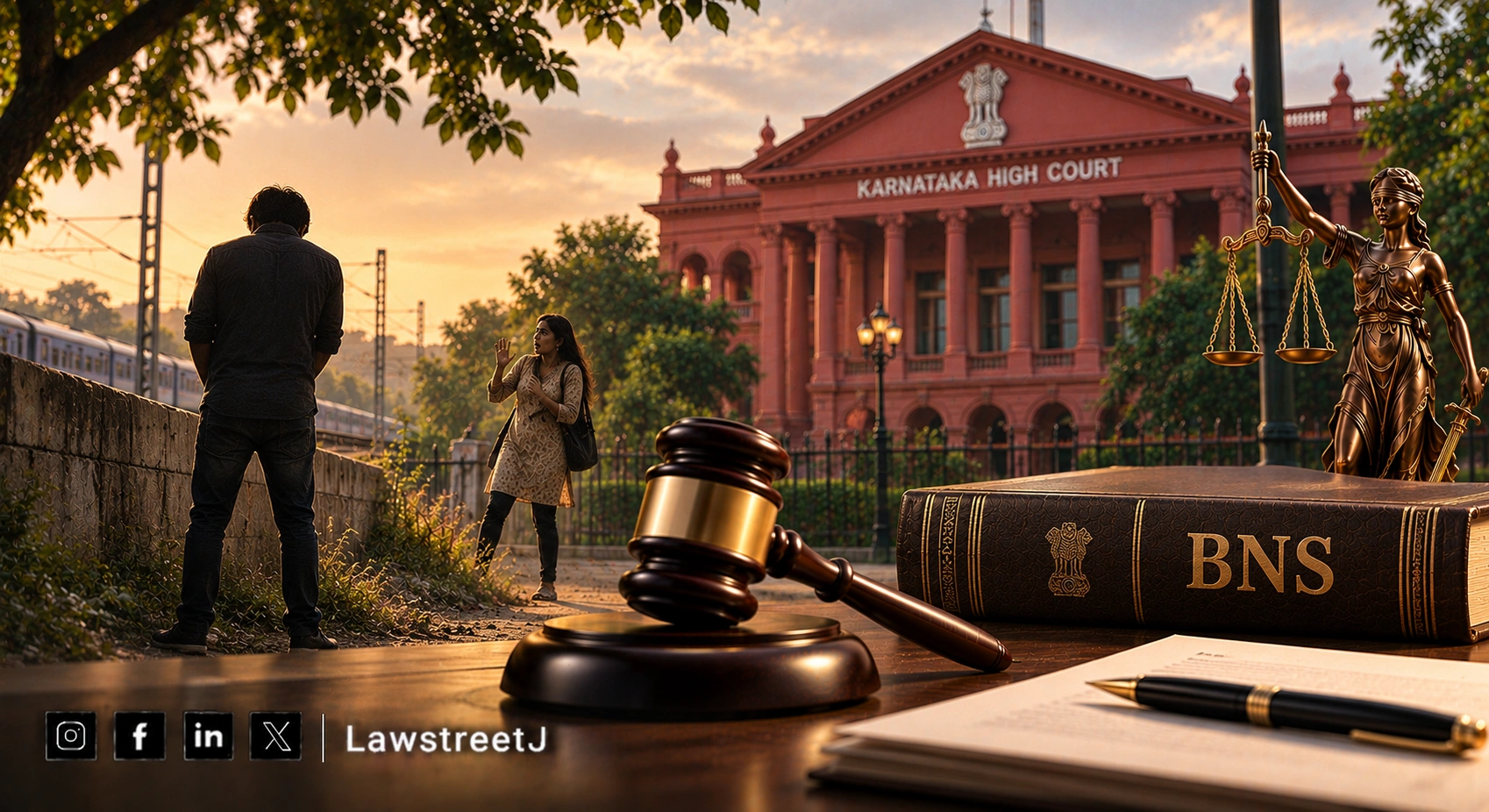
Bengaluru: The Karnataka High Court has quashed criminal proceedings registered against a 26-year-old man under Section 75(2) of the Bharatiya Nyaya Sanhita, 2023, holding that an accidental and unintended exposure, witnessed by a woman while the accused was answering nature's call, cannot be metamorphosed into an offence of sexual harassment in the absence of sexual intent directed towards her.
Justice M. Nagaprasanna was hearing a criminal petition filed under Section 482 of the Cr.P.C. (filed under Section 528 of the BNSS) seeking to quash the order passed by the 7th Additional Chief Judicial Magistrate, Bengaluru, taking cognizance against the petitioner for the offence under Section 75(2) of the BNS and issuing summons in C.C. No. 14887/2026.
As per the complaint registered on 24.01.2026, later registered as Crime No. 35 of 2026, the allegation was that the petitioner exposed his private part at a public place near Hebbal while the complainant was walking by. Following investigation, the police laid a charge sheet against the petitioner, leading to the impugned cognizance order.
Counsel for the petitioner submitted that after alighting from a bus and finding no restroom nearby, the petitioner had relieved himself by the side of the street, and that the complainant happened to walk past at that very moment; on noticing her, he turned around in shock, at which point she saw him. It was argued that this accidental circumstance, devoid of any sexual overture or intent directed at the complainant, did not satisfy the ingredients of Section 75(2) of the BNS (corresponding to Section 354A of the erstwhile IPC). Counsel for the complainant, supported by the State, contended that the petitioner had also made certain gestures, and that this was a matter fit to be tried, with the petitioner free to establish his innocence at trial.
Examining the complaint and the charge sheet, the Court noted that the complainant's own narration did not allege that the petitioner was waiting for her, beckoned her, followed her, made any sexually coloured remark, or deliberately exposed himself upon noticing her; rather, the reaction attributed to him was one of sudden shock, which, the Court observed, “far from supplying the element of sexual intent, prima facie travels in the opposite direction.”
The Court held that exposure of the body and intentional exposure for a sexual purpose are not synonymous, and that criminal law cannot mechanically criminalise the former merely because circumstances brought it within the sight of another, without the requisite mens rea and sexual overtone. It further held that permitting a criminal trial to proceed on such allegations, where the very substratum of the prosecution did not disclose the ingredients of the offence, would amount to allowing the process of law itself to become the punishment and would result in an abuse of process and miscarriage of justice.
Relying on the Supreme Court's decision in State of Haryana v. Bhajan Lal, which sets out the categories of cases where inherent jurisdiction may be exercised to quash proceedings including where the allegations, even if taken at face value, do not prima facie constitute an offence, or are so improbable that no prudent person could reach a just conclusion of sufficient ground to proceed the Court held that the present case squarely fell within these categories, warranting exercise of its inherent jurisdiction under Section 528 of the BNSS.
The criminal petition was accordingly allowed, and the proceedings in C.C. No. 14887/2026 pending before the 7th Additional Chief Judicial Magistrate, Bengaluru, were quashed.
Appearances:
Sri. Abhilash H.S., Advocate for the Petitioner; Sri. K. Nageshwarappa, HCGP for Respondent No. 1-State; Smt. Swati Gopalkrishna, Advocate for Respondent No. 2-Complainant.
Case Title: Anil Rohan Menezes vs. State of Karnataka & Anr., Criminal Petition No. 6103 of 2026


![Karnataka High Court: Cabinet Rank Status Not Equivalent to Ministerial Position [Read Order]](/secure/uploads/2023/09/lj_2318_fc1b99b7-aeed-472b-836e-33750bedb394.jpg)


![Woman living in adultery cannot claim maintenance: Karnataka High Court [Read Order]](/secure/uploads/2023/10/lj_3083_Women_living.jpg)