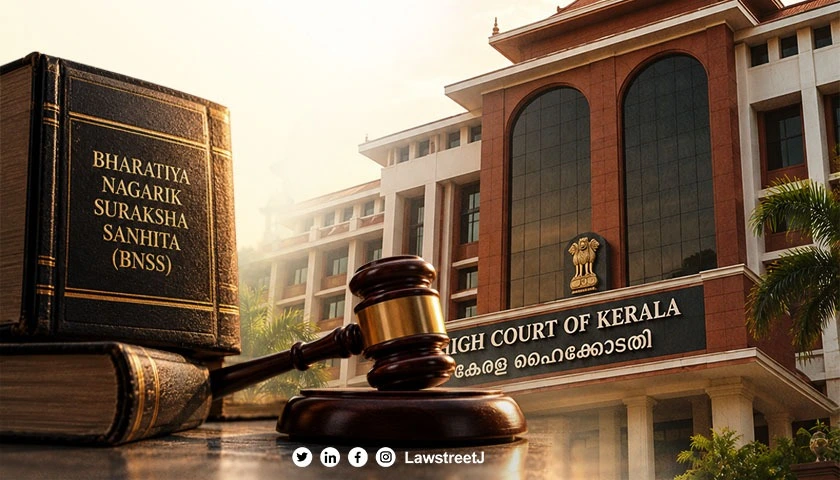
Kochi: The Kerala High Court has held that an investigating agency cannot compel an accused to produce his mobile phone by a summons under Section 94 of the Bharatiya Nagarik Suraksha Sanhita, 2023, when it is alleged to contain incriminating material, as this would violate the protection against testimonial compulsion in Article 20(3) of the Constitution.
Upholding the cancellation of bail of a man accused under the POCSO Actand the Bharatiya Nyaya Sanhita, the Court held that custodial interrogation was highly warranted to facilitate effective further investigation.
Justice Jobin Sebastian was hearing a petition by Abdul Rafeek, the first accused in Crime No. 54/2026 of Payyoli Police Station, Kozhikode, against the order of 24.10.2026 of the Fast Track Special Court, Koyilandy, cancelling his bail. The final report alleges offences under the BNS and the POCSO Act, in which a minor girl is the victim and her mother has been arrayed as the second accused. The petitioner was abroad when the crime was registered and was shown as absconding in the final report. After the Special Court took cognizance and issued summons, he appeared and was granted bail. The Circle Inspector then sought further investigation and cancellation of bail, saying that his custodial interrogation was necessary for a potency examination, recovery of further evidence and to prevent absconding.
The petitioner argued that bail cannot be cancelled solely because further investigation is needed, in the absence of any violation of bail conditions or misuse of liberty, that he was willing to cooperate, undergo the potency test and surrender his phone and passport, and that his prompt appearance on summons ruled out absconding. The Director General of Prosecution argued that the allegations were grave, that the accused had remained abroadthroughout the investigation, that his mobile phones and the places to which the victim was allegedly taken were yet to be traced, and that a summons under Section 94 BNSS for the phones would itself violate Article 20(3).
The Court first stated that the considerations for granting and cancelling bail are not identical, and that bail cannot be cancelled mechanically merely because further investigation is proposed. Ordinarily, compelling circumstances such as tampering with evidence or intimidation of witnesses are needed, as explained in Dolat Ram v. State of Haryana, (1995) 1 SCC 349. It held, however, that the power is not confined to misuse of liberty, since the possibility of absconding is also relevant, and an order of bail passed ignoring material in heinous offences can be set aside, as Puran v. Rambilas, (2001) 6 SCC 338, held.
The Court observed that, given the victim’s tender age, it would be unsafe to assume that her account exhaustively describes every place to which she was taken, so that identification of places, site plans and examination of persons connected with them cannot be treated as formal. It also held that questioning an accused on bail and custodial interrogation are not equivalent, citing CBI v. Anil Sharma, (1997) 7 SCC 187, and that the accused having stayed abroad without cooperating with the investigation, custodial interrogation was highly necessary.
On the key issue, the Court noted that under State of Bombay v. Kathi Kalu Oghad, directions for a potency test, voice sample or fingerprints are physical or medical evidenceand do not attract Article 20(3). However, relying on State of Gujarat v. Shyamlal Mohanlal Choksi, V.S. Kuttan Pillai v. Ramakrishnan and its own decisions in Gopalakrishnan Nayanar, Kurian v. Joseph and Rajesh T.K. v. State of Kerala, it held that Section 94(1) BNSS, like Section 91(1) Cr.P.C., cannot be invoked to compel an accused to produce things that would incriminate him. It stated:
“When the investigating agency seeks to compel the accused to produce his mobile phone, particularly when it is alleged to contain incriminating materials against him, such compulsion would violate the protection guaranteed under Article 20(3) of the Constitution of India.”
The Court therefore held that the agency cannot compel production of the phone by Section 94 BNSS, and that custodial interrogation was significant to ascertain how many phones were used and to recover them. The willingness to produce one phone did not make custodial interrogation unnecessary, since the prosecution said that several phones were used and the further investigation also had to identify the places where the alleged offences occurred. Finding no illegality in the Special Judge’s order, the Court dismissed the petition.
Appearances:
For the Petitioner: Mr. Sharan Shahier and Mr. P. Vijaya Bhanu, Senior Advocate.
For the State: Mr. T. Asaf Ali, Director General of Prosecution.
For the Victim (Respondent 2): Mr. Maaroof. For Additional Respondent 3: Ms. K.K. Preetha.
Case Title: Abdul Rafeek @ Rafeek vs. State of Kerala & Another, Crl.M.C. No. 8940 of 2026, 2026:KER:84411