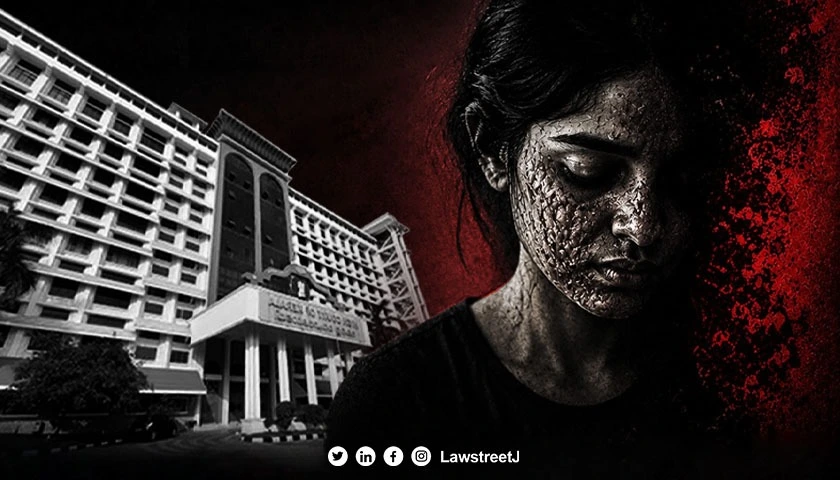
Ernakulam: The Kerala High Court has directed the District Legal Services Authority (DLSA), Kasaragod, to conduct an enquiry and determine the quantum of compensation payable to four victims of an acid attack under Section 357A of the Code of Criminal Procedure, holding that criminal courts are under a mandatory duty to apply their mind to the question of victim compensation, particularly in cases of this nature.
Justice Jobin Sebastian was hearing a Criminal Miscellaneous Case filed by the victims in S.C. No. 649 of 2014 on the file of the Sessions Court, Kasaragod, arising out of an acid attack case in which the sole accused was charge-sheeted under Sections 307 and 326A IPC. The trial court, by judgment dated 29.01.2015, had convicted the accused under Section 326A IPC and acquitted him under Section 307 IPC, sentencing him to 12 years' rigorous imprisonment and a fine of Rs.40,000/-, in default, two years' further rigorous imprisonment. Out of the fine amount, the trial court had directed Rs.25,000/- to be paid to PW1 and Rs.5,000/- each to PWs 2 to 4, the injured victims, as compensation under Section 357(1)(b) CrPC.
The petitioners' grievance was that, despite being victims of a brutal acid attack, the trial court had failed to make a recommendation for compensation under Section 357A of the Code, and that the amount awarded under Section 357(1)(b) was grossly inadequate having regard to the nature of their injuries and the long-term physical, psychological and financial consequences of the attack. They had approached the Sessions Court by way of C.M.P. No. 2135 of 2023 seeking a recommendation to the District Legal Services Authority under Section 357A, but the said petition was dismissed on the ground that, with an appeal against the conviction already pending before the High Court, it would not be proper for the trial court to pass an order that amounted to filling up a lacuna in the judgment already pronounced. The petitioners accordingly approached the High Court under Section 482 CrPC.
The learned Senior Public Prosecutor submitted that the accused had already preferred Criminal Appeal No. 192 of 2015 before the High Court, which was still pending, and that the issue raised could be more appropriately considered by the Bench hearing that appeal.
The Court held that in an acid attack case, the criminal court is under a statutory obligation to consider the question of awarding adequate compensation to the victims, since victim compensation is intended to alleviate the suffering endured by victims of serious offences. Relying on the Supreme Court's decision in Ankush Shivaji Gaikwad v. State of Maharashtra, [2013 KHC 4371], the Court reiterated that Section 357 CrPC confers a power coupled with a duty on courts to apply their mind to the question of compensation in every criminal case, and that failure to do so would defeat the very object of the provision. The Court also relied on a Division Bench ruling of the Kerala High Court, which had held that in acid attack cases, courts are under a mandatory obligation to ensure adequate compensation to victims, and that the expression "may" in sub-section (3) of Section 357A must be construed as mandatory.
The Court observed that the compensation of Rs.40,000/- awarded as fine was manifestly inadequate to compensate the victims for the pain, suffering, permanent disfigurement, trauma, medical expenses and other lifelong consequences flowing from the acid attack, and that there was, in any event, no certainty that the fine amount would be realised. It held that the compensation envisaged under Section 357A is independent of, and in addition to, compensation awarded under Section 357, and that the victims' entitlement could not be curtailed merely because a fine had been imposed. The Court observed that “the power to recommend compensation under Section 357A is a power coupled with a duty, and every criminal court is expected to consciously examine the question of victim compensation while rendering judgment, particularly in cases involving acid attacks. Failure to do so constitutes a serious omission.”
On the question of the pending appeal, the Court held that, since the appeal had remained pending since 2015, its mere pendency could not be a ground to decline the relief sought.
Exercising its inherent jurisdiction under Section 482 CrPC to remedy the omission and secure the ends of justice, the Court allowed the petition and directed the DLSA, Kasaragod, to conduct an enquiry and determine the quantum of compensation payable to PWs 1 to 4 under Section 357A CrPC, preferably within two months, and to ensure that the compensation so determined is disbursed to the victims without unnecessary delay.
Appearances:
For the Petitioners: Smt. Ipsita Ojal, Shri. Anil Kumar K.P., Smt. Mariyamma A.K.
For the Respondents: Sri. Navas V.A., Sr. Public Prosecutor.
Case Title: XXX & Ors. vs. State of Kerala & Anr., Crl.M.C. No. 6038 of 2023



![Kerala HC Quashes 498A Dowry Harassment Case Against Live-In Partner, Citing Lack of Relative Status [Read Order]](/secure/uploads/2023/08/lj_5693_1057c042-1e57-4e27-8c9e-25af0ec38ec4.jpg)
![Watching porn on mobile: Kerala HC highlights importance of mother cooked meals, outdoor sports [Read Order]](/secure/uploads/2023/09/lj_9155_Parental_supervision_of_mobile_phone_usage.jpg)
![Lakshadweep MP Mohammed Faizal Disqualified from Lok Sabha After Conviction Suspension Plea Rejected by Kerala High Court [Read Notice]](/secure/uploads/2023/10/lj_9640_87b5fd97-0e05-4ff8-9a99-3be1e4446192.jpg)