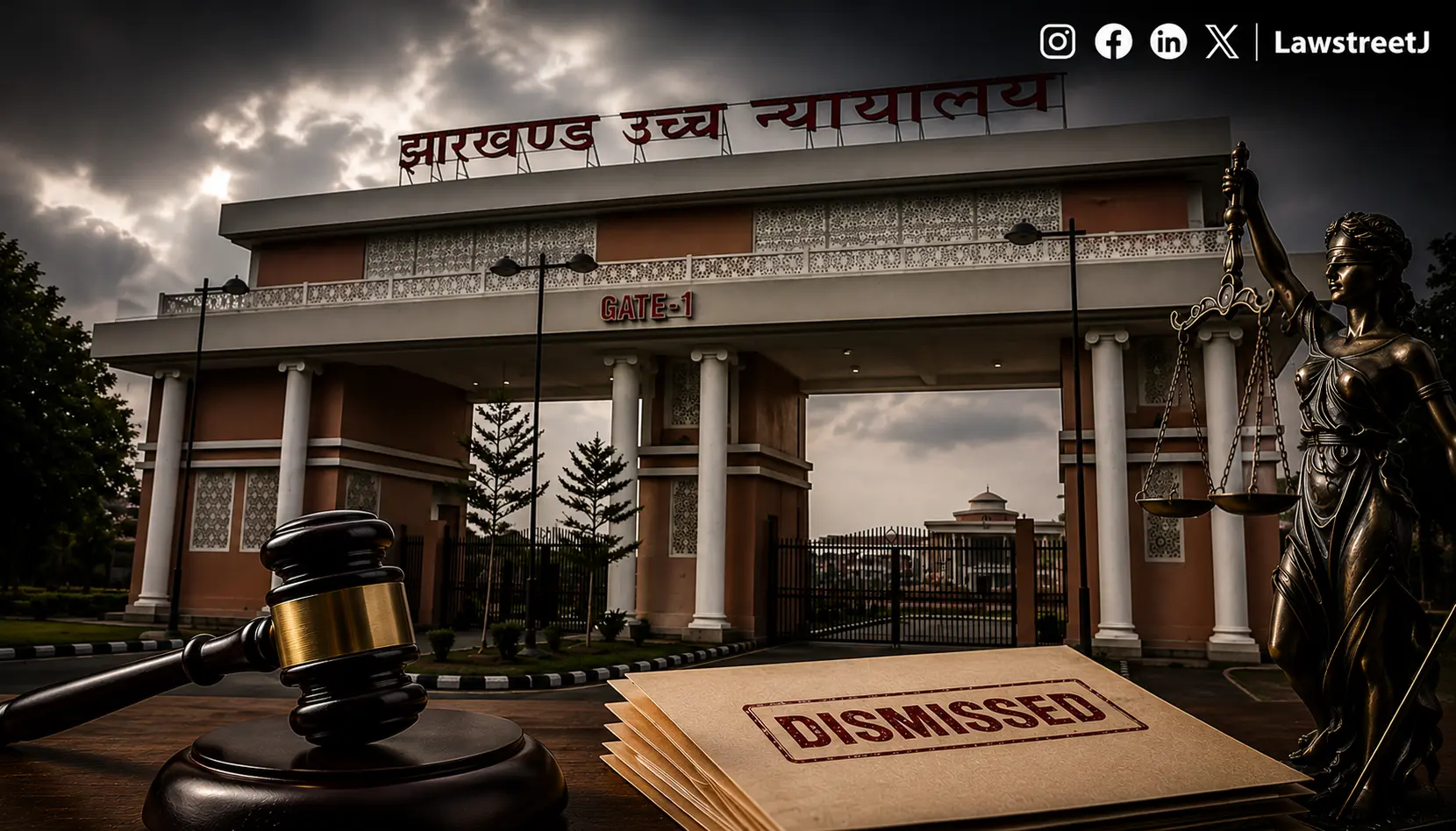
Ranchi: The Jharkhand High Court has held that adultery is no longer a criminal offence in view of the Supreme Court's ruling in Joseph Shine v. Union of India, while quashing the dismissal of a Jharkhand Armed Police constable whose services were terminated over an alleged extramarital relationship.
Justice Deepak Roshan allowed a writ petition filed by Bharat Pathak, also holding that the disciplinary authority had dismissed him on a ground that was never part of the charge-sheet, and directed his reinstatement as constable with back wages and consequential service benefits.
The petitioner, who joined the Jharkhand Armed Police in 2007, faced a complaint from a woman alleging that he had married her and maintained a physical relationship with her between October 2019 and April 2023 while already married, and that he later refused to continue the relationship. A preliminary enquiry found that both were married to other people but were living together at hotels and rented accommodation, and that the matter surfaced only after the petitioner denied the relationship over societal embarrassment, following which the complainant lodged both a departmental complaint and an FIR under Sections 417 and 376(2)(n) of the IPC.
The petitioner was suspended and a departmental charge-sheet was issued against him on the allegation of the relationship. During the departmental enquiry, the two officials who had conducted the preliminary enquiry were cross-examined and admitted that they had no documentary evidence beyond the complainant's own statement, that she had not produced proof of the alleged marriage, and that CCTV footage of the hotel where the relationship was alleged to have occurred was never examined. The petitioner could not cross-examine the complainant since the criminal case was pending before the competent court.
Despite these deficiencies, the disciplinary authority passed an order of removal from service on 31.12.2024, but on a ground never put to the petitioner during the enquiry: that the pending FIR under Section 376(2)(n) of the IPC amounted to a serious offence justifying dismissal. A consequential order to the same effect followed on 14.01.2025, and the petitioner's departmental appeal was rejected on 04.12.2025 on the ground that he was guilty of the alleged act despite being married.
Before the High Court, the petitioner argued that the penalty was based on a charge never framed against him, that the enquiry and the punishment orders were non-speaking and failed to address his defence, and that adultery was no longer a criminal offence following the Supreme Court's decision in Joseph Shine v. Union of India. The State, in its counter-affidavit, merely reiterated the findings of the enquiry report and maintained that natural justice had been complied with.
The Court found that the final dismissal order rested squarely on the existence of the FIR under Section 376(2)(n) of the IPC, a ground that was never part of the original charge-sheet, and held that this rendered both the dismissal order and the consequential order illegal. Relying on the Supreme Court's rulings in Punjab National Bank Ltd. v. All India Punjab National Bank Employees' Federation and Remington Rand of India Ltd. v. Tahir Ali Saifi, the Court reiterated that a disciplinary authority is confined to the charges set out in the charge-sheet and cannot travel beyond it while imposing punishment.
The Court further held that the disciplinary and appellate orders were non-speaking, since neither authority engaged with the petitioner's reply or explained how the charges stood proved on admissible evidence, relying instead on the Supreme Court's decision in ORYX Fisheries Private Limited v. Union of India and Ors. It also noted that the enquiry report itself showed no independent or documentary evidence beyond the complainant's statement, and that the disciplinary authority appeared to have been swayed by the nature of the allegations rather than by legally admissible evidence.
Addressing the petitioner's contention that the alleged relationship, even if true, could not have founded a dismissal, the Court held that the offence of adultery has already been struck down by the Supreme Court, and that Section 497 of the IPC could no longer be treated as a beneficial provision protected under Article 15(3) of the Constitution.
"It is pertinent to note that the offence of adultery has already been struck down by the Hon'ble Supreme Court in Joseph Shine vs Union of India, reported in (2019) 3 SCC 39, wherein it has been held that the offence of adultery is no more a crime."
The Court observed that the case appeared to have been lodged by a disgruntled complainant seeking to harass and pressure the petitioner, and that the allegations did not fall within the scope of "moral turpitude," a term that could not be left to the subjective discretion of the disciplinary authorities. Holding the dismissal to be arbitrary, disproportionate and violative of Articles 14 and 21 of the Constitution, the Court quashed the orders dated 31.12.2024, 14.01.2025 and 04.12.2025, and directed the respondents to reinstate the petitioner as constable with back wages and all consequential service benefits.
Appearances: For the Petitioner: Mr. Shresth Gautam, Mr. Shailesh Poddar and Mr. Shashank Shekhar No.3, Advocates. For the Respondents: Ms. Sonal Tiwary, A.C. to A.G.
Case Title: Bharat Pathak @ Bharat Kumar Pathak vs. The State of Jharkhand and Others, W.P.(S) No. 1833 of 2026



![Supreme Court Collegium approves new Chief Justices for five key High Courts in India [Read Recommendations]](/secure/uploads/2023/12/lj_8000_380d1135-6f3a-4988-a00a-4d5cd5901815.jpg)
!['Arbitrary, impermissible,' SC quashes HC's resolution raising aggregate cut off marks on district judges appointment [Read Judgment]](/secure/uploads/2024/02/lj_3605_Rule-for-Judge-Selection.webp)