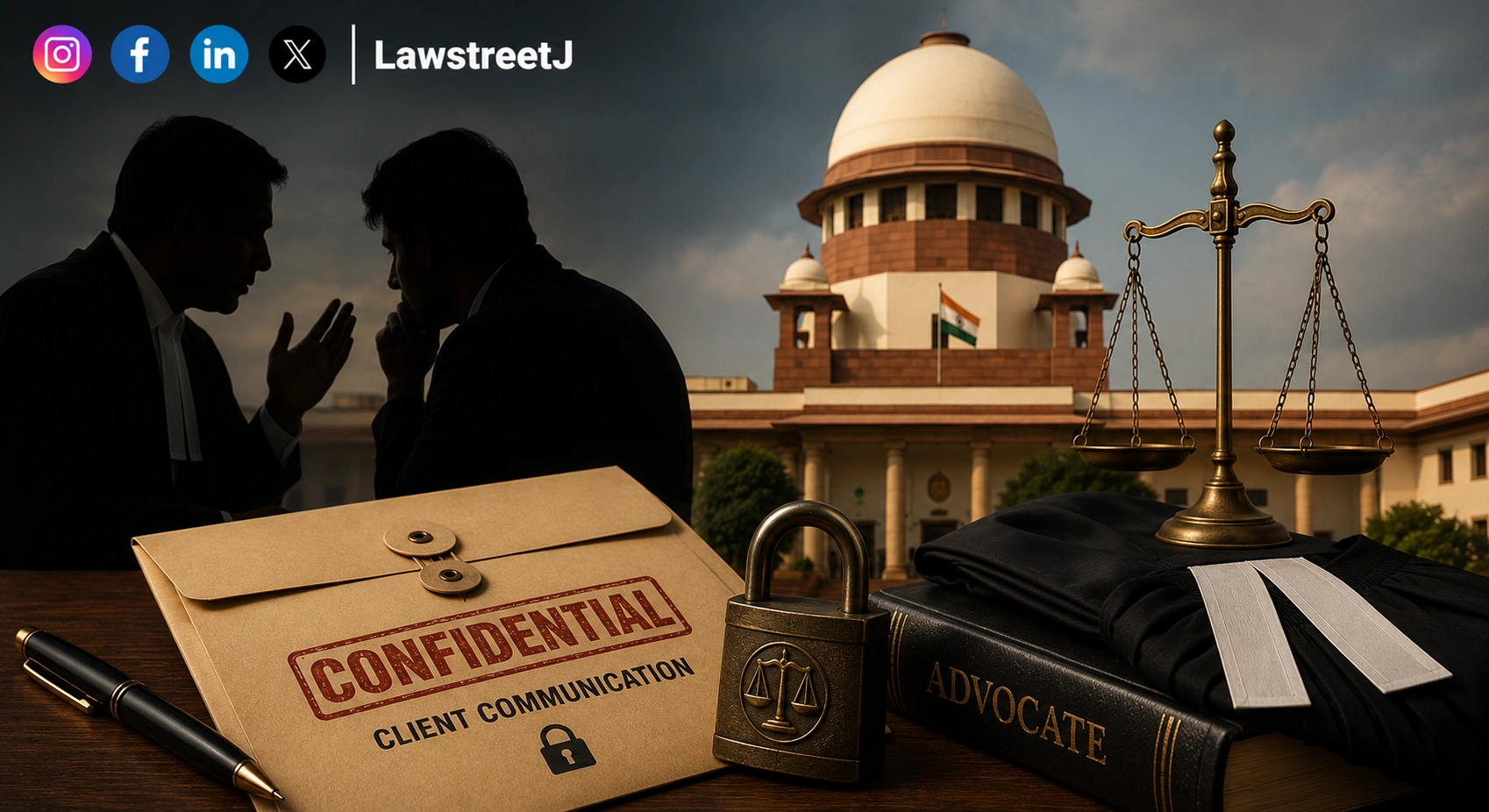
New Delhi: The Supreme Court has declined to enhance the punishment imposed on an advocate found guilty of professional misconduct for disclosing a former client's confidential communications on national television, while simultaneously rejecting the advocate's own challenge to the finding of misconduct.
A bench of Justices Vikram Nath, Sandeep Mehta and Vijay Bishnoi upheld a Bar Council of India order suspending the advocate, Rizwan Siddiquee, from practice for two years, and imposed costs of Rs. 5,00,000 on each of the two litigants for their conduct in the proceedings.
Background
The appellant, Rehana Khan, had engaged Siddiquee as her counsel for part of 2013 and 2014. According to her, she had approached a senior Mumbai police official for help after an altercation with her brother, and the official instead attempted to sexually assault her; she said she shared confidential details of her ordeal with Siddiquee while he represented her. A legal notice was sent to the police official through Siddiquee's office on 15th July 2014, whose authorisation the two sides dispute. On 24th July 2014, Khan filed an FIR against the official alleging offences including rape, naming Siddiquee as a person acting under the official's influence.
On 5th August 2014, Siddiquee gave a television interview broadcast on Aaj Tak and Zee News, discussing his interactions with Khan; recordings of their conversations and messaging exchanges were also aired. His office was searched by investigators on 13th August 2014, a search that too was broadcast. Khan filed a complaint before the Bar Council of Maharashtra and Goa in February 2015, later taken up by the Bar Council of India's Disciplinary Committee.
By its order dated 11th August 2025, the Disciplinary Committee found Siddiquee guilty of misconduct on three counts: unauthorised issuance of the notice, disclosure of confidential information leading to Khan's identification in the media, and derogatory public remarks about her. It suspended him from practice for two years, fined him Rs. 3,00,000 payable to Khan, and directed a further Rs. 2,00,000 to the Bar Council of India's Welfare Fund. Both sides challenged the order Khan seeking enhancement before the Supreme Court, and Siddiquee first by writ petition before the Bombay High Court and then by separate appeal, with the writ petition later transferred to the Supreme Court and heard together.
Arguments
Khan, appearing in person, argued that Siddiquee had betrayed the trust of the lawyer-client relationship by colluding with the opposing party, disclosing her confidential information to the press, and publicly branding her complaint a false case of rape. She pointed to record of continuous telephonic contact and an in-person meeting between Siddiquee and the police official on 18th July 2014 as evidence of collusion, and sought his permanent debarment along with compensation of Rs. 2,00,00,000.
Siddiquee, through counsel, denied acting improperly. His case was that Khan had approached him only to send a notice over an official's alleged dereliction of duty linked to an investigation into an escort service run in her name, that he had advised her the facts did not disclose any sexual offence, and that she filed the FIR naming him only after that advice was rejected, in pursuit of publicity for a planned reality television appearance. He denied disclosing her identity, said the broadcast material was footage furnished to the police rather than to journalists, and contended he was no longer her counsel by the time of the interview, having spoken only to answer public accusations against him. He also argued that the Disciplinary Committee's order was passed ex parte without notice at his correct address. Counsel for the Bar Council of India supported the order as proportionate.
Findings
The Court rejected the natural justice challenge, noting that Siddiquee had entered appearance, filed a written statement, was represented by counsel and participated in the recording of evidence throughout the disciplinary proceedings, and could not credibly claim he had been unaware of them.
On the substance, the Court held that whatever the disputes over the 15th July 2014 notice, one fact was undisputed: Siddiquee had given a television interview disclosing his former client's confidences, playing recorded conversations and describing her complaint as a false case of rape. This, the Court said, was misconduct regardless of Siddiquee's justification that he was answering public accusations against him, holding that “An advocate’s duty is not conditional upon the client’s continued good behaviour towards the advocate.”
The Court found this single finding sufficient to sustain the disciplinary order and dismissed Siddiquee's appeal and transferred petition.
On Khan's plea for enhancement, the Court held that she too had not been forthcoming, noting record of discussions between her and Siddiquee about trapping the police official, her own voluntary media appearance on 28th July 2014, and her decision not to challenge the trial court's discharge of the police official in December 2015. Refusing her enhancement plea, the Court reiterated its opening observation that “neither the appellant nor the respondent leaves this Court with credit.”
Conclusion
The Supreme Court dismissed all three matters and upheld the Bar Council of India's order of 11th August 2025 in its entirety. Expressing strong disapproval of both parties for occupying the time of the Bar Council, a High Court and itself over eleven years, the Court directed Khan and Siddiquee to each pay costs of Rs. 5,00,000 to the Supreme Court Legal Services Committee within four weeks, failing which the amount would be recovered in accordance with law.
Case Title: Rehana Khan v. Rizwan Siddiquee, Civil Appeal No. 12256 of 2025



.jpeg)