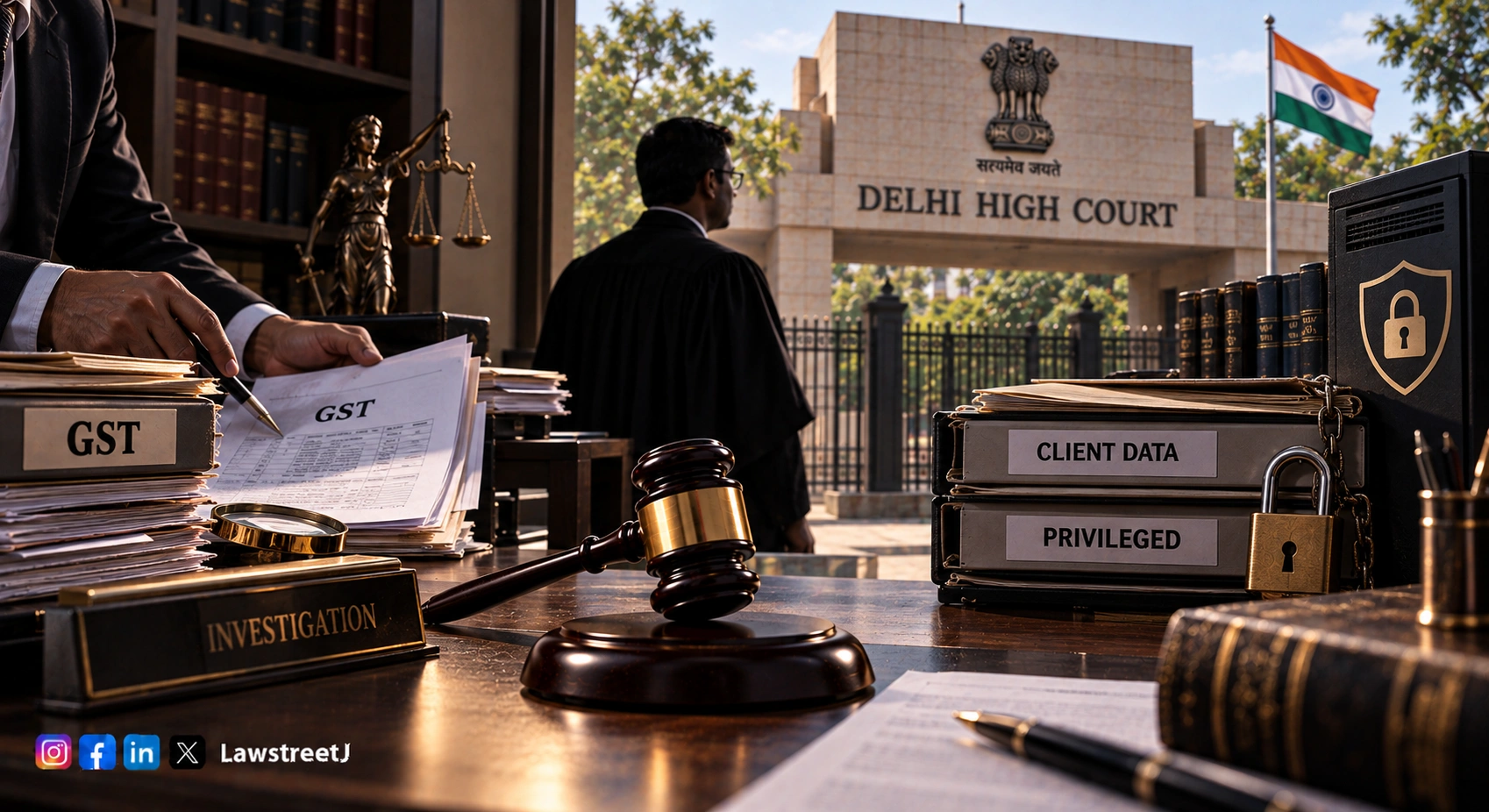
New Delhi: The Delhi High Court has dismissed a writ petition filed by an advocate challenging a GST search of his law firm's premises and the seizure of his office computer, holding that while advocate-client privilege protects confidential communications, it cannot operate as an absolute bar against investigation into the advocate's own conduct where the Department places prima facie material suggesting personal involvement in the client's affairs, going beyond the role of a legal adviser.
A Division Bench of Justices Anil Kshetarpal and Shail Jain was hearing a writ petition filed by Advocate Puneet Batra against the Union of India and the CGST authorities, challenging the search conducted on 25.07.2025 at the premises of M/s Bass Legal LLP, a tax consulting firm run by the petitioner's parents, the consequential seizure of a CPU from his cabin, the panchnama drawn on that date, and the summons issued to him.
The petitioner, an advocate who primarily handled taxation matters for Bass Legal, had rendered professional and legal services since 2023 to M/s Martkarma Technology Pvt. Ltd. (MTPL), a gaming company, in relation to GST, corporate and IP compliances. Following a GST search at MTPL's premises in September 2024, the petitioner withdrew his vakalatnama and was issued a series of summons, to which he responded and eventually appeared and gave statements. On 25.07.2025, CGST's Anti-Evasion Branch searched Bass Legal's premises under an authorisation issued under Section 67(2) of the CGST Act, seizing MTPL-related documents and a CPU from the petitioner's cabin in his absence, and simultaneously summoning him. The Department's case was that the petitioner was not merely representing MTPL as counsel but was actively involved in running its affairs, allegedly earning 0.7% of revenue collected by MTPL through an offshore gaming website. The Court had earlier passed a series of interim orders permitting forensic examination of the CPU under safeguards, including cloning of data and protection of third-party client information, while restraining coercive action against the petitioner.
Senior counsel for the petitioner submitted that the search and seizure of the petitioner's cabin was unauthorised, since documents and data held by an advocate for his client are protected by advocate-client privilege, and that the Department could not access or seize electronic data likely to contain privileged material relating to MTPL as well as other clients. It was argued that production of certain material before the Court in a sealed cover, without giving copies to the petitioner, was impermissible in law, relying on Madhyamam Broadcasting Limited v. Union of India, and that the petitioner ought to have been shown all material relied upon so that he could rebut it. It was further submitted that no Show Cause Notice had been issued to MTPL, and that the Department had shifted its stance from earlier identifying another individual as the key person controlling the company's affairs to now alleging that the petitioner played that role. Reliance was placed on an earlier order of the Court, departmental Instructions and the Master Circular on Show Cause Notice, Adjudication and Recovery, and on provisions of the CBI Manual on search and seizure of digital evidence, to contend that the procedure followed was illegal. It was also urged that the Department had failed to record adequate reasons to believe before authorising the search, and that a later Board Resolution of MTPL waiving privilege could not cure the illegality of a search already carried out.
The Additional Solicitor General, appearing for the Union of India and the GST Department, submitted that an investigation into tax evasion by entities unlawfully collecting payments for offshore online gambling websites, including one operated under the domain 11winner.com, revealed that MTPL, said to have received about Rs. 1,306 crores from users with an unpaid GST liability of roughly Rs. 365.68 crores, was in fact controlled by the petitioner along with others, and that he was a conduit and beneficiary of the illegal model rather than a mere legal adviser. It was submitted that statements of MTPL employees and officials repeatedly described the petitioner as actively running the company's affairs, that he allegedly earned 0.7% of every rupee deposited by users, and that privilege could not be invoked by a participant in the very illegality under investigation. The search, it was submitted, was validly authorised for the premises of Bass Legal, of which the petitioner's cabin formed an integral part, and Section 132 of the Bharatiya Sakshya Adhiniyam permitted waiver of privilege, which had occurred through MTPL's subsequent Board Resolution. It was further alleged that the petitioner had remotely deleted data from his computer during the search, had access to the offshore website and MTPL's bank account, had generated invoices without corresponding supply of goods, made repeated visits to Hong Kong, and had not cooperated with the Court-appointed Local Commissioners during examination of the seized data.
The Court held that once the premises of Bass Legal were validly authorised to be searched under Section 67(2) of the CGST Act, the fact that one of its cabins was used by the petitioner, an advocate, did not by itself render the search of that cabin unauthorised, since the petitioner's cabin formed part and parcel of the firm's office and shared its address.
On privilege, the Court clarified that the protection under Section 132 of the BSA is conferred for the benefit of the client and not as a personal privilege of the advocate, and that material relating to the advocate's own independent affairs or activities cannot be placed beyond investigation merely because it is found in his office. Since the Department had placed material, including witness statements, indicating that the petitioner may have been personally involved in MTPL's affairs rather than merely representing it, the Court held that this was sufficient, at this stage, to permit investigation into his conduct, without returning any finding on his ultimate guilt or liability.
The Court declined to direct that copies of the sealed-cover material be furnished to the petitioner, drawing on the principle against disclosure of ongoing investigative material and case-diary-like records, and held that Madhyamam Broadcasting was distinguishable on facts. It further held that the absence of a Show Cause Notice to MTPL, the alleged change in the Department's stance regarding who controlled the company's affairs, and the alleged non-compliance with departmental instructions and the Master Circular did not, individually or cumulatively, vitiate the search, since administrative circulars cannot curtail a statutory power and an investigation may legitimately evolve as fresh material emerges.
The Court noted that MTPL's Board had, by a subsequent resolution, consented to the handover of its material to the GST authorities, but held that this consent, being subsequent to the search, could not retrospectively validate the search itself, though it was relevant to the present handling of MTPL's data. The Court also recorded that the petitioner had admitted to remote deletion of files during the search and had declined the Court's offer to identify and exclude data relating to his other clients, while reaffirming that the safeguards already directed for cloning, examination and protection of third-party client data would continue to apply.
Accordingly, the Court held that the search and seizure could not be declared illegal or void ab initio, dismissed the writ petition along with the pending applications, and vacated the interim orders except to the extent of the safeguards already directed for the examination and use of the seized electronic data, while clarifying that the judgment did not lay down any general proposition diluting advocate-client privilege and was confined to the peculiar facts where the petitioner's own role, and not merely privileged communications, formed the subject matter of investigation. A subsequent request for a one-week stay of the judgment was declined by the Bench.
Appearances:
For the Petitioner: Mr. N. Hariharan, Mr. Avi Singh and Mr. Mohit Mathur, Senior Advocates, with Mr. Vinit Bhatia and other Advocates, along with the Petitioner in-person.
For the Respondents: Mr. Tushar Mehta, Solicitor General, and Mr. S.V. Raju, Additional Solicitor General, with Mr. Akash Panwar, JSC, Mr. T. Singhdev, Senior Advocate, Mr. Anurag Ojha, SSC, Mr. Varun Mishra, SPC, and other Advocates for the Revenue.
Case Title: Puneet Batra vs. Union of India & Ors., W.P.(C) 11021/2025, CM APPL. 45387/2025, CM APPL. 56648/2025, CM APPL. 68661/2025, CM APPL. 79226/2025 and CM APPL. 58787/2026



![Delhi High Court Sets Aside Arbitral Tribunal's Award Against NHAI in Highway Project Delay Case [Read Judgment]](/secure/uploads/2023/07/lj_9605_23374c2e-392c-4491-a2fe-f2f12fc5272f.jpg)
![Delhi Court Rejects Stay Request in Defamation Case Against Rajasthan CM Ashok Gehlot [Read Order]](/secure/uploads/2023/08/lj_5208_80de1ddc-d76a-4f7f-b180-408e3ae14fb4.jpg)