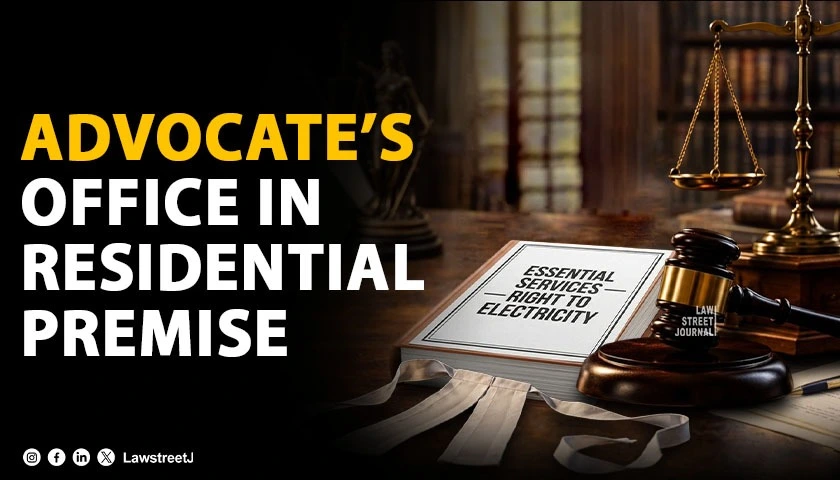
Madhya Pradesh: Madhya Pradesh High Court has held that an advocate running his office from his residential premises cannot be charged electricity tariff at commercial rates, setting aside an order of the electricity distribution company that had declared the petitioner’s office to be a commercial activity and levied commercial tariff on him.
Justice Milind Ramesh Phadke of the High Court of Madhya Pradesh at Gwalior passed the order on May 11, 2026, in Writ Petition No. 1507 of 2021, allowing the petition filed by advocate Santosh Agrawal, who had challenged an order dated December 31, 2020, passed by the Manager, Nagar Kendriya Sambhag, Gwalior.
Background
The petitioner, an advocate, was running his office from his residential premises. The Manager, Nagar Kendriya Sambhag, Gwalior, by order dated December 31, 2020, declared the office to be a commercial activity and directed that electricity tariff be charged at commercial rates. The petitioner challenged this order before the High Court, appearing in person.
Petitioner’s Submissions
The petitioner argued that since his office was being run from his residential premises, he could not be held liable to pay electricity charges at commercial rates. Placing reliance on this Court’s earlier judgment in Dheeraj Singh v. Hemant Kumar Sharma in Second Appeal No. 2617 of 2024 dated August 6, 2024, he submitted that the expression “commerce” or “commercial” necessarily involves the concept of a trading activity and that the generic term for all such aspects is buying and selling. In the legal profession, there is no such buying, selling, or trading of any kind whatsoever, and to compare the legal profession with trade and business would be entirely misplaced.
The petitioner further submitted that a professional activity is one carried on by an individual through personal skill and intelligence, and that there is a fundamental distinction between a professional activity and an activity of a commercial character. He also relied on the Madras High Court’s judgment in K. Kanagasabai v. The Superintending Engineer, Kanniyakumari Electricity Distribution Circle, in W.P. No. 21731 of 2003 dated December 23, 2010, to submit that an advocate running his office from his residence cannot be charged additional tariff on a commercial basis, and that the distinction must be drawn between an office run in a residence and an office run in an independent commercial place.
Respondent’s Submissions
Counsel for the respondent electricity board relied on the Supreme Court’s judgment in Chairman, M.P. Electricity Board and Others v. Shiv Narayan and Another in Civil Appeal No. 1065 of 2000 dated October 27, 2005, and argued that the Apex Court had held that since the use of the premises by an advocate is admittedly non-domestic, he would fall in the category of non-commercial but non-domestic use and would therefore be liable to pay electricity charges at the commercial rate.
Court’s Findings
Justice Phadke examined the Supreme Court’s judgment in Chairman, M.P. Electricity Board v. Shiv Narayan and found that the tariff entries before the Supreme Court in that case were of only two categories: domestic purposes and commercial or non-domestic purposes, and that the Apex Court had not gone into the question of whether an advocate could be said to be carrying on a commercial activity. The Supreme Court in that case had held only that the use was non-domestic and therefore fell in the commercial and non-domestic category. The court held that this decision did not conclusively settle whether an advocate’s office constitutes a commercial activity.
The court then relied on its own earlier judgment in Dheeraj Singh v. Himanshu Kumar Sharma, which had directly addressed this question and held that the expression “commerce” or “commercial” necessarily involves the concept of a trading activity, and that the legal profession involves no buying, selling, or trading of any kind. The court quoted Black’s Law Dictionary’s definition of “commerce” to hold that commerce and commercial activity involve the exchange, buying, selling, and transportation of goods, none of which is involved in the practice of law.
The court further relied on the Madras High Court’s observations in Kanagasabai, which noted that the Supreme Court’s larger Bench in Civil Appeal No. 1065 of 2000 had in fact held that an advocate running his office from his residence cannot be charged additional tariff on a commercial basis, with the distinction being that if the office is run in an independent commercial place, the advocate cannot be exempted from commercial tariff. The court noted that a Division Bench of the Rajasthan High Court in J.V.V.N. Limited and Others v. Smt. Parinitoo Jain and Another, AIR 2009 Rajasthan 110, had taken the same view.
The court held that by no stretch of imagination could an advocate running an office from his residence be held liable to pay electricity dues at commercial rates. The respondent had committed a material illegality in charging commercial tariff.
The court accordingly set aside both impugned orders and directed the respondents to raise bills of electricity dues at residential rates, holding that the petitioner was only liable to pay electricity dues for his office situated at his residence at residential rates and not at commercial rates.
Case Details
- Case Title: Santosh Agrawal v. Madhya Pradesh Madhya Ksheta Vidhut Vitran Com. Ltd. and Others
- Case Number: Writ Petition No. 1507 of 2021
- Neutral Citation: 2026:MPHC-GWL:15567
- Court: High Court of Madhya Pradesh at Gwalior
- Judge: Justice Milind Ramesh Phadke
- Date of Order: May 11, 2026
- Petitioner: Santosh Agrawal (appearing in person)
- Respondents’ Advocate: Shri Narottam Sharma



.jpeg)

![Supporting defamatory WhatsApp posts doesn’t constitute involvement in offence of defamation: MP HC [Read Order]](/secure/uploads/2024/09/lj_6675_WhatsApp_Image_2024-09-16_at_12.24.54_PM.webp)