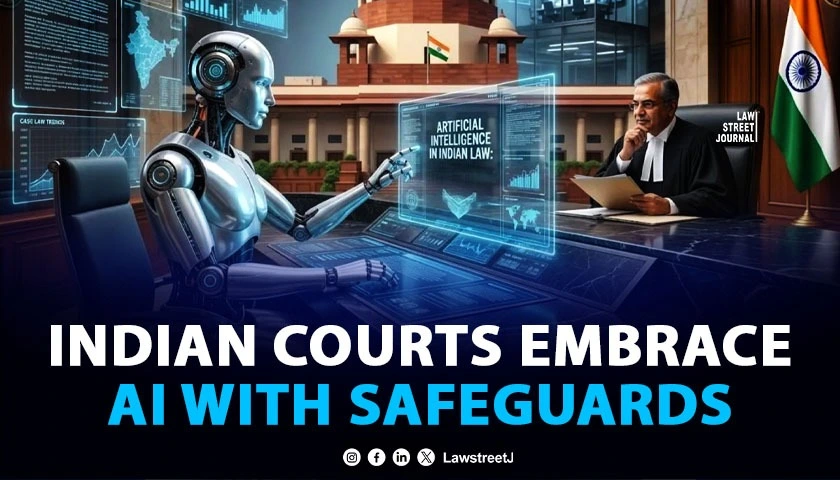
New Delhi: The Supreme Court of India has released draft regulations to govern the use of Artificial Intelligence across the country’s judicial system, proposing a comprehensive framework that balances openness to innovation with firm safeguards for judicial independence, data privacy, and litigant rights.
The draft, titled ‘Regulations for Use of Artificial Intelligence in Courts, 2026’, was published by the AI Committee of the Supreme Court, inviting views from stakeholders and the general public until June 20.
The regulations, prepared under the aegis of the Artificial Intelligence Committee of the Supreme Court, will apply to the use, deployment, or integration of AI in any judicial, adjudicatory, or administrative function of the Supreme Court, High Courts, and all courts, including tribunals and statutory commissions performing adjudicatory functions within the territory of India.
The draft sets out a foundational philosophy in its opening chapters, declaring that “the use of Artificial Intelligence in Court processes shall at all times remain strictly subservient to human judgment and judicial authority.” Every AI system, under the proposed framework, shall function solely in an assistive capacity and shall not supplant or compromise the independent exercise of judicial authority by a duly appointed judicial officer.
Among the most significant provisions is the requirement that lawyers and parties disclose the use of AI in any document, pleading, or evidence submitted to courts. The draft requires that any AI-assisted material be accompanied by a duly executed declaration or certificate in a prescribed format at the time of submission. Courts are also required to inform parties wherever an AI tool materially assists in case management, document analysis, or judicial administration in a manner that may affect the conduct of proceedings.
The regulations draw a sharp distinction between permissible and prohibited uses of AI. On the permissible side, the draft lists case management, automated transcription subject to mandatory accuracy review, translation of judgments and pleadings with human verification, legal research and precedent retrieval, defect scrutiny, litigant-facing chatbots with human oversight, accessibility tools for persons with disabilities, and anonymisation of judgments for public domain publication. Analytical tools for monitoring court performance and backlog are also permitted.
The prohibitions are stated to be absolute and non-derogable, not subject to relaxation by any authority. No judicial outcome shall be reached through algorithmic decision-making alone, and no AI system shall perform the function of adjudication or sentencing without a mandatory Human-in-the-Loop. Notably, the draft prohibits the use of AI for Risk Scoring in any court process, expressly banning its use in the assessment of flight risk, prediction of recidivism, evaluation of bail eligibility, or determination of the credibility of witnesses or parties. It further prohibits the use of AI to predict or profile the future conduct of accused persons, witnesses, or legal representatives, and no undisclosed or unexplainable AI system may be used in any process that could materially affect the lawful rights or personal liberty of any party.
The framework proposes an institutional architecture built around a permanent Apex Body at the Supreme Court, to be constituted by the Chief Justice of India. The Apex Body would include two Supreme Court judges, two Chief Justices of High Courts, two High Court judges, a representative from an institution of national importance, an officer from the Ministry of Electronics and Information Technology, experts in finance and cybersecurity, advocates specialising in technology law, and the professor heading the AI field at the National Judicial Academy, Bhopal.
The Apex Body would be supported by five committees: a Judicial Committee, a Technical Committee, a Committee on Infrastructure and Finance, a Case and Data Management Committee, and a Cyber Security Committee.
At each High Court, an AI Committee and a dedicated AI Secretariat headed by an officer in the cadre of a District Judge would be constituted to oversee compliance, approve AI tools, and handle incident reporting. The draft also envisages a Centre of Research and Excellence on Artificial Intelligence (CoRE-AI) to conduct original research on AI in judicial contexts, evaluate AI tools and prototypes and publish white papers and empirical studies.
On data protection, the regulations mandate that sensitive judicial data shall not be transferred to any external system without express written authorisation, and that anonymisation shall be applied to personal data before its use in training or testing any AI system. Agreements with private entities engaging in AI-related services must include provisions governing data ownership, prohibition on using court data beyond the scope of engagement, indemnity clauses protecting courts from liability for defects in vendor-supplied systems, and an explicit prohibition on retraining AI models using court data without the written approval of the AI Committee. Private entities are prohibited from claiming exclusive intellectual property rights over tools developed primarily using judicial data or public resources.
The draft mandates annual audits of all court AI systems, conducted in-house, with no source code, algorithms, or datasets to be shared with any third party outside court premises. Each court must maintain an AI Register documenting all approved systems, their purpose and scope, the identity of service providers, and records of impact assessments and incidents. Every High Court must also submit an Annual Transparency Report on AI adoption to the Apex Body and publish it on its official website.
The regulations recognise the phenomenon of AI hallucination, defined as outputs that appear plausible but are factually incorrect, fabricated, or unsupported by verifiable data, and make clear that no officer may invoke the opaqueness of a black box system or the occurrence of hallucination as a ground for avoiding accountability for an incorrect, illegal, or harmful decision. The draft further states that any person who submits fabricated or misleading AI-generated content shall bear full responsibility and cannot rely on the AI-generated nature of the content as a defence.
A grievance redressal mechanism is also proposed, enabling any party harmed by prohibited use of AI to file an application before the court in which the relevant AI system was deployed. The regulations expressly state they are not in derogation of existing laws, including the Information Technology Act, 2000, and the Digital Personal Data Protection Act, 2023.
Stakeholders and the public may send their comments to the Member Secretary, AI Committee, Supreme Court of India at office.regcc@sci.nic.in on or before June 20, 2026.