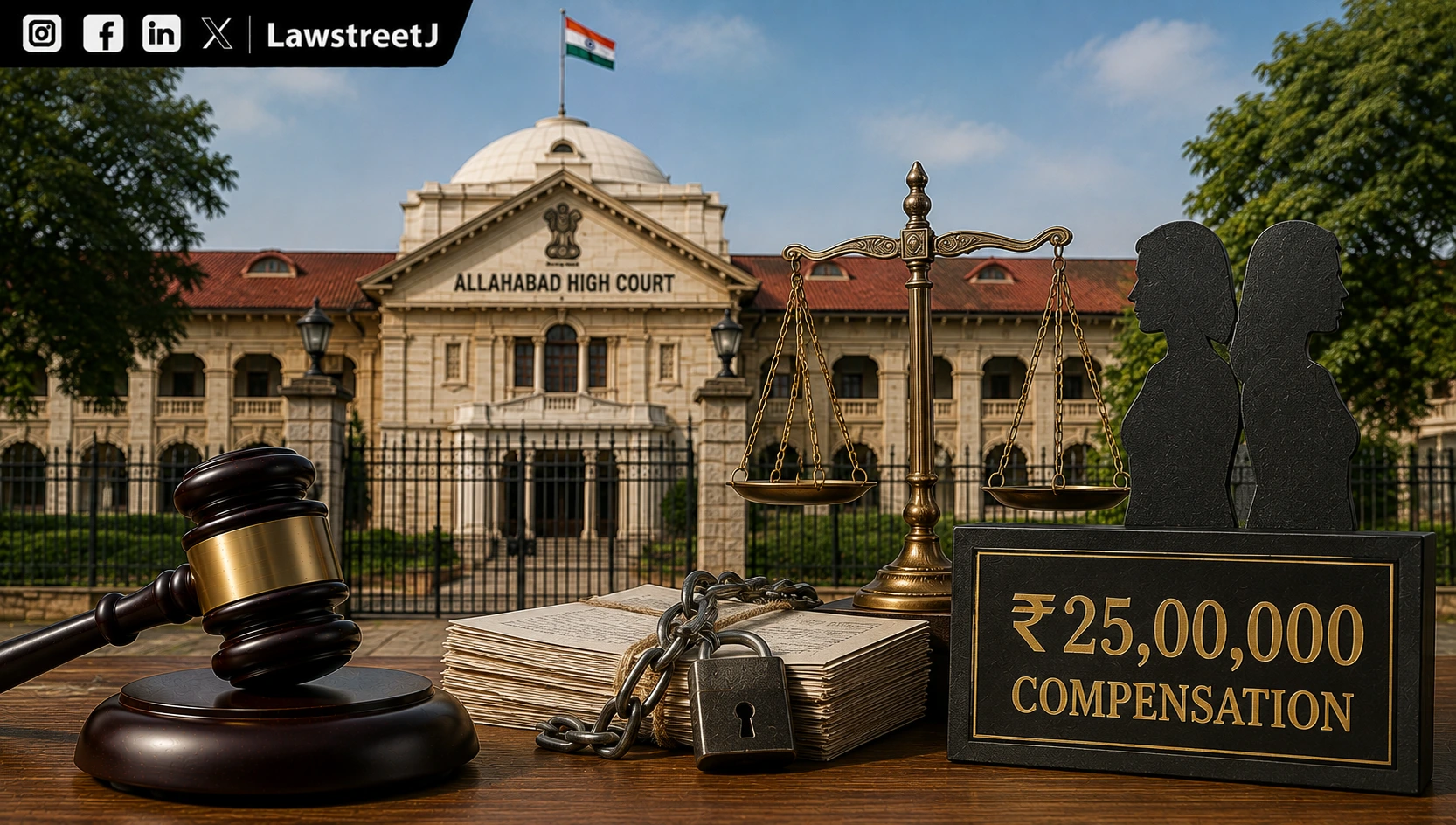
Allahabad: The Allahabad High Court has held that two major women, who were forcibly confined by their father after they embraced Islam of their own free will, were unlawfully deprived of their personal liberty, and has directed the father and the State of Uttar Pradesh to jointly pay them compensation of Rs 25 lakh.
The Bench of Justice Sandeep Jain was hearing a habeas corpus petition seeking production of the two corpus, aged about 35 and 20 years respectively, who had allegedly been confined by their father in Agra after they converted to Islam in 2020 and 2021. Pursuant to an earlier order directing the State to produce the corpus, both women were brought before the Court by the police.
On interaction with the Court, the elder corpus, a postgraduate in Zoology who had also worked as a lecturer, stated that she had embraced Islam voluntarily in 2020 for mental peace and spiritual fulfilment, and that the decision was entirely her own, free of any inducement or coercion. She alleged that after her conversion, she was forcibly confined by her father, who employed physical restraint, intimidation and mental harassment to compel her to revert to Hinduism, and that her passport, educational certificates and other personal documents remained in her father's custody.
The younger corpus, who had studied up to the Intermediate level and had attained majority, similarly stated that she had voluntarily converted to Islam in 2021 and was thereafter confined by her father against her wishes for professing a different faith.
Appearing for the State, the Additional Advocate General opposed the maintainability of the petition, submitting that the father had lodged an FIR alleging forcible and deceitful conversion, initially under Section 87 of the Bharatiya Nyaya Sanhita, 2023, to which Sections 61(2), 111(3), 111(4) and 152 BNS, along with provisions of the Uttar Pradesh Prohibition of Unlawful Conversion of Religion Act, 2021, were subsequently added. It was contended that the conversions formed part of a larger conspiracy with implications for the sovereignty and integrity of the nation, involving foreign entities, and that releasing the corpus at this stage could prejudice the ongoing investigation.
Counsel for the petitioners countered that the corpus were major women fully competent to take independent decisions regarding faith, residence and association, and that the State's apprehensions regarding national security were speculative and unsupported by material. Reliance was placed on the judgments of the Supreme Court in Rajendra Bihari Lal v. State of U.P. and Shafin Jahan v. Asokan K.M. to submit that constitutional courts are obligated to protect the autonomy of adult individuals in matters of faith and residence.
The Court, after independently interacting with both corpus, found their responses to be spontaneous, coherent and unequivocal, with nothing to suggest coercion or undue influence. It held that the freedom of conscience under Article 25 necessarily includes the right of a competent adult to change her faith according to her own will, and that this choice is protected both under Article 25 and the guarantee of personal liberty and dignity under Article 21.
"Once an individual attains majority, the Constitution recognises her autonomy to take decisions relating to faith, belief, residence, association and every other facet of personal liberty, subject only to restrictions sanctioned by law."
The Court clarified that the validity of the conversion under the Uttar Pradesh Prohibition of Unlawful Conversion of Religion Act, 2021, was not under challenge in the habeas corpus proceedings, and that even assuming the conversion had not strictly complied with the Act, this would not by itself authorise the father to confine the women. It further held that the State had produced no material beyond the FIR and pending investigation to substantiate the claim that the conversions threatened the sovereignty or integrity of the nation, and that mere apprehensions could not override established fundamental rights.
Relying on Home Secretary (Prison) v. H. Nilofer Nisha, Soni Gerry v. Gerry Douglas, Urmila Jharia v. State of Madhya Pradesh, Rajamohan MS v. State of Kerala and Joju George v. State of Kerala, the Court reiterated that parental authority yields to constitutional liberty once a child attains majority, and that a major woman cannot be treated as being in anyone's "custody" against her wishes merely on account of parental disapproval of her choices.
Holding that the detention of the corpus by their father, in collusion with the State, was wholly illegal, the Court proceeded to examine whether compensation could be awarded for the violation of their fundamental rights. Relying on Rudul Sah v. State of Bihar and Nilabati Behera v. State of Orissa, it held that monetary compensation is an appropriate public law remedy for established violations of Article 21, observing that the State had failed in its constitutional duty to protect the corpus and had instead allowed their confinement to continue under the guise of the pending criminal investigation.
"The present case discloses an exceptionally grave and egregious violation of constitutional rights... Such prolonged and coercive confinement strikes at the very foundation of constitutional democracy, which recognises the autonomy of every adult individual as sacrosanct and beyond the reach of parental or societal control."
Allowing the petition, the Court declared both corpus free to reside at any place and with any person of their choice without interference from their father, the State or any other person. It directed the father and the State of Uttar Pradesh to jointly pay Rs 25 lakh as compensation, to be equally divided between the two women, within eight weeks, with liberty to the State to recover 50 per cent of the amount from the father and the remaining 50 per cent from any delinquent public servant found responsible, after due enquiry. The father was further directed to return the corpus's passports, educational certificates, identity documents and other personal belongings within seven days, and the State authorities were directed to ensure their safety and non-interference with their liberty.
The Court clarified that its observations were confined to the question of illegal detention and would not affect the independent adjudication of the criminal proceedings or the validity of the alleged conversion, which would proceed uninfluenced by the judgment.
Appearances
Counsel for the Petitioners: Ali Bin Saif and Dinesh Kumar Yadav, assisted by Kaif Hasan, Mohd. Abubakar, Mohd. Areeb Masood and Faraz Khan, Advocates.
Counsel for the Respondents: Manish Goyal, Additional Advocate General, assisted by Pankaj Saxena, AGA; Mahipal Singh and Nripendra Pratap Singh, Advocates.
Case Title: KSA And 2 Others v. State of U.P. And 3 Others [Habeas Corpus Writ Petition No. 1079 of 2026]


!["No Loudspeakers For Azan, No Fundamental Right To Create Noise," Says Allahabad HC To Two Mosques [Read Judgment]](/secure/uploads/2020/01/lj_4995_Allahabad_HC_AZAN.jpg)

.jpeg)