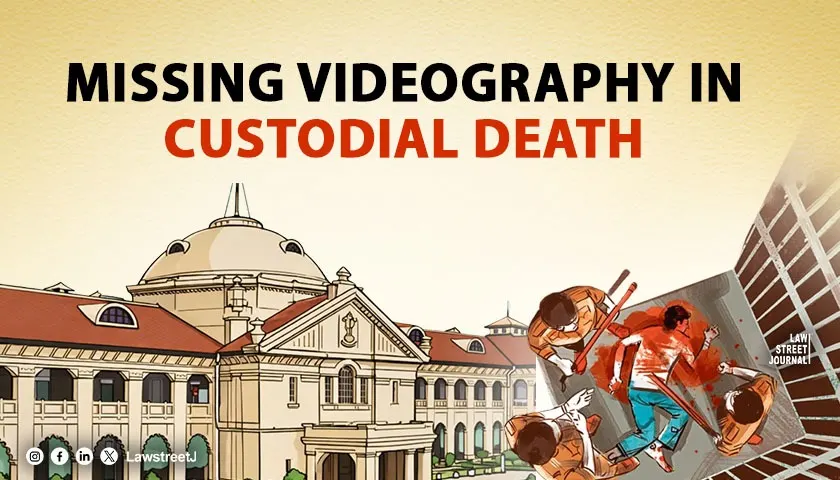
Prayagraj: The Allahabad High Court on May 18, 2026 directed the Central Bureau of Investigation (CBI) to secure within sixty days the videography of the scene of the occurrence and the postmortem in a custodial death case dating back to 2009, in a public interest litigation pending before the Court for sixteen years. The case is titled Association for Advocacy and Legal Initiatives, Lucknow v. State of U.P. Through Secretary (Home) & Ors., PIL No. 16563 of 2010. The order was passed by a Division Bench comprising Justices Atul Sreedharan and Siddharth Nandan, with the judgment authored by Justice Sreedharan.
Background
The PIL was filed in 2010 by the Association for Advocacy and Legal Initiatives (AALI), a women-led organisation committed to the protection of the rights of women, children and marginalised communities. The case concerns the custodial death of Nahar Singh, also known as Sneh, a physically handicapped person with 40% disability, who died on May 9, 2009 while in custody at Police Station Dannahar, District Mainpuri. The official version of the police was that he was found hanging in the urinal section of the lockup using his belt, in what was claimed to be a suicide.
The circumstances gave rise to suspicion from the outset. The Court noted that a police lockup is not a secluded area — it is enclosed with iron bars, with the urinal inside, under constant vigil of police personnel — and that it was prima facie inconsistent with the official account that a man with 40% physical disability could have hanged himself undetected within such a space.
The postmortem report compounded this suspicion. The Court noted that while recording external ante-mortem injuries, the doctor had noted the presence of a knot mark or knot impression on the right side behind the ear — inconsistent with the use of a leather belt, which would ordinarily leave a belt buckle impression. Further, upon dissection of the neck, the doctor found fractures of the third, fourth and fifth tracheal rings, which the Court observed are more probable in a case of strangulation than hanging, and are improbable where the deceased’s feet were nearly touching the ground and the deceased had a significant physical disability.
The Court observed that this raised a reasonable suspicion that Nahar Singh was first strangulated inside the police station and his body was then hung in the urinal to disguise the killing as a suicide.
Three Institutional Failures
The Court identified three successive institutional failures in the case.
First, the Court acknowledged its own failure, observing that a PIL involving a custodial death warranted urgency and repeated listings with short dates to secure and protect evidence. The Court held that had the case been concluded within three months of its first listing, the probability of securing the videography would have been far higher. Instead, sixteen years of procedural delay had given the police and the State an opportunity to cover their tracks, obscuring the truth and frustrating the Court’s ability to access the videographic evidence.
Second, the Court identified the State and police as having failed. Despite orders passed on January 6, February 9, February 23, March 16 and April 7, 2026 directing the State to produce the videography of the scene of occurrence and the postmortem, the records had not been produced.
The State’s position was that the videography had been sent to the National Human Rights Commission (NHRC) along with other documentation when the NHRC took up the father’s complaint in 2009. However, the Court found this explanation unsubstantiated: the letter from the Superintendent of Police to the NHRC did not describe the documents sent, and the State was unable to satisfy the Court that the video recordings had ever left police possession.
A letter filed in 2026 by the current SHO of P.S. Dannahar — a person who was in all likelihood not posted there at the time of the incident — asserting without supporting details or source that videography had been sent to the NHRC fifteen years earlier, was described by the Court as an attempt by the police to pass the buck to the NHRC.
The Court observed that the State’s apparent unwillingness to produce the videography was “perhaps to conceal a crime.”
Third, the Court expressed strong disappointment with the NHRC, whose proceedings were reproduced in the order. The NHRC had received the complaint from the deceased’s father, called for a report from the police and, based solely on that report and the SDM’s enquiry, closed the case in October 2011 with a finding that the deceased had committed suicide in frustration after a girl’s father refused to give his daughter in marriage to him.
The Court found that the NHRC had conducted no independent investigation: it had not recorded the statements of the father, the girl, her parents, neighbours or police personnel present at the station on the date of the incident, and had not sought the assistance of the State Human Rights Commission.
The Court observed that accepting the version of the police, an interested party in a custodial death, as gospel truth without seeking independent evidence “calls into question the very existence of the NHRC.” The Court reserved its final findings on the NHRC’s conduct pending hearing of its counsel.
CBI Direction
Finding that repeated attempts to secure the videography had borne no fruit and that the State and police had been evasive, the Court directed the CBI through its ACB office at Ghaziabad to secure the video recordings within sixty days from the date of the order.
The Court clarified that no FIR need be registered at this stage since the CBI would be acting under judicial directions. The CBI is to produce the videography before the Court on the next date of hearing.
The petitioner’s counsel was directed to implead the CBI through the In-charge of its ACB Office, Ghaziabad as respondent no. 7. The matter is listed for further hearing on August 10, 2026.
Case Details: Association for Advocacy and Legal Initiatives, Lucknow v. State of U.P. Through Secretary (Home) & Ors., Allahabad High Court, PIL No. 16563/2010. Before Justices Atul Sreedharan and Siddharth Nandan. Order dated May 18, 2026. Advocates Ankur Sharma and Ravi Kiran Jain appeared for the Petitioner.


!["No Loudspeakers For Azan, No Fundamental Right To Create Noise," Says Allahabad HC To Two Mosques [Read Judgment]](/secure/uploads/2020/01/lj_4995_Allahabad_HC_AZAN.jpg)