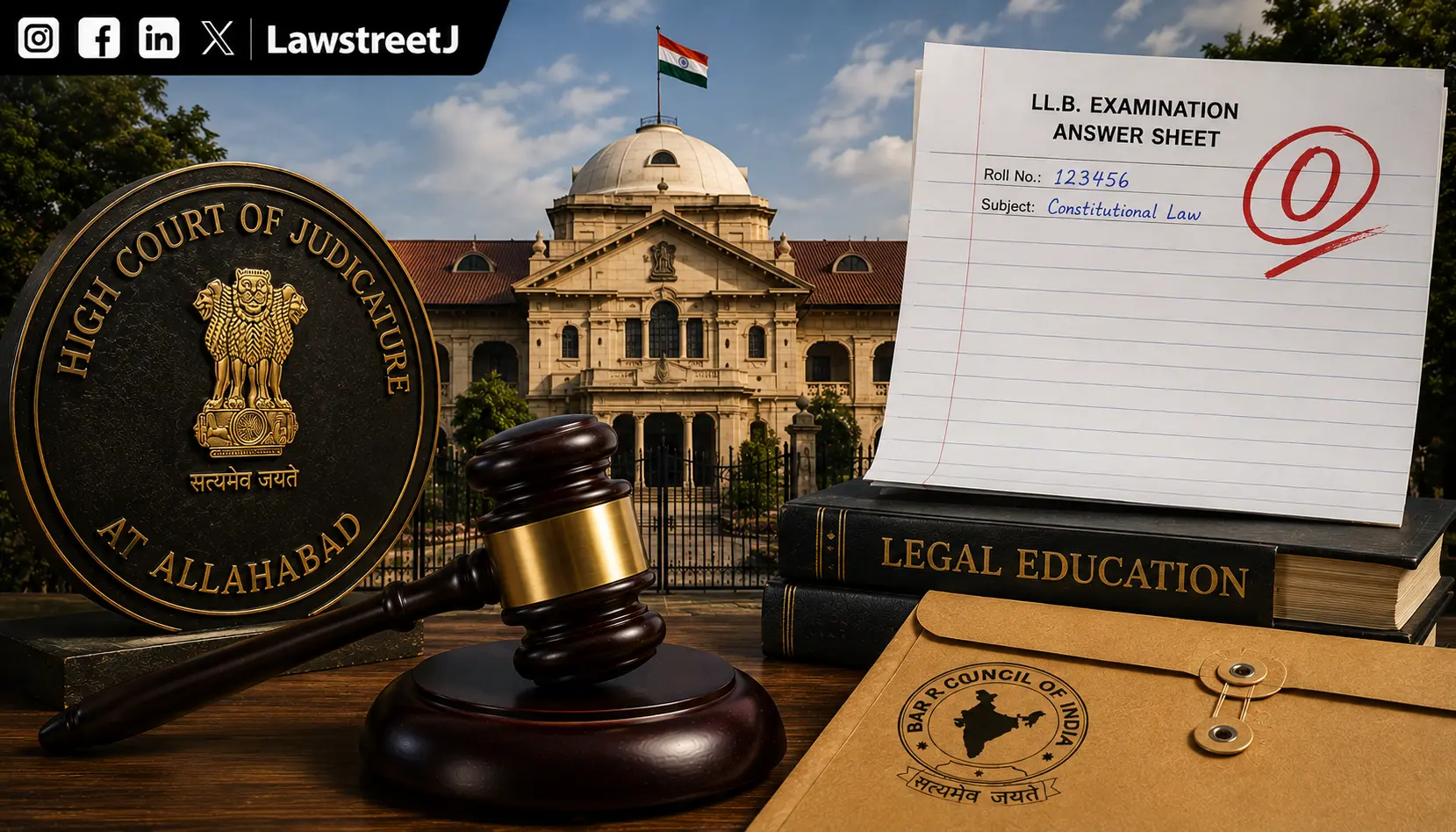
Allahabad: The Allahabad High Court has dismissed a law student's writ petition seeking re-evaluation of his answer book, in which he was awarded zero marks, but directed that a redacted copy of the answer book along with the question paper be sent to the Bar Council of India and the Law Commission of India, expressing concern over declining academic standards in law colleges.
Justice Vinod Diwakar was hearing a writ petition filed by a B.A. LL.B. student seeking a mandamus directing the university to re-examine his answer book in the subject “Bio-Diversity Protection Law” for the Ninth Semester Examination 2025–26, and to award marks in accordance with the answers written by him. The petitioner had cleared all examinations from Semester I to Semester VIII, but upon declaration of the result on March 18, 2026, was awarded zero marks in every question he had attempted in the subject.
He contended that he had expected to score more than fifty marks, and that a copy obtained under the Right to Information Act, 2005 confirmed that no marks had been awarded to any of his answers. Representations seeking re-evaluation before the University had gone unanswered. It was also stated that the petitioner had since qualified the LL.M. entrance examination and was awaiting admission through counselling.
On an earlier date of hearing, the Court had directed the respondent-University to produce the original question paper and answer sheet. During the hearing, the Court directed the learned Standing Counsel to read out the petitioner's answer to Question 3(c), which asked the candidate to describe national laws in India relating to biodiversity conservation. The answer, extracted in the order, referred to concepts such as “the trustee of God,” “maternity of grudges,” and the “felicititation of discovery,” before naming the Wildlife Protection Act, 1973 and a “Biodiversity Origin and Regulation Act, 1996.” Standing Counsel, after reading the answer, fairly conceded that he was unable to comprehend its purport or discern any coherent reasoning, factual narration or legal proposition relatable to the question or the subject.
Examining the answer book itself, the Court arrived at the same conclusion, holding that
“The answer to Question No. 3-C does not disclose any legal understanding of the subject. Consequently, no fault can be found with the evaluation undertaken by the examiner in awarding zero marks for the said answer,” and that the position was similar with respect to the remaining answers in the book. The Court found no material to show that the petitioner had suffered any prejudice on account of the evaluation, or that the examiner had acted arbitrarily.
The Court, however, went on to record its concern over the larger issue reflected by the record. It observed that legal education constitutes the foundation of the justice delivery system, and that a substantial decline in academic standards at the institutional level affects not merely the legal profession but the administration of justice itself. The Court noted that this was not a solitary instance, and that matters of this nature had come before it with disquieting frequency. It observed that
“It is not unlikely that, had the student been properly counselled before the examination, had a suitable orientation programme been provided, and had he been adequately taught, supervised and apprised of what is expected of an examinee, the answers in question would not have been written in the manner they were. The deficiency, if any, lies as much in the institution's failure to discharge its responsibility of imparting quality education as in the answers produced by the student.”
In view of these observations, the Court considered it appropriate that the Bar Council of India, as the statutory regulator entrusted under the Advocates Act, 1961 with maintaining standards of legal education, examine whether the concerned institution continues to satisfy the prescribed academic and infrastructural standards, and undertake such inspection as it may deem appropriate. It clarified that these observations were intended only to invite the attention of the regulatory bodies to a matter of general concern, and were not to be construed as a finding against the institution or any teacher or examiner, none of whom was before the Court.
The writ petition was accordingly dismissed, with the Court holding that no ground for interference under Article 226 of the Constitution was made out. The original question paper and evaluated answer book were directed to be returned to the respondent-University for safe custody.
The Registrar (Compliance) was directed to transmit a copy of the order, along with a photocopy of the question paper and a redacted copy of the answer book, with all particulars identifying the petitioner masked, to the Principal Secretary, Bar Council of India, for such consideration as it may deem fit, including whether existing standards of legal education and the mechanism for approval and inspection of institutions require strengthening.
A copy was also directed to be placed before the Chairman of the Law Commission of India for consideration of possible proposals for reform in legal education.
Appearances:
For the Petitioner: Vinod Kumar Ojha, Advocate.
For the Respondents: Pratik Chandra, Standing Counsel; Vaibhav Tripathi, Standing Counsel.
Case Title: XXX vs. State of U.P. & 3 Ors., Writ – C No. 26475 of 2026


!["No Loudspeakers For Azan, No Fundamental Right To Create Noise," Says Allahabad HC To Two Mosques [Read Judgment]](/secure/uploads/2020/01/lj_4995_Allahabad_HC_AZAN.jpg)