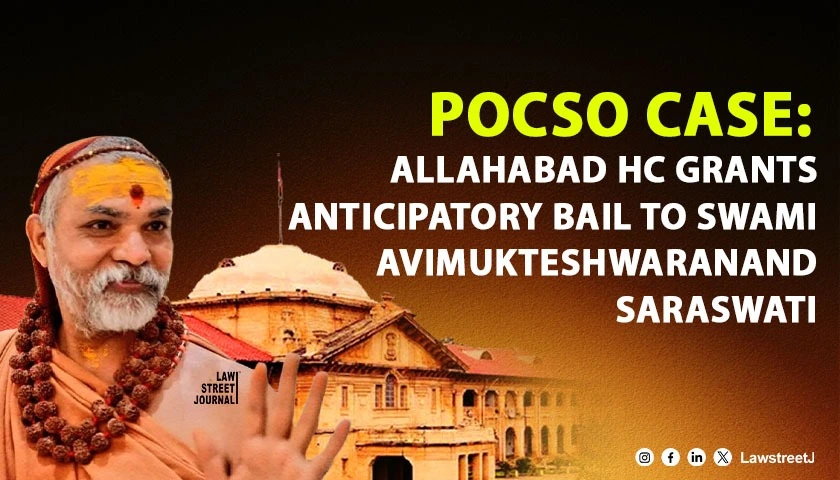
Prayagraj: The Allahabad High Court has granted anticipatory bail to Swami Avimukteshwaranand Saraswati and his associate Swami Pratyakchaitanya Mukundanand Giri in a case registered under Section 351(3) of the Bharatiya Nyaya Sanhita, 2023 and Sections 3, 4(2), 5(1), 6, 16 and 17 of the Protection of Children from Sexual Offences Act, 2012 (POCSO Act) at Police Station Jhunsi, District Prayagraj.
Justice Jitendra Kumar Sinha, while allowing the anticipatory bail application, also held that the statutory presumption under Section 29 of the POCSO Act cannot be invoked at the stage of a pre-arrest bail application, particularly before charges have been framed by the trial court.
The First Information Report in Case Crime No. 58 of 2026 was registered on 21.02.2026 pursuant to an order of the Special Judge (POCSO Act) / Additional Sessions Judge, Prayagraj, passed on an application filed by one Ashutosh Brahmachari Maharaj under Section 173(4) of the Bharatiya Nagarik Suraksha Sanhita, 2023 (BNSS). The first informant claimed to be the guardian of the minor victims and alleged that they had been subjected to penetrative sexual assault by the applicants.
As a preliminary question, the Court examined whether the applicants could directly approach the High Court for anticipatory bail under Section 482 BNSS without first approaching the Sessions Court. The Court noted that while Section 482 BNSS vests concurrent jurisdiction in both the High Court and the Court of Session to entertain anticipatory bail applications, various judicial precedents have held that the Sessions Court should ordinarily be approached first.
The Court referred to the judgment of a Five-Judge Bench of the Allahabad High Court in Ankit Bharti v. State of U.P., which held that the High Court may be approached directly in special circumstances, leaving it to the judge dealing with the application to determine whether such circumstances exist. The Court also noted the Supreme Court’s order in Manjeet Singh v. State of Uttar Pradesh, where the Apex Court remanded the matter for a determination of whether special circumstances existed. The Supreme Court’s decision in Mohammed Rasal C. v. State of Kerala was also referred to, where an Amicus Curiae had suggested, as one category for direct access to the High Court, cases where the special court dealing with the offences is of the rank of Sessions Court.
The Court held that since the First Information Report had been lodged on the order of the Special Judge (POCSO Act) / Additional Sessions Judge, who exercises a dual capacity as both a Magistrate and a Court of Session, as held by the Supreme Court in Harshad S. Mehta v. State of Maharashtra (2001) 8 SCC 257, the present application came within the purview of special and extraordinary circumstances. The preliminary objection of the State was accordingly overruled.
On the question of the applicability of the presumption under Section 29 of the POCSO Act at the anticipatory bail stage, the Court referred extensively to the judgment of the Delhi High Court in Dharmander Singh v. State (Govt. of NCT of Delhi), which held that the presumption under Section 29 cannot be invoked at least before charges are framed by the trial court. The Delhi High Court had reasoned that a presumption of guilt arising even before charges are framed would require a court considering a bail application to conduct a mini-trial and compel an accused to rebut guilt before the prosecution had placed foundational allegations on record, which would be contrary to fundamental criminal jurisprudence, as well as the right to silence and the right to a fair trial under Article 21 of the Constitution.
The Allahabad High Court also relied on the decision of a coordinate bench of the same Court in Monish and Others v. State of U.P., which held that the presumption of culpable intent under Section 29 of the POCSO Act cannot be read to mean that the accused shall be presumed guilty from the lodgement of the FIR, and that the prosecution must first establish primary facts to trigger the presumption.
The Court examined the judgment of the Supreme Court in State of Bihar v. Rajballav Prasad (2017) 2 SCC 178, relied upon by the State, and noted that in that case charges had already been framed when the Court took Section 29 into account. Similarly, in respect of the judgment in Sumitha Pradeep v. Arun Kumar C.K. (2022) 17 SCC 391, the Court noted that the Supreme Court had expressly stated that it was not going into the issue of Section 29 in that case and had decided the matter on other settled bail principles. The Court held that neither judgment laid down any law that the presumption under Section 29 is applicable at the stage of pre-arrest bail or bail before framing of charge.
On the merits, the Court noted several attending circumstances. The FIR was lodged after a delay of six days from the date the first informant claimed to have received information from the victims, and the reason offered for the delay was that he was engaged in pooja or yagya. Furthermore, on 21.01.2026, prior to disclosing the alleged offence, the first informant had separately filed a complaint with the police regarding a different matter, in which there was no mention of the offences now alleged.
The Court noted that the victims had remained in the constant company of the first informant without being placed in proper custody or handed over to their natural guardians prior to 25.02.2026. It was also noted that after the lodging of the FIR, the victims were interviewed by several leading Hindi news channels, which the Court described as highly condemnable, deplorable, and not consistent with the law and procedure applicable to POCSO cases.
The Court observed that there were material improvements in the victims’ statements regarding the place and period of the alleged offence. As per the FIR, the period of offence was stated to be from January 2025 to February 2026 at Prayagraj during the Mahakumbh and Magh Mela, whereas one of the victims subsequently stated in his recorded statement that the incident occurred in June 2024 at Narsinghpur in Madhya Pradesh and at Badrinath in Uttarakhand. The Court noted that this victim’s date of birth, as per his educational certificate, made him a major on the date of occurrence as described in the FIR, whereas he would have been a minor in June 2024 as stated in his subsequent statement, which constituted a material improvement.
The Court further noted that the victims were institutional students of a Sanskrit school in District Hardoi and were not students of any ashram of the first applicant. The medical report did not disclose any external injury and only opined that sexual assault cannot be ruled out, with the FSL report still awaited. The medical examination of the applicants themselves had not been conducted.
The Court also observed that the date on which the first informant claimed to have received information from the victims regarding the alleged offence was the same date on which a dispute had arisen between the first applicant and the administration over bathing arrangements at the Sangam on the occasion of Mauni Amavasya, which it held to be facts requiring careful examination.
The Court, while explicitly stating that it was not expressing any opinion on the merits of the case and that its findings were limited to the purpose of deciding the anticipatory bail application and would have no bearing on the investigation or trial, held that a case for grant of anticipatory bail was made out.
The applicants were directed to be released on anticipatory bail on furnishing a personal bond of Rs. 50,000/- with two sureties each in the like amount to the satisfaction of the Court concerned. Conditions imposed included a direction not to tamper with evidence, not to make any inducement or threat to any person acquainted with the facts of the case, to cooperate during trial, not to leave India without prior permission, and not to misuse the liberty of bail.
Notably, the Court also directed that the applicants, the victims, and the first informant shall not give any interview to the media regarding the present case during the pendency of the investigation and trial.
Appearance:
For the Applicants: Shri Dilip Kumar, Senior Counsel assisted by Shri Rajshri Gupta, Shri Sudhanshu Kumar and Shri Varad Nath, Advocates
For the State: Shri Manish Goyal, Additional Advocate General assisted by Shri Patanjali Mishra, Government Advocate and Shri Roopak Chaubey, AGA-I
For the First Informant: Ms. Reena N. Singh, Advocate (through Video Conferencing)
Case Title: Swami Avimukteshwaranand Saraswati Jagatguru Shankaracharya Jyotishpeethadheeshwar and Another v. State of U.P. and 5 Others


!["No Loudspeakers For Azan, No Fundamental Right To Create Noise," Says Allahabad HC To Two Mosques [Read Judgment]](/secure/uploads/2020/01/lj_4995_Allahabad_HC_AZAN.jpg)