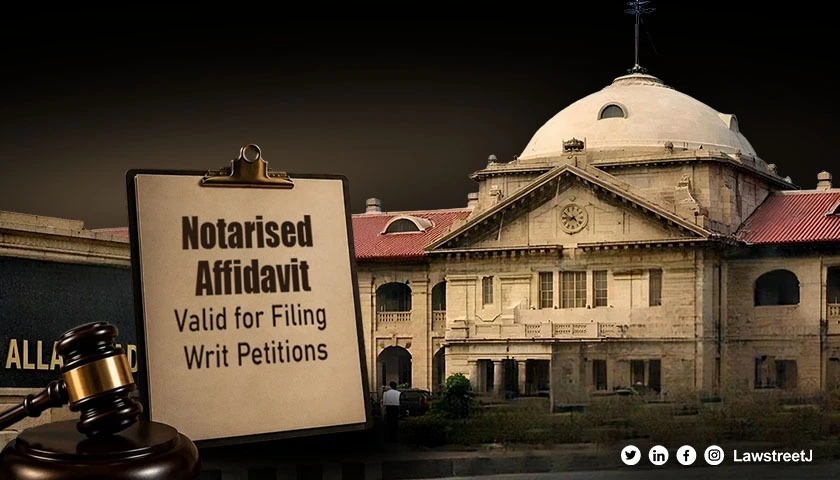
Lucknow: The Allahabad High Court has clarified that an affidavit duly notarised anywhere in the country is accepted at the stage of filing a writ petition, and that no litigant is mandatorily required to travel to the High Court at Allahabad or its Lucknow Bench for photo verification before instituting writ proceedings.
A Bench comprising Justices Alok Mathur and Amitabh Kumar Rai made these observations while dismissing a writ petition that challenged the validity of an Office Memorandum dated 07.10.2015 governing the 'Photo Affidavit Identification Regime'.
The petitioner, appearing in person, had assailed the Office Memorandum on the ground that the differential treatment accorded to officials of the State Government, Union Government and instrumentalities of the State, as opposed to ordinary litigants, under the photo affidavit regime was arbitrary, discriminatory and violative of Article 14 of the Constitution. He submitted that he had earlier approached the Supreme Court by way of Writ Petition (Civil) No. 479 of 2025 challenging the same regime, and that the Supreme Court, while disposing of the petition, had granted him liberty to submit a representation before the Chief Justice.
The petitioner thereafter filed applications under the Right to Information Act, 2005 seeking disclosure of records concerning the legal basis, scope and continuing applicability of the photo affidavit regime, and specifically queried whether the High Court Registry accepted affidavits sworn before Notaries Public at a litigant's place of residence. In response, the High Court had informed the petitioner that the Stamp Reporting Section accepts all duly sworn affidavits, whether through the photo affidavit procedure 'or otherwise', in accordance with the Allahabad High Court Rules, 1952, the Codes of Civil and Criminal Procedure, the Bharatiya Nagarik Suraksha Sanhita, 2023 and the Notaries Act, 1952.
“With respect to Point No. 3 : The Stamp Reporting Section of this Hon’ble Court at Lucknow accepts all the duly sworn affidavits whether sworn through the Photo Affidavit procedure or otherwise in accordance with the provisions of the Allahabad High Court Rules, 1952, Civil Procedure Code, 1908, Criminal Procedure Code, 1973, Bharatiya Nagarik Suraksha Sanhita, 2023 and Notaries Act, 1952.”
Taking note of this response, and of the submission made by Shri Vijay Dixit, learned counsel for the respondents, that notarised affidavits are accepted by the Stamp Reporting Section without any defect being raised, the Court held that no person is mandatorily required to approach the Photo Verification Centre established at the High Court for verification of an affidavit at the filing stage.
“Any person desirous of filing a writ petition or any other application is required to file an affidavit along with such petition or application. Such affidavit may be notarised anywhere in the country, which clearly indicates that there is no mandatory requirement for any person to physically appear before the Photo Verification Centre at either Allahabad or Lucknow.”
The Court further noted that in an earlier petition filed by him under Article 227 of the Constitution, no adverse report had been raised by the Registry, even though the petitioner claimed to have travelled to Allahabad for photo verification on the advice of his counsel. Declining to comment on the correctness of that legal advice, the Bench observed that it could only adjudicate upon the rules governing the swearing of affidavits, and not upon opinions rendered by counsel.
Since the High Court had already clarified, in response to the petitioner's own RTI application, that notarised affidavits are accepted, the Court found no reason for the petitioner to press the writ petition further, terming it 'superfluous' and one that had unnecessarily consumed the Court's time.
Holding that no interference was called for, the High Court dismissed the writ petition.
Appearances: Shri Biswajit Chowdhury, petitioner-in-person (through online mode); Shri Vijay Dixit, learned counsel, for respondent nos. 1 and 2.
Case Title: Biswajit Chowdhury v. Registrar General, High Court Of Judicature At Allahabad And Ors., Writ - C No. 6896 of 2026


!["No Loudspeakers For Azan, No Fundamental Right To Create Noise," Says Allahabad HC To Two Mosques [Read Judgment]](/secure/uploads/2020/01/lj_4995_Allahabad_HC_AZAN.jpg)