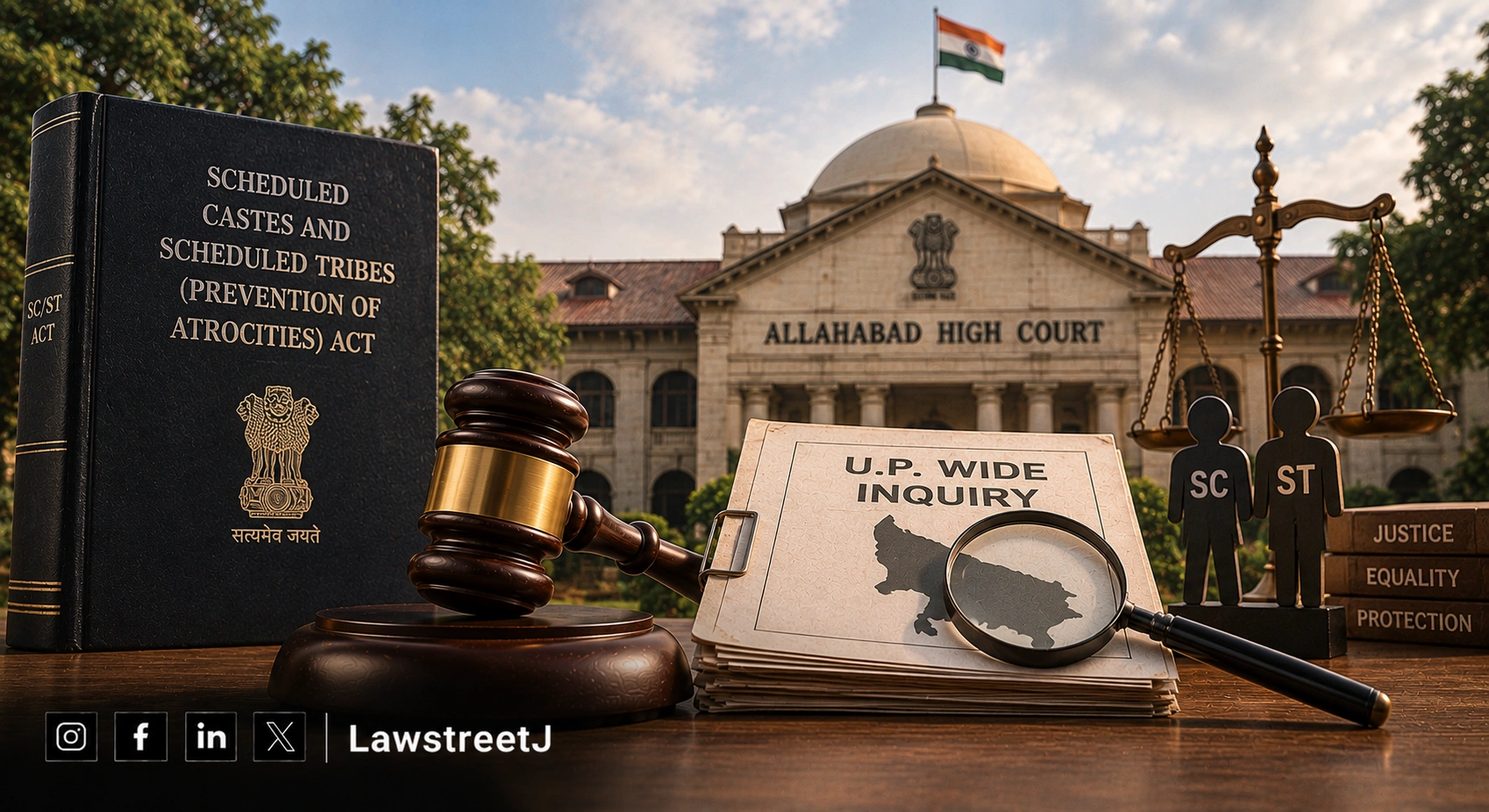
Allahabad: The Allahabad High Court has set aside orders passed by a Special Judge under the Scheduled Castes and the Scheduled Tribes (Prevention of Atrocities) Act, 1989, rejecting applications for release of the balance financial relief due to victims, holding that the Special Court had wrongly disclaimed jurisdiction to examine the adequacy of relief paid.
At the same time, taking note of disclosures that one of the appellants and his family had received over Rs. 23 lakh in relief across numerous criminal cases, the court directed a time-bound enquiry into possible misuse of the beneficial scheme, along with a broader statewide review of how such relief is disbursed.
Justice Santosh Rai was hearing two connected criminal appeals against orders passed by the Special Judge, SC/ST Act (Prevention of Atrocities), Jhansi, rejecting their applications under Rules 12(4) and 12(7) of the Scheduled Castes and the Scheduled Tribes (Prevention of Atrocities) Rules, 1995, seeking release of the balance 37½ per cent relief amount, i.e., Rs. 75,000 to each victim, in two separate criminal cases registered at Jhansi.
The court noted that the investigating officer, while filing the charge-sheets, had proposed relief of Rs. 2,00,000 to each victim under Item No. 41 of the Schedule to Rule 12(4), payable in stages of 25 per cent at the FIR stage, 50 per cent on submission of the charge-sheet, and the remaining 25 per cent upon conviction meaning that Rs. 1,50,000 had become due at the charge-sheet stage itself. Instead, the District Social Welfare Officer, Jhansi, had restricted payment to 37.5 per cent, i.e., Rs. 75,000 to each victim, and despite repeated representations, the balance amount was not released, prompting the applications before the Special Judge.
The impugned order had noted a report of the District Social Welfare Officer stating that the District Level Committee had itself assessed the admissible relief at Rs. 1,00,000, of which 75 per cent had already been paid, and held that it would not be proper for the court to determine the nature of the offence or fix or enhance the quantum of assistance, or to issue any direction to the Committee in that regard.
Counsel for the appellants submitted that this approach fundamentally misconstrued Rule 12(7), which expressly empowers the Special Court, upon a report from the District Magistrate, Sub-Divisional Magistrate or Superintendent of Police, to satisfy itself whether relief has been paid within time and whether it is adequate, and to direct payment of the balance amount where it finds it deficient. It was further submitted that the offences in question fell under Sections 3(1)(r), 3(1)(s) and 3(2)(va) of the Act, corresponding to Serial Nos. 18, 19 and 41 of the Schedule to Rule 12(4), and that the entitlement of the victims had to be determined strictly in conformity with the Schedule.
The learned A.G.A., while not seriously disputing this statutory position, brought on record through the State's counter affidavit that the appellant Santosh Kumar Dohrey, an advocate, along with his family members, had till date received a cumulative sum of Rs. 23,36,250 by way of relief under the Rules of 1995 and connected schemes across various criminal cases, with a further 10 to 12 cases said to be pending before the District Level Committee. It was submitted that while genuine victims could not be denied their entitlement, the scale and frequency of such claims raised a legitimate apprehension of possible misuse of the scheme, warranting a fair, fact-based enquiry.
Agreeing with the appellants on the interpretation of Rule 12(7), the court held that the provision was not merely enabling but contemplated active judicial scrutiny by the Special Court of the adequacy and timeliness of relief disbursed, and that the Special Judge had erred in treating any exercise of determining the quantum of assistance as impermissible. The impugned orders, being founded on a misconstruction of the Special Court's own jurisdiction, could not be sustained.
At the same time, the court observed that the scheme of relief under the Act and the Rules of 1995 was a benevolent and protective measure for genuine victims of caste-based atrocities whose integrity had to be zealously safeguarded, and that while recurrent registration of cases followed by relief claims did not by itself establish misuse, the scale and frequency disclosed in the present proceedings could not be left unexamined.
The court accordingly directed that the District Magistrate, Jhansi, in coordination with the Senior Superintendent of Police, conduct a thorough, fair and time-bound enquiry, within three months, into the antecedents of the criminal cases registered by the appellant Santosh Kumar Dohrey and his family and the relief amounts received or claimed therein, to ascertain whether the beneficial provisions have been misused, with appropriate action to follow against any person found responsible.
The court clarified that these observations would not amount to a finding on the merits of any party's entitlement to relief, which would be determined independently by the District Level Committee, nor would they affect the enquiry directed, which would proceed strictly on its own merits.
Going further, the court directed the State Government to undertake a broad-based, intensive enquiry across Uttar Pradesh and to develop an effective regulatory and supervisory mechanism in every district for verifying claims made under the Act and the Rules of 1995, particularly repeated claims by the same persons or their family members, and directed Special Judges under the SC/ST Act across the State to remain conscious of the possibility of misuse of the beneficial provisions, while cautioning that this should not be understood as requiring courts to prejudge or deny any genuine claim.
On the specific dispute over quantum, the court directed the Special Judge, SC/ST Act, Jhansi, to examine the nature and ingredients of the offences afresh and record a clear finding as to which entry of the Schedule — Serial Nos. 18, 19 or 41 was actually attracted, rather than proceeding mechanically on the basis of the sections cited in the charge-sheet, and to place the matter before the District Welfare Committee for a reasoned determination of whether compensation of Rs. 1,00,000 or Rs. 2,00,000 was payable.
The impugned orders dated 23.07.2024 were accordingly set aside, and the matter was remitted to the Special Judge, SC/ST Act (Prevention of Atrocities), Jhansi, to decide the applications afresh, strictly in accordance with law and the observations made, within six weeks.
Both criminal appeals were disposed of, with directions for circulation of the judgment to the District & Sessions Judges, District Magistrates, police heads and Special Judges SC/ST Act across all districts of Uttar Pradesh, as also to the Chief Secretary and the Principal Secretaries of the Home and Law/Justice Departments, Government of Uttar Pradesh.
Appearances:
For the Appellants: Mr. Braj Mohan Singh, Advocate.
For the Respondents: Government Advocate; Mr. Shikhar Tandon, Advocate; Mr. Rajesh Kumar Shukla, learned A.G.A.
Case Title: Arvind Kumar and 2 others vs. State of U.P. and 2 others, Criminal Appeal No. 10745 of 2024, with Santosh Kumar Dohrey vs. State of U.P. and 2 others, Criminal Appeal No. 10484 of 2024


!["No Loudspeakers For Azan, No Fundamental Right To Create Noise," Says Allahabad HC To Two Mosques [Read Judgment]](/secure/uploads/2020/01/lj_4995_Allahabad_HC_AZAN.jpg)