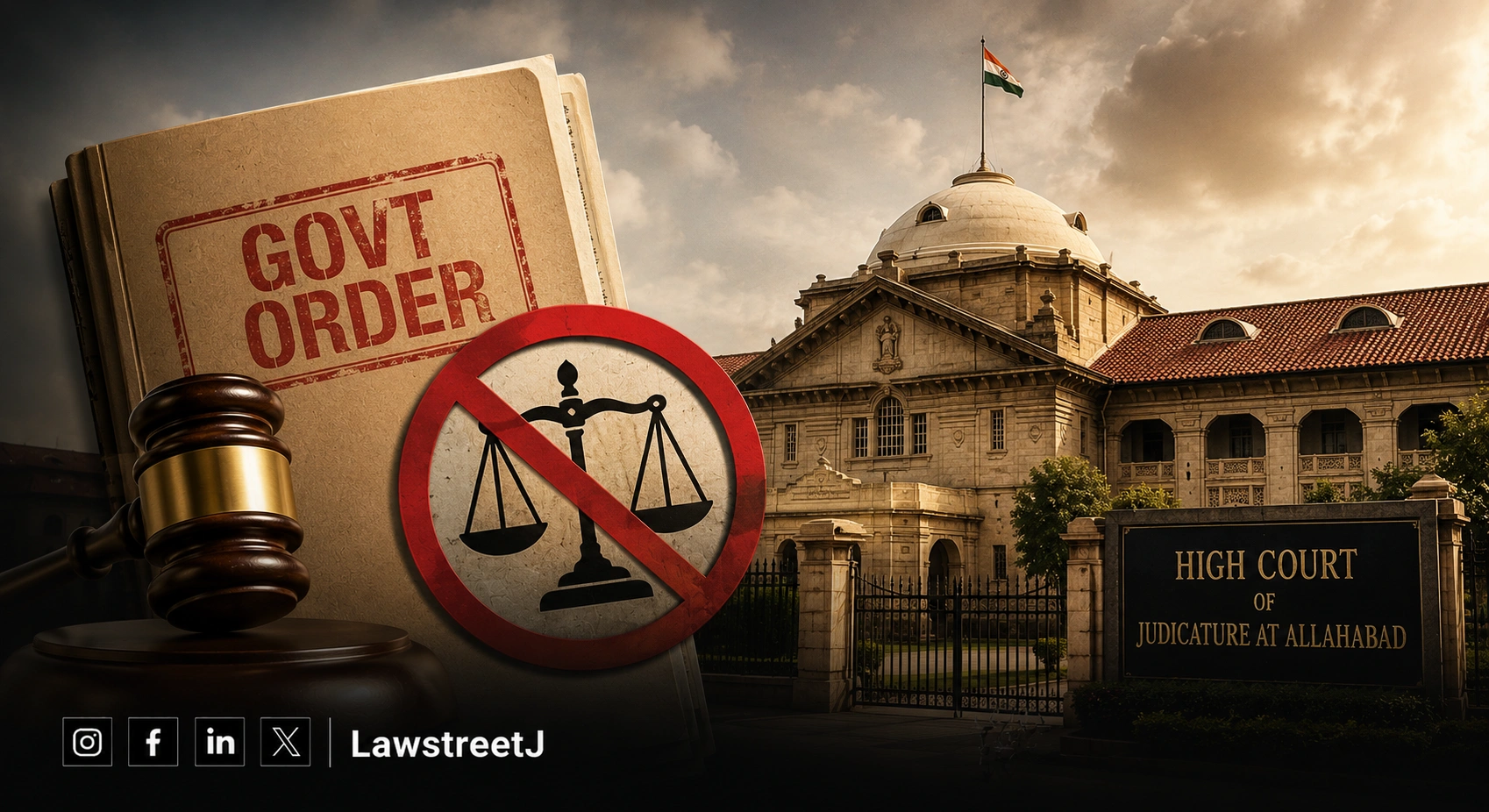
Prayagraj: The Allahabad High Court has declined to direct authorities to remove an alleged encroachment from a senior citizen's land, holding that his remedy lies before the civil court, while expressing surprise at a State Government Order that purports to vest an administrative committee with the power to get encroached property vacated by the use of force.
The Division Bench of Justice J.J. Munir and Justice Indrajeet Shukla was hearing a writ petition filed by a 70-year-old petitioner, who had purchased two plots admeasuring 4-8-0 in Village Visayakpur Raniya, Tahsil Akbarpur, District Kanpur Dehat, through a registered sale deed dated 20.05.1988, and whose name had since been mutated in the revenue records. The land, converted to commercial use in 2007, had earlier housed a paper mill which was subsequently closed.
It was the petitioner's case that respondent no. 7, described as an anti-social element with a criminal background and said to be facing seven criminal cases, had trespassed upon the property along with other anti-social elements and forcibly taken possession of it. Being a senior citizen incapable of resisting with physical force, the petitioner stated that he had approached the District Magistrate, Kanpur Dehat, invoking a Government Order dated 01.05.2017, which provides for Anti Land Grabbing Committees at the tahsil and district levels, empowered to inquire into land grabbing and get such land vacated using necessary force.
On examining this Government Order, the Court observed that it was surprised that a Government Order has come to be issued, virtually transferring judicial power of the State to an administrative committee dehors the statute by an executive order, and noted that the Government Order was already under challenge in a separate writ petition pending before the Court.
The petitioner further stated that he had made representations to various authorities, including an application received at the Chief Minister's Janta Darshan, on which the Superintendent of Police, Kanpur Dehat, was directed to take appropriate legal action, but without any result. It was also brought on record that respondent no. 7 had instituted a civil suit concerning a different property, allegedly to create a frivolous dispute, in which no injunction had been granted in his favour.
The Court noted that this was not the petitioner's first attempt at this relief. In an earlier writ petition, Writ-C No. 8209 of 2026, seeking a mandamus to the District Magistrate to invoke the same Government Order for protecting the petitioner's property, the Court had held that the relief was in the nature of an injunction arising out of a civil dispute involving disputed questions of fact, and had declined to grant indulgence, leaving the petitioner to avail his remedy of a civil suit. In the present petition, the same relief was recast as a prayer for a mandamus directing the District Magistrate to hold an inquiry under Rules 21 and 22 of the Uttar Pradesh Maintenance and Welfare of Parents and Senior Citizens Rules, 2014.
Observing that the two reliefs were essentially identical, the Court held that a civil court could not be deprived of its jurisdiction to decide questions of a civil nature, including a suit for recovery of possession founded on title, unless such jurisdiction was expressly or by necessary implication barred. It held that the petitioner could not ask the Court to convert the Collector into a judge trying civil actions on behalf of senior citizens.
While acknowledging that the petitioner's hesitation in approaching the civil court, arising from delays and the ad valorem court fee payable on such suits, was not entirely unfounded, the Court held that the law had to be applied as it stood. It recommended that the Government consider ameliorating the hardship caused by taxing civil justice at ad valorem rates, observing that while the levy of court fee itself was not objectionable, taxing justice at ad valorem rates was harsh and did not sit well with the constitutional scheme.
The writ petition was accordingly disposed of, with the Court directing the petitioner to approach the civil court of competent jurisdiction for the relief sought, and directing that its order be communicated to the Chief Secretary, the Principal Secretary, Revenue Department, and the Principal Secretary (Law) and Legal Remembrancer, Government of Uttar Pradesh, for consideration.
Appearances:
For the Petitioner: Mr. Devbratt Yadav, Mr. Phool Singh Yadav and Mr. Ram Pratap Yadav, Advocates.
For the State: Mr. Girijesh Kumar Tripathi, Additional Chief Standing Counsel.
Case Title: Laxmikant Aggarwal vs. State of U.P. and others, Writ-C No. 28925 of 2026


!["No Loudspeakers For Azan, No Fundamental Right To Create Noise," Says Allahabad HC To Two Mosques [Read Judgment]](/secure/uploads/2020/01/lj_4995_Allahabad_HC_AZAN.jpg)