Prayagraj: The Allahabad High Court has dismissed a writ petition seeking a direction to register an FIR, holding that a litigant aggrieved by non-registration of an FIR must first exhaust the statutory remedy of approaching the jurisdictional Magistrate under Section 175(3) of the Bharatiya Nagarik Suraksha Sanhita, 2023 (BNSS), rather than directly invoking the extraordinary writ jurisdiction of the High Court under Article 226.
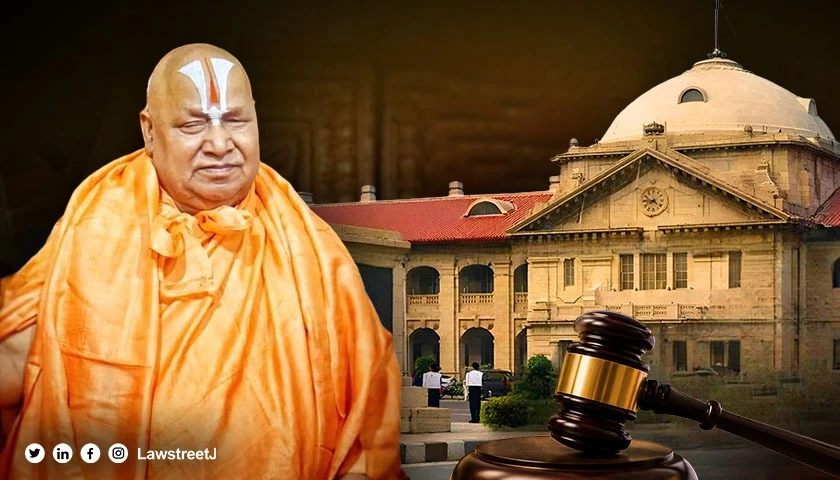
A Bench of Justice Chandra Dhari Singh and Justice Tarun Saxena was hearing a petition filed by advocate Ramesh Upadhyay, seeking a mandamus directing the police to register an FIR against Jagadguru Rambhadracharya, based on a complaint alleging that statements made by him in a video circulated on social media hurt the sentiments of persons belonging to the “Upadhyay” community and made objectionable remarks against revered religious personalities, including Shankaracharyas.
The petitioner’s counsel submitted that a complaint had been sent to the Commissioner of Police, Varanasi, on 8th October 2025, but despite disclosure of a cognizable offence, no FIR had been registered, which was argued to be in violation of the Supreme Court’s mandate in Lalita Kumari v. State of U.P. [AIR 2014 SC (Criminal) 66]. The State, opposing the petition, contended that it was a gross misuse of process, that the petitioner had never actually approached the concerned police station, that the letter relied upon had neither been received by any police official nor authenticated through postal or police records, and that the appropriate remedy lay before the jurisdictional Magistrate rather than the High Court.
Examining the record, the Court found that the writ petition contained no pleading regarding proof of receipt or postal tracking of the letter said to have been sent to the police, leaving the very foundation of the grievance unsubstantiated. Reiterating settled law, the Court held that where a person’s FIR has not been registered, or a proper investigation is not being conducted, the remedy lies in approaching the Magistrate under Section 175(3) BNSS (formerly Section 156(3) CrPC), which confers wide powers to direct registration of an FIR and to monitor investigation, and that this remedy is not merely an alternative but the primary and preferred one to be exhausted before invoking Article 226.
Relying on the Supreme Court’s rulings in Sakiri Vasu v. State of Uttar Pradesh [(2008) 2 SCC 409] and the more recent Sujal Vishwas Attavar v. State of Maharashtra [2026 INSC 442], the Court observed that the extraordinary jurisdiction under Article 226 cannot be used to compel FIR registration where efficacious statutory remedies remain unexhausted, and expressed concern over the growing trend of litigants approaching the High Court directly without first pursuing the statutory hierarchy of police superintendent and Magistrate. The Court clarified that while Lalita Kumari makes registration of an FIR mandatory once a cognizable offence is disclosed, that ruling was never intended to sanction bypassing the statutory remedies available when the police fail to act.
Holding that the right to fair investigation under Article 21 does not permit sympathy to override procedure, and finding no cogent reason to invoke its extraordinary writ jurisdiction on the facts presented, the Court dismissed the petition as devoid of merit, while granting the petitioner liberty to avail the appropriate statutory remedy if so advised.
Case Title: Ramesh Upadhyay vs. State of U.P. and 4 Others, Criminal Misc. Writ Petition No. 20106 of 2026


!["No Loudspeakers For Azan, No Fundamental Right To Create Noise," Says Allahabad HC To Two Mosques [Read Judgment]](/secure/uploads/2020/01/lj_4995_Allahabad_HC_AZAN.jpg)