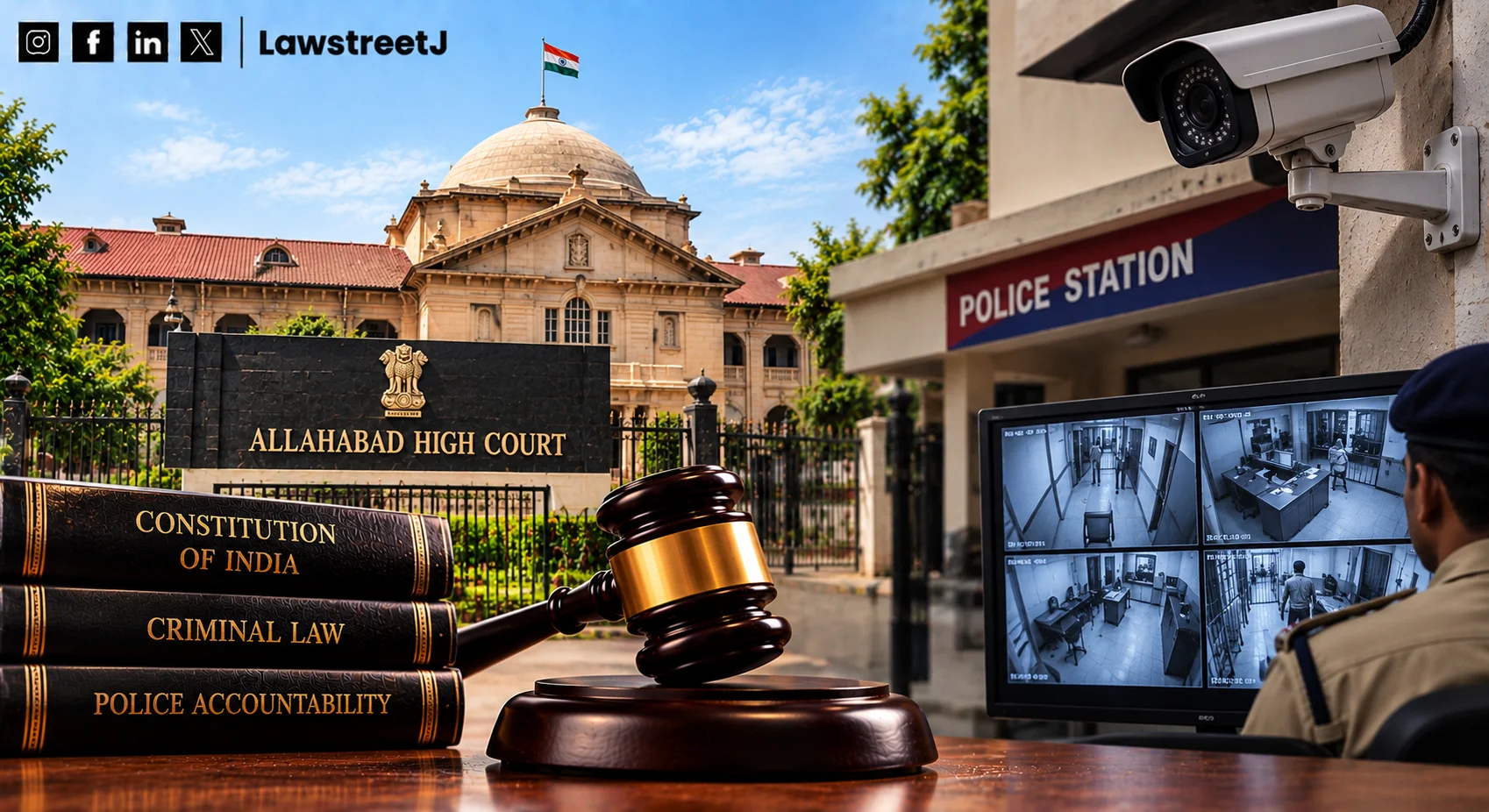
Prayagraj: The Allahabad High Court has set aside the arrest of a businessman in a cheating and breach of trust case, drawing an adverse presumption against the police after the CCTV feeds of three cameras inside a police station went missing, and holding that the grounds of arrest were not communicated in accordance with law. The court also laid down directions requiring police stations to keep CCTV systems functional round the clock and to record lapses in the general diary.
A Division Bench of Justice Atul Sreedharan and Justice Achal Sachdev was hearing a habeas corpus petition filed by Raghvendra Dubey through his wife, Jyotsana Dubey. He was in custody pursuant to an FIR registered as Crime No. 87 of 2026 dated 09.05.2026 under Sections 420, 406 and 506 of the Indian Penal Code, at the instance of Pradeep Yadav, proprietor of M/s RPS Enterprises, in respect of an alleged incident of 15.06.2021.
The court noted that the case revolved around a prima facie civil transaction. The petitioner had been allotted sand mining work over 108.499 hectares in Chitrakoot for five years from 15.06.2021, and the informant alleged that he was induced with a promise of a 19% share of income and profit, performed the work as per the agreement, was never paid, and was removed from the site and threatened with death. The informant claimed to have spent over Rs. 1.05 crore and Rs. 24.84 lakh on a road, a camp office and a weighbridge, and to have given Rs. 1.07 crore to the petitioner's firm. Since the informant himself accepted that the dispute arose from a civil dispute, the court refrained from saying whether a criminal angle existed, leaving that to the appropriate court.
The petitioner claimed that he was illegally picked up from a barber shop in Asansol on 12.07.2026 and brought to Chitrakoot at the behest of the informant, and produced photographs in support. The State denied this, saying that he had been absconding and was taken into custody only on non-bailable warrants.
The court focused on 13.07.2026. CCTV footage was available from only two of the five cameras in the police station. The entrance camera showed the petitioner brought in at 9:00 am and leaving at 10:19 am in the informant's vehicle, accompanied by the investigating officer, and returning only at 8:24 pm. The arrest memo showed his arrest at 3:30 pm near a flyover within Rajapur police station limits, although the case belonged to Sardhuwa police station, and the general diary recorded his lodgement in the lock up at 6:41 pm, which the footage showed to be impossible. The court held that when he left at 10:19 am he remained in constructive custody of the police.
The then SHO, Shiv Ashrey, told the court that the computer operator had not saved the feeds of the three cameras inside the station, and the State said the operator had been punished by withholding one month's salary. The Bench rejected this as *"false and mischievous,"* observing that the DVR saves feeds automatically and that no malfunction had been pleaded. It listed three possibilities: the camera had malfunctioned, the feed was deliberately shut down, or the saved feed was deliberately deleted. The court held that the feeds were deliberately deleted or not saved, and that the operator could not have acted without orders of the SHO or the investigating officer.
Invoking the presumption under Section 114(g) of the Evidence Act, corresponding to Section 119(g) of the Bharatiya Sakshya Adhiniyam, that evidence which is withheld would be unfavourable to the person withholding it, the court held that there was a strong presumption that the petitioner's case was correct.
On the second aspect, the court held that the grounds of arrest were woefully inadequate and had not been given in accordance with the law laid down by the Supreme Court, as the memo merely referred to details in the case diary. The arrest was therefore held violative of Article 21 of the Constitution. It also noted that both witnesses to the arrest memo were police personnel and that no independent witness had authenticated the arrest.
Expressing concern over repeated attempts by police to manipulate CCTV cameras, the court laid down that once a CCTV system is installed in a police station, it must function 24/7 for 365 days. Any failure must be recorded in the general diary by the SHO, with the official to whom it was reported in writing, and the Superintendent of Police must be informed, ensure minimal down time and record the action taken for repair.
The court further directed that where the system is down and a person is brought in for interrogation or on arrest, the details must be entered forthwith in the general diary. If a person is interrogated and released during such time, the time of release must be recorded, and a receipt must be taken stating when he was released and in whose company or to which relative he was handed over. Failure to follow these safeguards would lead the court to presume allegations of illegal detention to be correct under Section 119(g) of the Bharatiya Sakshya Adhiniyam.
Allowing the petition, the Bench set aside the arrest and directed that the petitioner be released forthwith, if not wanted in any other case. It awarded compensation of Rs. 10,000 for the 24 hours of illegal custody, to be recovered from the person found responsible after due inquiry. The court added that the facts prima facie strongly showed that "police personnel acted as recovery agents on behalf of the complainant." It clarified that its observations would not prejudice the trial court in any manner.
Appearances:
For the Petitioners: Mr. Vinay Saran, Senior Advocate, assisted by Mr. Shubham Tripathi, Advocate, along with Mr. Gyanendra Singh, Mr. Karuna Nand Tiwari, Mr. Manish Dubey and Mr. Saumitra Dwivedi, Advocates.
For the State: Mr. M.C. Chaturvedi, Additional Advocate General.
Case Title: Raghvendra Dubey & Anr. vs. State of U.P. & 4 Ors., Habeas Corpus Writ Petition No. 1169 of 2026


!["No Loudspeakers For Azan, No Fundamental Right To Create Noise," Says Allahabad HC To Two Mosques [Read Judgment]](/secure/uploads/2020/01/lj_4995_Allahabad_HC_AZAN.jpg)