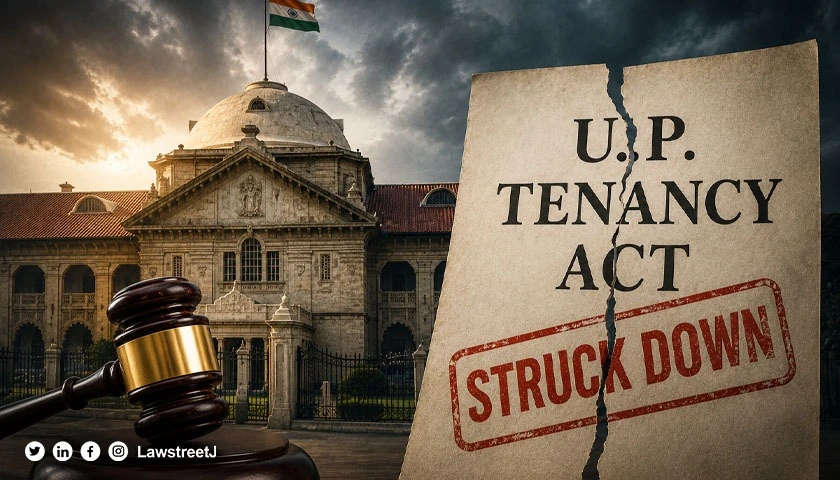
Prayagraj: The Allahabad High Court has held that the rent-revision, rent-determination and overriding provisions of the U.P. Regulation of Urban Premises Tenancy Act, 2021 could not have been enacted without prior Presidential assent, since they collide with the Transfer of Property Act and the Provincial Small Cause Courts Act as amended with Presidential assent in 1972, while clarifying that the repealed 1972 Rent Act automatically revives to fill the resulting gap.
A Division Bench of Justice Saumitra Dayal Singh and Justice Swarupama Chaturvedi was hearing sixteen connected writ petitions, challenging the validity of the 2021 Act along with individual orders passed by Rent Authorities enhancing rent under Section 10, and consequential execution and eviction proceedings in some of the cases. In the lead matter, the Municipal Corporation, Agra had in 1947 leased land at Raja Ki Mandi to Sri Dharam Chandra Jain, who built a market on it; the property later passed to his successors, who filed an eviction suit against the petitioner-tenant in 2008. After the 2021 Act came into force, the landlady sought fixation of provisional rent under Section 10(4), and the Rent Authority enhanced it from Rs.1,000 to Rs.750 per square foot per month by an ex-parte order dated 22.07.2022, later reiterated on 27.05.2024, giving rise to the writ petition.
Sri Shashi Nandan, Senior Advocate for the petitioners, argued that the 2021 Act was wholly ultra vires for want of Presidential assent, since it fell within the shadow of pre-existing Parliamentary legislation, the Transfer of Property Act and the Provincial Small Cause Courts Act, the latter as amended with Presidential assent by the U.P. Civil Laws (Amendment) Act, 1972. He submitted that Section 10 of the Act, read in isolation from Sections 8 and 9, vested the Rent Authority with uncanalised discretion to fix rent at “prevailing market value,” and that the individual impugned orders suffered from procedural defects including inadequate notice and reliance on rents of renovated shops for comparison. He relied on the Constitution Bench decision in Indu Bhushan Bose vs. Rama Sundari Devi to contend that legislative competence over building tenancies traces to Entries 6, 7 and 13 of the Concurrent List, not Entry 18 of the State List. He argued that the later five-judge decision in Rajendra Diwan vs. Pradeep Kumar Ranibala, sometimes cited for a contrary view, had in fact decided only the narrow question of a State legislature's competence to confer a direct appeal to the Supreme Court, and did not conflict with Indu Bhushan Bose.
Sri Rahul Agarwal, Additional Advocate General, and Sri Ashish Kumar Singh and Sri Sudeep Harkauli, Senior Advocates for the landlords, countered that the field fell squarely under Entry 18 of the State List, that Rajendra Diwan was the more considered later decision, and that Sections 8, 9 and 10 of the 2021 Act operated at distinct stages without any need to read one into the other. Reliance was placed on a Madras High Court ruling upholding a similar Tamil Nadu tenancy law, and on the nine-judge Bench in Property Owners Association to argue that even if the new Act fell, the repealed Rent Act of 1972 would revive.
The Bench held that Indu Bhushan Bose and Rajendra Diwan, both five-judge decisions, were not in conflict, since the latter had answered only whether the Chhattisgarh legislature could confer appellate jurisdiction on the Supreme Court, and its passing observations on Entry 18 could not be read as deciding the separate question of competence over transfer of property. It followed that Indu Bhushan Bose remained the only direct authority, tracing tenancy legislation for buildings to Entry 6 of the Concurrent List. Comparing the two statutory schemes, the Court found that while the 2021 Act's basic definitions of tenancy did not by themselves create repugnancy, its provisions on rent revision and determination departed materially from the Transfer of Property Act, under which lease rent could be varied only by private agreement and never by statutory fiat. It observed that the Act's additional statutory grounds for eviction, its penal-rent clause, and its adjudicatory scheme under the Rent Authority were similarly irreconcilable with Sections 108 and 111 of the Transfer of Property Act and with the forum created under the Provincial Small Cause Courts Act as amended by the 1972 Civil Laws Act.
Holding that repugnancy could arise where a State law takes away the rights conferred by the other central legislation, the Court found that Sections 8, 9 and 10, along with the overriding provisions in Sections 38 and 42, could not survive without prior Presidential assent under Article 254(2), which admittedly had not been obtained for the 2021 Act.
The Court declared Sections 8, 9, 10, 38 and 42 of the U.P. Regulation of Urban Premises Tenancy Act, 2021 ultra vires with effect from the date of judgment, while protecting all rent agreements, revisions and proceedings already concluded under those provisions where no challenge had been raised. It held that the repealed U.P. Urban Buildings (Regulation of Letting, Rent and Eviction) Act, 1972 would automatically revive to occupy the resulting vacuum, since a statute repealed by a subsequently invalidated law does not remain in suspension. The individual Rent Authority orders impugned in each of the sixteen writ petitions were quashed, and the petitions were allowed with no order as to costs.
Appearances:
For the Petitioners: Mr. Shashi Nandan, Senior Advocate, assisted by Ms. Shreya Gupta, Mr. Archit Mehrotra and Mr. Tanishk Goyal, Advocates.
For the State: Mr. Rahul Agarwal, Additional Advocate General, assisted by Mr. Bharat Pratap Singh, Additional Chief Standing Counsel.
For the Respondent-Landlords: Mr. Sudeep Harkauli and Mr. Ashish Kumar Singh, Senior Advocates, assisted by Mr. Devesh Kumar Verma, Advocate.
Case Title: Inder Bhushan Sawhney vs. Kanchan Kumari Jain (Dead) and 2 Others, Writ-A No. 13349 of 2024, with connected petitions


!["No Loudspeakers For Azan, No Fundamental Right To Create Noise," Says Allahabad HC To Two Mosques [Read Judgment]](/secure/uploads/2020/01/lj_4995_Allahabad_HC_AZAN.jpg)