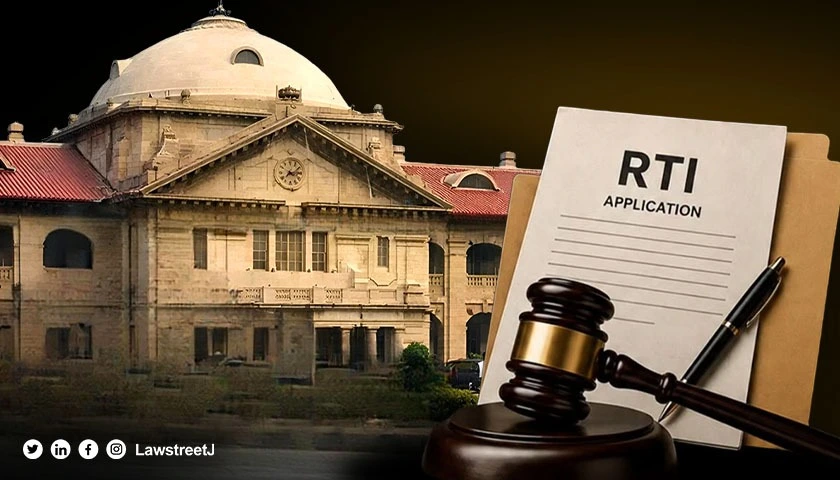
Allahabad: The Allahabad High Court has dismissed a writ petition and imposed costs totalling Rs.6,70,000 on a petitioner-in-person, holding that he had persistently misused the Right to Information Act, 2005 to harass the Registry and obstruct the administration of justice, and had further defied the Court's direction to appear in person.
Justice Saurabh Shyam Shamshery was hearing a writ petition filed by Vemula Venkata Vinay Babu alias Vinay Vemula challenging an order dated 28.07.2023 passed by the Commissioner, State Information Commission, U.P., Lucknow, which had dismissed his RTI appeal on the ground that the information sought had already been furnished to him by registered post.
The petition, initially filed through counsel, was later pursued by the petitioner in person after his application to discharge his advocate and appear through video conferencing was only partly allowed the Court having permitted him to appear in person, but not exclusively through video conferencing, a mode of appearance it held to be a matter of convenience and judicial discretion rather than a fundamental right.
The Court recorded that by its earlier order dated 24.07.2026 it had directed the petitioner to appear in person on the next date, failing which the petition would be decided ex-parte, and had also flagged that he had filed a stream of RTI applications concerning the Court's own internal administration ranging from office note sheets and file movement registers to video-conferencing server logs and cause-list arrangements that had no bearing on his case. Despite this, the petitioner appeared once again only through video conferencing and, when offered a date of his convenience, insisted he would not travel to Prayagraj, citing logistical difficulties, even though the record showed he had appeared in person on several earlier occasions.
The Court also considered and dismissed a separate application by the petitioner seeking to punish three of the four respondents for allegedly failing to file a counter affidavit, noting that the counter affidavit of the sole contesting respondent had in fact been filed and served well before the application was moved, and that no such direction had been issued against the other respondents in the first place. Terming the application misconceived and contrary to record, the Court dismissed it with costs of Rs.50,000.
On the petitioner's RTI applications, the Court noted that a Deputy Registrar's report showed 24 such applications filed between 04.06.2026 and 17.07.2026, seeking information such as Bench Secretary log entries, Cisco Webex session logs, and reasons why particular matters were listed or passed over. Holding that such applications served no purpose but to burden Court staff and interfere with judicial functioning, the Court directed that all of them be consigned to record and imposed a cost of Rs.5,000 on each, amounting to Rs.1,20,000 in total.
It is the Court's discretion to allow Video Conferencing or not. If a direction is passed by the Court to appear in-person, that has to be followed without any unreasonable excuse.
On the merits, the Court examined the petitioner's original RTI application and found that each of the queries raised largely concerning police records of complaints made against him had in fact been answered by the authorities, and that the petitioner had neither denied receipt of the earlier registered-post reply nor placed any contrary material on record. The Court also noted a report annexed to the petition indicating that the petitioner was harassing a complainant and her daughter who had lodged a complaint against him. Finding no ground to interfere with the impugned order, the Court dismissed the writ petition, and imposed a further cost of Rs.5,00,000 to discourage litigants from disrupting Court proceedings in this manner.
The Court directed that the cumulative costs of Rs.6,70,000 be deposited by the petitioner with the High Court Legal Services Committee within four weeks, failing which the Registrar General was directed to take appropriate steps for recovery.
Appearances:
For the Petitioner: Mr. Prateek Samadhiya, Advocate.
Case Title: Vemula Venkata Vinay Babu Alias Vinay Vemula vs. State of U.P. and 3 others, Writ - C No. 547 of 2024


!["No Loudspeakers For Azan, No Fundamental Right To Create Noise," Says Allahabad HC To Two Mosques [Read Judgment]](/secure/uploads/2020/01/lj_4995_Allahabad_HC_AZAN.jpg)