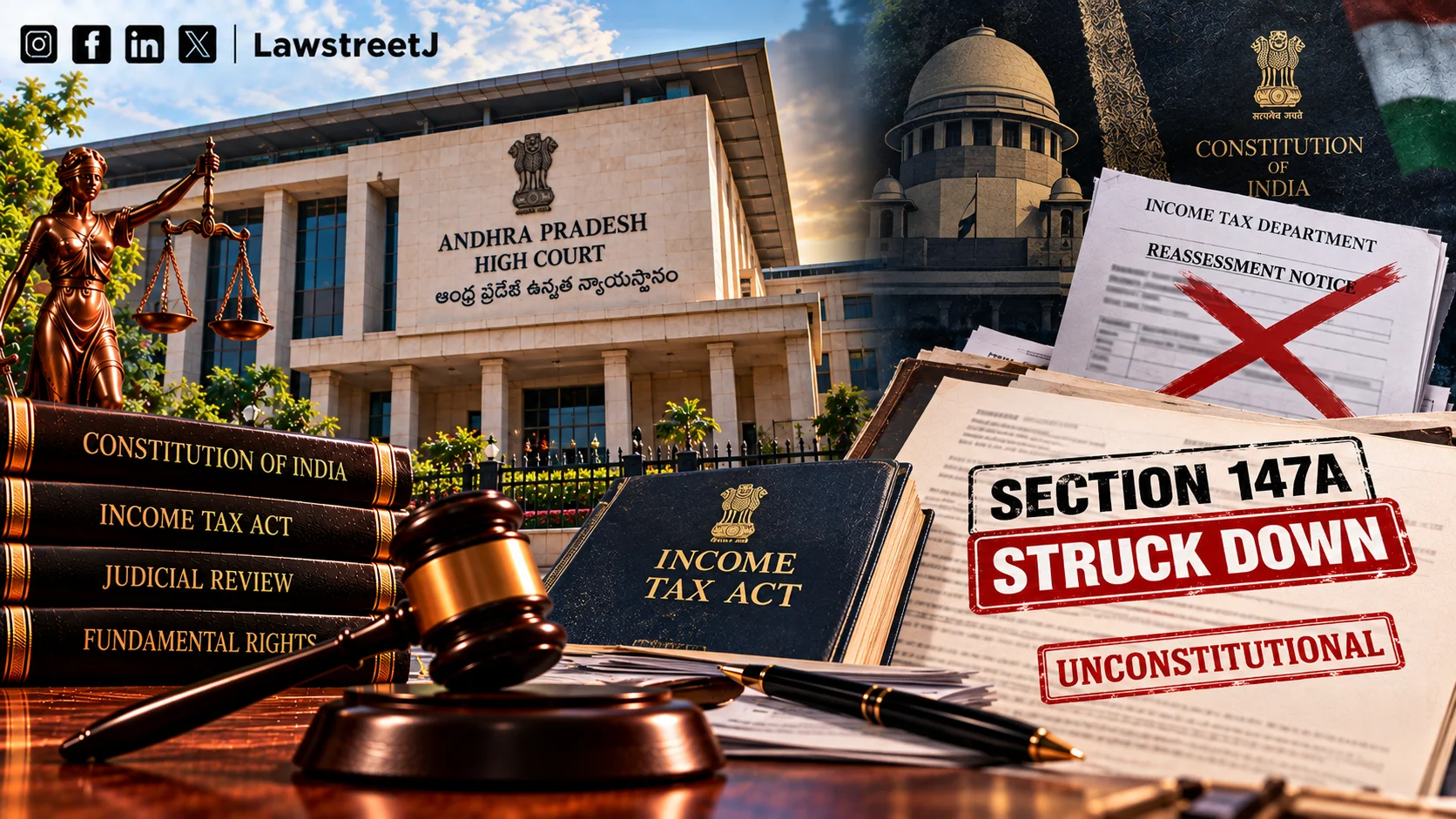
Amaravati: The Andhra Pradesh High Court at Amaravati has struck down Section 147A of the Income Tax Act, 1961, inserted by the Finance Act, 2026 (Act No. 4 of 2026) with retrospective effect from 01.04.2021, as unconstitutional, and has set aside the proceedings initiated by Jurisdictional Assessing Officers (JAOs) under Sections 148A and 148 as being without jurisdiction, holding that they were required to be undertaken in a faceless manner.
A Division Bench of Justice Ninala Jayasurya and Justice T.C.D. Sekhar, in a common order authored by Justice Sekhar, allowed WP No. 28520 of 2023 and a large batch of connected writ petitions. Orders were reserved on 22/23.09.2026 and pronounced on 12.10.2026.
The Court noted that the e-Assessment of Income Escaping Assessment Scheme, 2022, notified on 29.03.2022 under Section 151A, provides that assessment, reassessment or re-computation under Section 147 and issuance of notice under Section 148 shall be through automated allocation and in a faceless manner. A coordinate Bench had on 28.10.2025 set aside notices issued by JAOs under Sections 148A and 148 for violating Section 151A read with that scheme. While the Revenue's special leave petitions were pending, Section 147A was inserted, providing, notwithstanding any judgment, Section 151A or any scheme, that for Sections 148 and 148A the Assessing Officer shall always be deemed to mean an officer other than the National Faceless Assessment Centre or any assessment unit. On 10.04.2026 the Supreme Court disposed of the appeals, left all questions on the amended provision open, relegated the assessees to the High Courts, and requested decisions preferably by 30.09.2026.
The petitioners argued that Parliament cannot nullify judicial decisions by an amendment styled as a clarification, that Section 147A could not confer on JAOs a jurisdiction they never had, that Section 151A and the scheme remained unamended, and that the amendment violated the separation of powers. They also contended that the Income Tax Act, 1961 stood repealed when the amendment took effect, since the Income Tax Act, 2025 came into force on 01.04.2026, and that Section 536 of the 2025 Act confers no power to amend a repealed enactment.
The Revenue, represented by Additional Solicitor General N. Venkataraman, relied on the presumption of constitutionality, the wider latitude available in fiscal legislation, and the position that reassessment has two stages, with the pre-assessment stage under Sections 148A and 148 retained with the JAO and only assessment under Section 147 being faceless. It said the amendment was made to end litigation caused by divergent High Court views. By an additional affidavit it stated that notices under Section 148 were issued against 8,82,146 assessees for assessment years 2016-17 to 2025-26, about 0.127% of filers, that reassessment orders had been passed against 6,46,897 assessees, and that income of about Rs. 21.71 lakh crore had been assessed, so that interference would harm public interest.
On the scheme, the Court held that clause 3 requires notices under Section 148 to issue through automated allocation under the Board's risk management strategy, that the Revenue admitted no such arrangement existed and cases were identified by JAOs, and that the word "shall" ousted JAOs from exercising Section 148 powers. Having included Section 148 in the scheme, the Revenue could not say that "faceless" applied only to Section 147, and the proviso to Section 151A(2), barring directions after 31.03.2022, meant the scheme remained as it was. The Court rejected reliance on Notification No. 61 of 2022 conferring concurrent jurisdiction, as contrary to Sections 130 and 151A, held that Section 148A not being named in the scheme gave JAOs no power, and said the Revenue was "blowing hot and cold".
On Section 147A itself, the Court held that the scheme under Section 151A remained unamended and that no defect in the Act or the scheme had been found in the earlier round, only that JAOs lacked jurisdiction. Citing Shri Prithvi Cotton Mills v. Broach Borough Municipality and State of Tamil Nadu v. M. Rayappaiah Gounder, it observed that a legislature may remove the basis of a judgment but no Legislature in this Country has power to ask the instrumentalities of the State to disobey or disregard the decision given by Courts, and held that the Legislature cannot nullify the judgment rendered by any Court by enacting law without removing the basis. Section 147A, it held, overreaches the earlier decisions in conflict with the doctrine of separation of powers, a basic structure of the Constitution.
The Court separately accepted the repeal argument. It noted that Section 1(3) of the Income Tax Act, 2025 brings it into force on 01.04.2026 and that Section 2(a) of the Finance Act, 2026 likewise provides that its relevant sections come into force on 01.04.2026, so that the 1961 Act stood repealed at midnight on 31.03.2026. It rejected the Revenue's reliance on the President's assent on 30.03.2026, holding that Section 5 of the General Clauses Act applies only where an Act does not express its commencement date, as explained in Common Cause v. Union of India. The insertion of Section 147A into a repealed enactment was held to be unsustainable and without legal sanctity.
Rejecting the public interest plea, the Court held that the fact that most assessees did not challenge notices gave the Revenue no right to assess in a non-faceless manner. It noted that the Punjab and Haryana High Court had struck down Section 147A on 10.09.2026, that this was stayed by the Supreme Court on 18.09.2026 in SLP (Civil) No. 33196 of 2026, and that it had dealt with the matter independently.
Concluding, the Court declared Section 147A unconstitutional and struck it down, held that all proceedings initiated by JAOs under Sections 148A and 148 are without jurisdiction because they must be undertaken in a faceless manner, and allowed the writ petitions, setting aside the impugned proceedings and orders.
Appearances:
For the Petitioners: Mr. A.V.A. Siva Kartikeya, Mr. Kondala Rao Kotapati, Mr. P. Pavan Kumar Rao and other Advocates.
For the Respondents: Mr. N. Venkataraman, Additional Solicitor General of India; Mr. T. Niranjan, Additional Solicitor General, High Court of Andhra Pradesh; Mr. Y.N. Vivekananda and Mr. Anup Koushik Karavadi, Senior Standing Counsel for Income Tax.
Case Title: Bala Sreenivas Rao Somisetty vs. The Income Tax Officer, Ward 1, Eluru & Others, WP No. 28520 of 2023 and batch