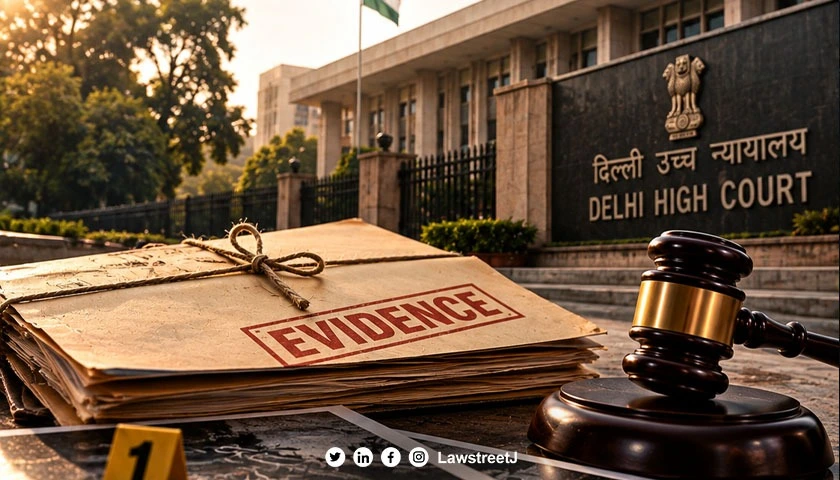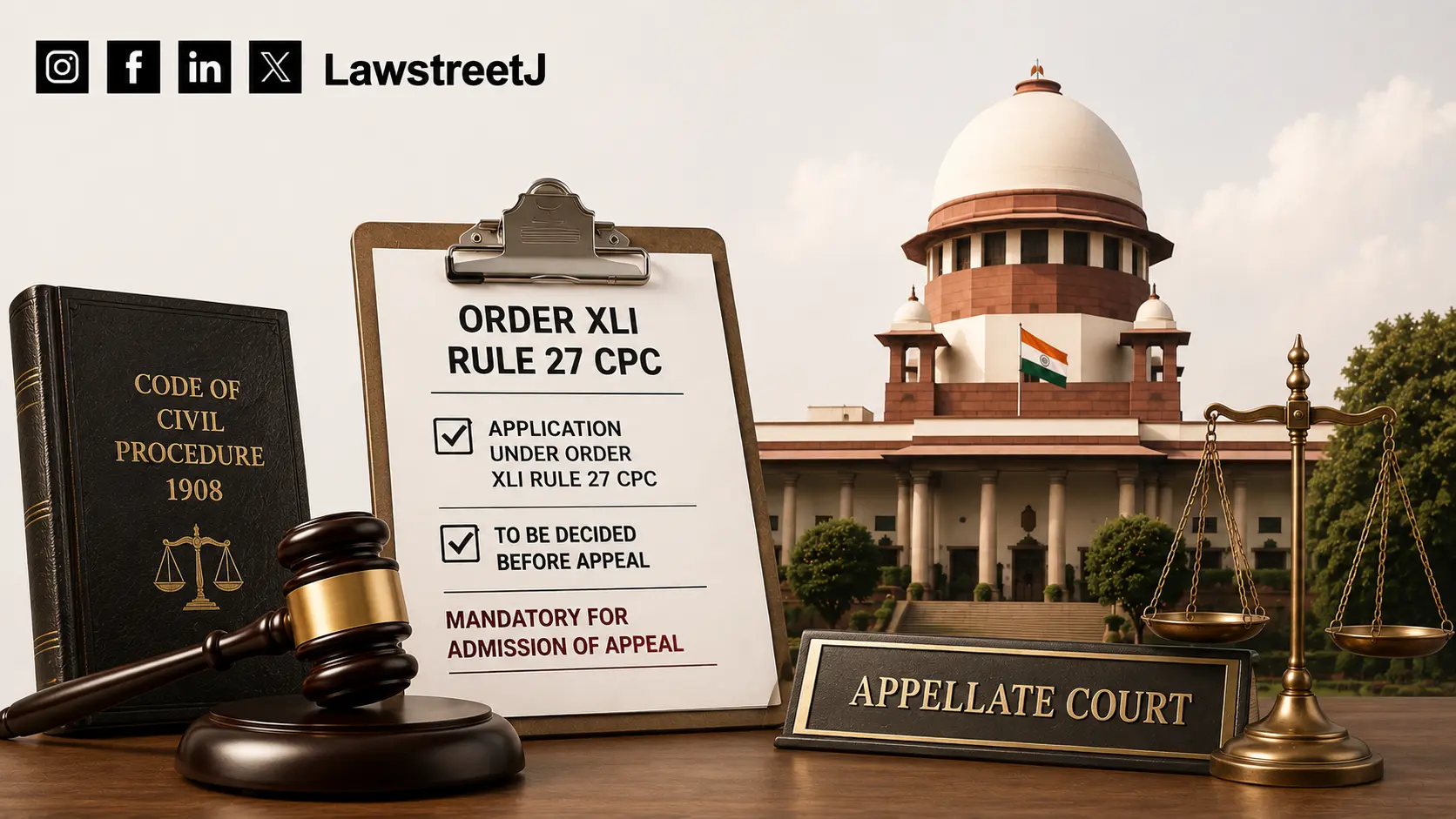
New Delhi : The Supreme Court has set aside a Karnataka High Court judgment dismissing a first appeal and cross-objections in a partition suit, holding that the High Court committed a jurisdictional error by dismissing the appeal without deciding an application for production of additional evidence filed under Order XLI Rule 27 of the Code of Civil Procedure, 1908.
A bench of Justices S.V.N. Bhatti and N.V. Anjaria was hearing an appeal filed by the appellant, arrayed as Defendant No. 1 in the original suit, against a judgment of the High Court of Karnataka dated December 16, 2025, dismissing RFA No. 2076 of 2006 along with the appellant's cross-objections. The underlying suit, filed for partition and separate possession of certain properties, had been decreed by the Trial Court at Devanahalli in 2006, leading to the first appeal and cross-objections before the High Court.
Ms. Kiran Suri, Senior Counsel for the appellant, argued that although the High Court had examined some of the controversies between the parties and affirmed the Trial Court's view, the judgment was liable to be set aside on the short ground that I.A. No. 1/25, an application seeking to place additional evidence on record, had never been heard or decided. She submitted that the application conformed to the requirements of Order XLI Rule 27 CPC and that the evidence sought to be produced would establish infirmities in the plaintiffs' case.
For the contesting respondents, Advocate Prabha Swami had sought time to verify the factual position, and one of the respondents subsequently filed an affidavit stating that the application to bring additional documents on record had in fact been listed along with the final hearing on November 4, 2025, when the High Court recorded the matter as “heard” and “reserved for orders,” before pronouncing judgment on December 16, 2025. It was accordingly argued that this was not a case where the application had gone unheard, but one where it had not been formally disposed of by a separate order.
The Court set out the text of Order XLI Rule 27 CPC and examined the precedents cited by the appellant, distilling from them a set of principles governing such applications. It held that an appellate court has a statutory duty to deal with an application for additional evidence on its merits, and cannot ignore it while proceeding to pronounce final judgment. The application, the Court noted, must be considered simultaneously with the hearing of the main appeal to determine whether the documents are required to pronounce judgment or for any other substantial cause. The appellate court must pass a specific order either allowing or rejecting the application, recording its reasons if the evidence is admitted, and before evaluating any additional evidence it must first examine the pleadings to ensure the foundational case supports its introduction. Dismissing an appeal without deciding a pending application of this kind, the Court held, amounts to a jurisdictional error and results in a severe miscarriage of justice.
Applying these principles, the Court found that the High Court had dismissed the cross-objections without referring to, considering, or adjudicating the application for production of crucial documents, including judgments from an earlier suit, bank loan discharge records, and surveyor sketches:
“The High Court committed a direct jurisdictional error by completely ignoring the Application while disposing of the Appeal, directly contravening the principles laid out in the decisions supra... The failure to pass a reasoned order either allowing or rejecting this Application before sustaining the Trial Court's decree resulted in a procedural failure and a miscarriage of justice.”
Accordingly, the Court set aside the High Court's judgment dated December 16, 2025, allowed the civil appeals, and restored RFA No. 2076 of 2006 along with the cross-objections, remanding the matter to the High Court for fresh disposal.
Appearances: Ms. Kiran Suri, Senior Counsel, appeared for the appellant, while Mrs. Prabha Swami appeared for the contesting respondents.
Case Title: Chowdappa vs. Hanumantharayappa and Others, SLP(C) Diary No. 10525 of 2026