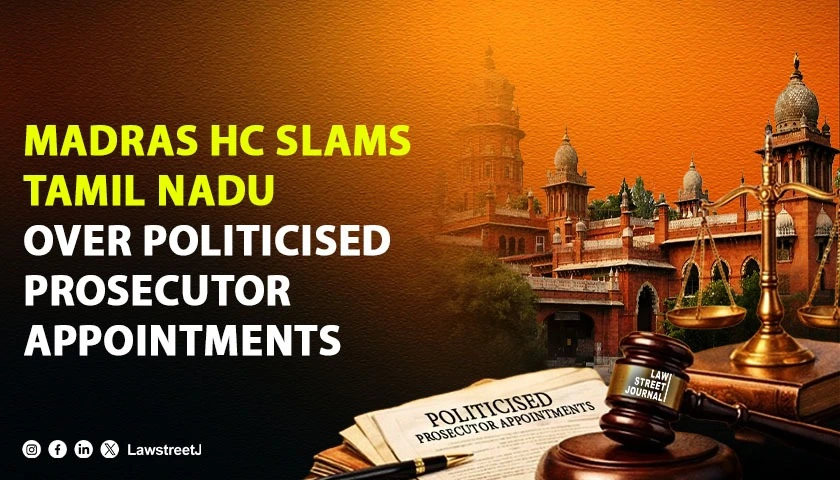
Chennai: The Madurai Bench of the Madras High Court has come down heavily on the Tamil Nadu Government for appointing Public Prosecutors and Law Officers on the basis of political allegiance rather than merit, observing that such appointments—extending at times to individuals whose only qualification is affixing election posters—strike at the very root of the professional standards expected of Law Officers and leave litigants to suffer, thereby compromising the administration of justice.
The sharp observations were made by Justice B. Pugalendhi on April 1, 2026, while dismissing a petition filed by a convict seeking suspension of sentence in a case involving an attempt to rape a woman belonging to the Scheduled Caste community, and directing the Government to act within four weeks on a long-pending recommendation for removal of a negligent Special Public Prosecutor.
The petitioner, Rajkumar, had been convicted by the Special Court for Trial of Cases under the SC/ST (Prevention of Atrocities) Act, Theni, for offences under Section 376 read with 511 of the IPC and Section 3(1)(w)(i) of the SC/ST (PoA) Act, and sentenced to five years’ rigorous imprisonment. The prosecution’s case was that, in the early morning of November 4, 2019, the petitioner punched the victim and pushed her to the floor before attempting to commit rape. A complaint was lodged immediately, and the victim was taken to the Government Hospital the same morning, where the examining doctor recorded four injuries in the Accident Register dated November 4, 2019.
While dismissing the bail application on merits, given the serious nature of the offence against a woman from an oppressed community, the Court turned its attention to a far more troubling aspect of the case—namely, the manner in which the prosecution had been conducted at the trial stage. The Accident Register, a document of critical evidentiary value recording the injuries sustained by the victim, was never exhibited before the trial court, nor were any questions put to the examining doctor regarding it during the trial.
The Court noted that this was not a new revelation. In an earlier application for suspension of sentence filed by the same petitioner, which was dismissed by order dated April 23, 2025, the Court had already directed the Director of Prosecution to take appropriate action against the Special Public Prosecutor responsible for conducting the trial. The Director of Prosecution thereafter filed a report before the Court acknowledging the lapses and recommending removal of the concerned Law Officer as early as July 7, 2025. Despite this, the Government had taken no decision on the recommendation, with several months elapsing without any action.
The Court found the Government’s inaction deeply troubling, observing that by keeping the file pending, the Government was effectively enabling an unfit person to continue in office and cause injustice to other victims as well. The Court also pointed out a procedural anomaly, noting that since the Law Officer had been appointed at the district level by the District Collector, who is also the appointing authority, it was unclear why the matter had been referred upward to the Government. The Court suspected that the referral was either to protect the Law Officer or to keep the matter in cold storage.
Taking strong exception to the state of affairs, the Court made sweeping observations on the broader malaise of politically motivated appointments to prosecutorial positions. It noted that a significant number of Law Officer appointees lack the requisite competence and legal acumen to effectively conduct cases, and that even after appointment, little effort is made to develop the necessary skills. The Court recalled that the First Bench of the Madras High Court, in V. Vasanthakumar v. The Chief Secretary, Government of Tamil Nadu (W.P. No. 12951 of 2017, dated April 28, 2018), had already directed the State Government to formulate definite guidelines for selection of Law Officers based on merit and basic qualifications, with a specific direction that appointments must not be made to serve political purposes. The Court lamented that, notwithstanding those directions, the Secretaries to the Government involved in the selection process continued to facilitate the same pattern of politically driven appointments.
Considering the Government’s prolonged inaction on the Director of Prosecution’s recommendation, the Court exercised its suo motu powers to implead the District Collector, Theni, and the Secretary to the Government, Home Department, Chennai, as parties to the petition, directing them to take a decision on the removal proposal within four weeks without fail.
Appearances:
For the Petitioner: Mr. S. Ramanathan, Advocate
For Respondents R1, R3, R4: Mr. A.S. Abul Kalaam Azad, Government Advocate (Criminal Side)
For Respondent R2: Mr. R. Karunanidhi, Advocate
Case Title: Rajkumar v. State of Tamil Nadu and Ors., Crl.MP(MD) No. 12468 of 2025 in Crl.A(MD) No. 405 of 2025, Madurai Bench of Madras High Court



![TN Medical Council declares change of gender identity of LGBTQIA+ as misconduct [Read Notification]](/secure/uploads/2022/12/lj_5268_5cebb05a-97fb-40fb-8045-25cdf8f4207a.jpg)
![Madras High Court Directs Tamil Nadu Government to Ensure Quota for Transgenders in Local Body Elections [Read Order]](/secure/uploads/2023/08/lj_2507_7a03d113-08b1-4670-b6fb-9058aee481d0.jpg)
![Anti Corruption sleuths acted like "puppets in The Muppet Show", HC notice to ex TN CM in disproportionate assets case [Read Order]](/secure/uploads/2023/09/lj_8675_7b37fc02-1b2d-4f4a-9816-3df20545b37e.jpg)