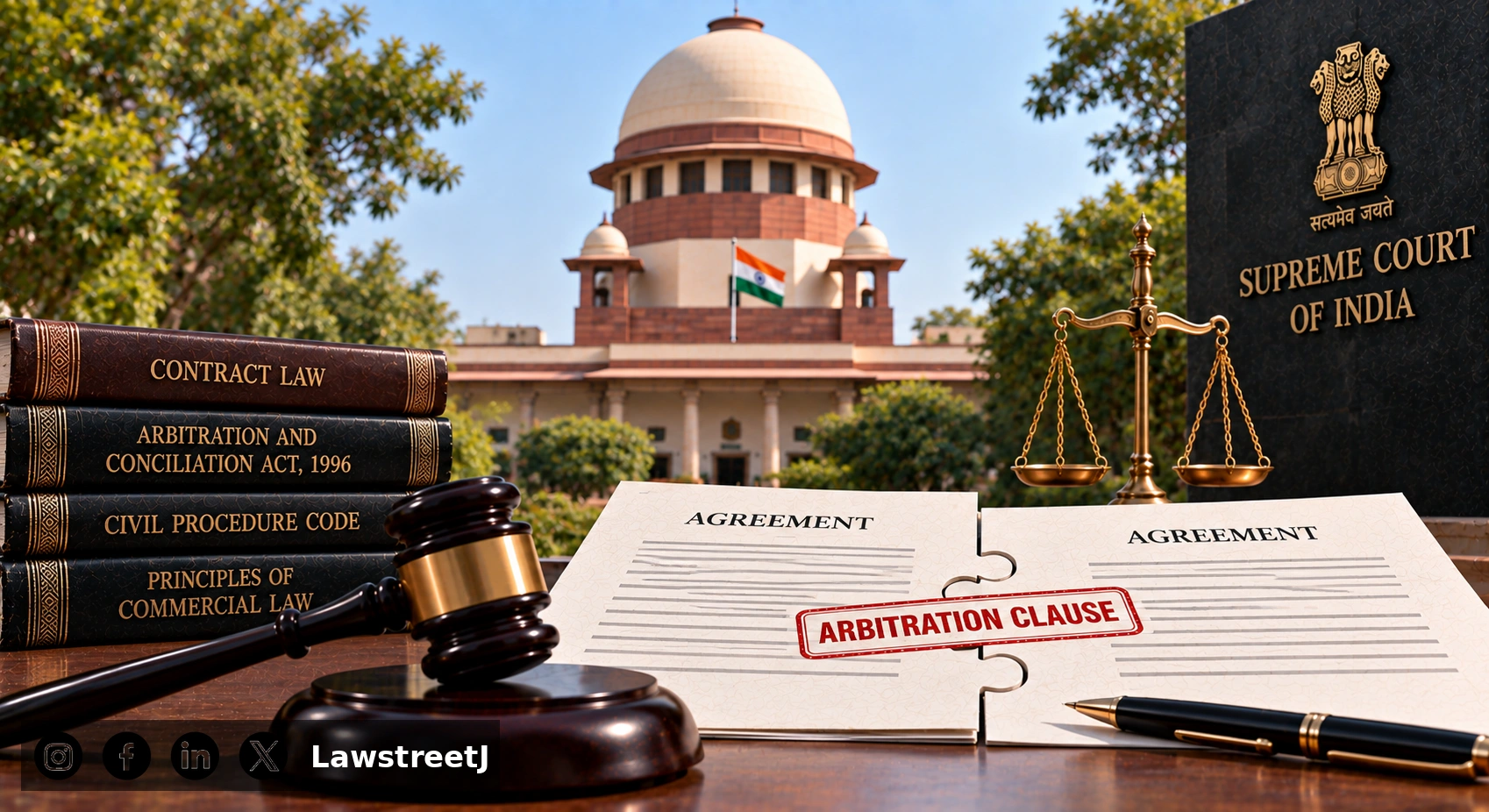
New Delhi: The Supreme Court has allowed an appeal filed by the National Skill Development Corporation, holding that where a personal guarantee is expressly rendered an integral and inseparable part of a loan agreement, the arbitration clause contained in the loan agreement stands incorporated into the guarantee under Section 7(5) of the Arbitration and Conciliation Act, 1996, even though the guarantee itself contains no arbitration clause, and quashing orders of the Delhi High Court and the Sole Arbitrator that had deleted the guarantor from the arbitral proceedings.
The Bench of Justice Pamidighantam Sri Narasimha and Justice Alok Aradhe, in a judgment authored by Justice Aradhe, was considering whether, where parties structure a single transaction through several interconnected instruments, an arbitration clause contained in one instrument can bind a party through another instrument that is expressly integrated with it but does not itself contain an arbitration clause.
The appeal arose from a judgment dated 28.01.2026 of the High Court of Delhi, which had affirmed an order of the Sole Arbitrator directing deletion of four respondents, including respondent no.2, from the array of parties to arbitral proceedings on the ground that they were non-signatories to the loan agreements in their personal capacities. The appeal was confined to the correctness of the order insofar as it concerned respondent no.2.
The dispute arose out of the Ministry of Skill Development and Entrepreneurship's scheme to establish Pradhan Mantri Kaushal Kendras, for which the appellant, as implementing agency, had extended loans to respondent no.1 company and respondent no.4 society for jointly setting up training centres. On 20.12.2016 and again on 18.08.2017, the parties executed contemporaneous clusters of agreements, each comprising a Loan Agreement and ancillary Facility Agreements, including a Personal Guarantee executed by respondent no.2, who was Managing Director of the borrower company. Following default and issuance of loan recall notices, the appellant initiated arbitral proceedings before the Indian Council of Arbitration, whereupon respondent no.2 and other non-signatories applied under Section 16 of the 1996 Act contending that the Tribunal lacked jurisdiction over them.
The Sole Arbitrator allowed the application, and the High Court affirmed, holding that the Personal Guarantees contained no arbitration clause of their own, that a mere general reference to a document does not automatically import an arbitration clause, and that jurisdiction could not be founded merely on commercial linkage between instruments absent an express or validly incorporated arbitral undertaking or proof that respondent no.2 was the alter ego of the company.
Counsel for the appellant submitted that a conjoint reading of Clause 11.2 of the Loan Agreements with the definition clauses and Schedules showed that the Personal Guarantees were mandatory pre-disbursement conditions, contractually defined as "Facility Agreements" deemed to form an integral and inseparable part of the Loan Agreements, and that the High Court had applied Section 7(5) of the 1996 Act in an unduly technical manner. Counsel for respondent no.2 submitted that only four of the seven instruments executed between the parties contained arbitration clauses, that Clause 11.2 confined arbitration to disputes concerning the Loan Agreement itself, and that this was a "two contract case" in which the intention to bind a non-signatory had to be gathered from the language of the document rather than presumed.
Tracing the law on incorporation by reference under Section 7(5) of the 1996 Act through M.R. Engineers and Contractors Private Limited v. Som Datt Builders Limited, Inox Wind Limited v. Thermocables Limited, Shinhan Bank v. Carol Info Services Limited, and the Constitution Bench decision in Cox and Kings Limited v. SAP India Pvt. Ltd., the Court reaffirmed that a general reference to another contract does not, by itself, incorporate an arbitration clause, but that in a composite transaction involving multiple agreements, courts and tribunals must assess whether the agreements are consequential to, or a follow-up of, the principal agreement, and that conduct may indicate a non-signatory's consent to be bound.
Examining the definition clauses of the Loan Agreements, the Court found that the Personal Guarantees were expressly enumerated in Schedule IV as "Facility Agreements", that Clause 1.1 declared the "Agreement" to include all annexed Schedules, and that Clause 12.1 stipulated that Facility Agreements would be deemed part of the Agreement "as if the provisions thereof were set out herein in extension". The Court held that this deeming fiction, read with the stipulation in Schedule I that execution of the Facility Agreements was a pre-disbursement condition, and the contemporaneity of execution of the Personal Guarantees with the Loan Agreements, conclusively established that the parties intended the entire cluster of documents to constitute a single, composite transaction, making the intention to incorporate the Personal Guarantees into the Loan Agreements explicit rather than a matter of inference.
The Court observed that respondent no.2's failure to sign the Loan Agreements in his personal capacity was not decisive, since personal guarantees of individuals controlling thinly capitalised training partners were exacted as a mandatory pre-disbursement condition and constituted the real assurance that publicly disbursed funds would be recovered, and that such a guarantee, integrated by deeming fiction into the Agreement, could not be severed from the dispute resolution clause governing it while remaining tethered to it for every other purpose.
The Court accordingly held that the arbitration clause in Clause 11.2 of the Loan Agreements stood incorporated into the Personal Guarantees under Section 7(5) of the 1996 Act, and that respondent no.2 was bound to submit to arbitration. The judgment of the High Court and the order of the Sole Arbitrator, insofar as they concerned respondent no.2, were quashed and set aside, and the appeal was allowed with no order as to costs.
Appearances:
For the Appellant: Mr. J.K. Chaudhary, Advocate.
For Respondent No.2: Mr. Sudev Singh Juneja, Advocate.
Case Title: National Skill Development Corporation v. Surya Wires Private Limited & Ors.