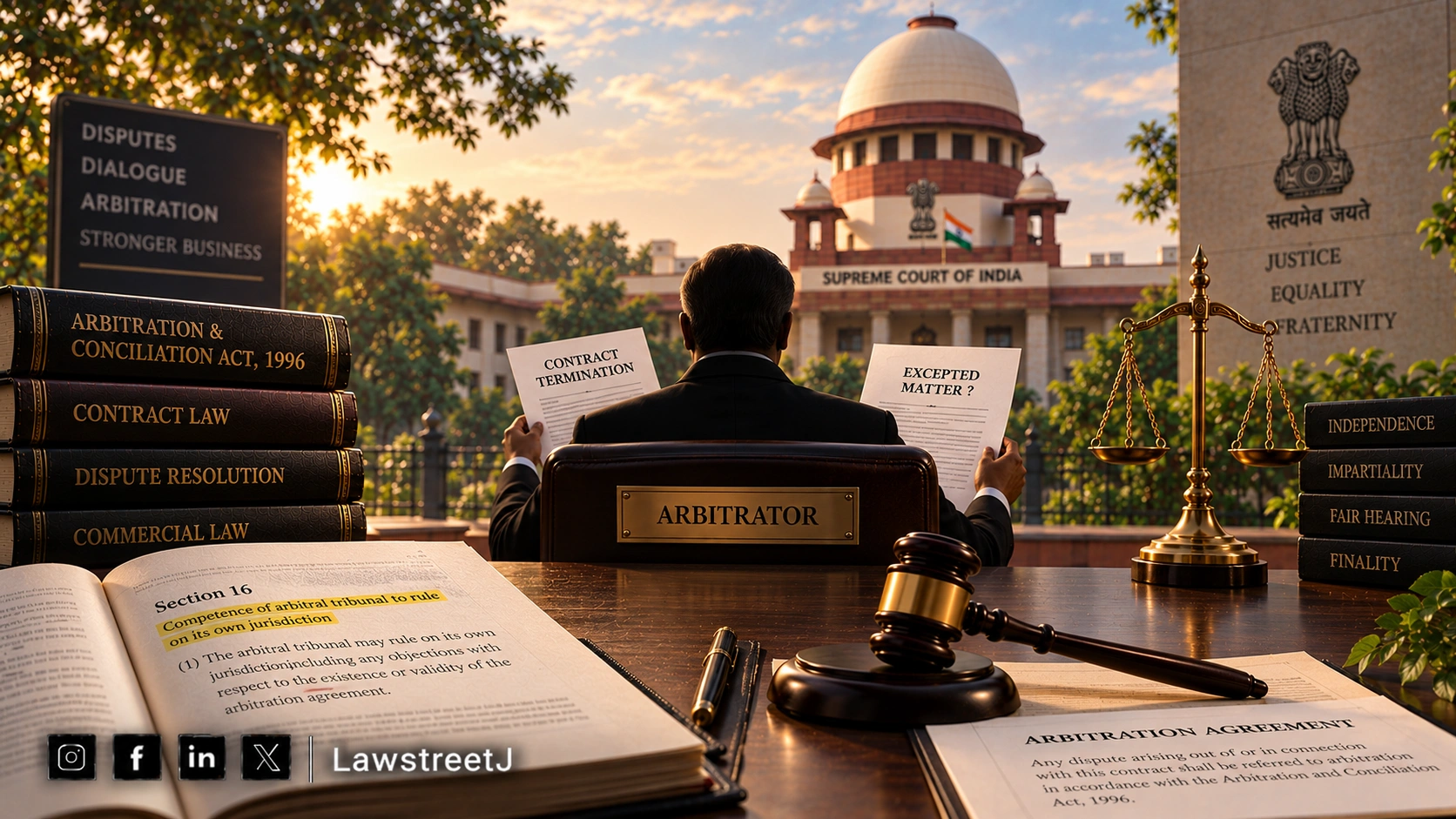
New Delhi: The Supreme Court has clarified that a direction issued by a writ appellate court to an Arbitral Tribunal to decide claims "strictly in accordance with the terms of the contract" cannot be construed to impinge upon the Tribunal's jurisdiction under Section 16 of the Arbitration and Conciliation Act, 1996 to rule on its own jurisdiction, including over disputes concerning termination of contract.
The appeal arose from a works contract dispute between M/s. GVV Constructions Private Limited and South Central Railway concerning the doubling of track between the Guntur-Guntakal section. The contract, was terminated by the Railway under Clause 62 of the Indian Railways Standard General Conditions of Contract, with forfeiture of the appellant's performance guarantee and security. The appellant's writ petition challenging the termination was dismissed by a Single Judge of the High Court for the State of Telangana at Hyderabad, who held that serious and complicated questions of fact were not amenable to adjudication under Article 226, but nonetheless recorded, in paragraph 35 of the order, a finding that there existed no irregularity in the termination, while also noting that the appellant had already invoked arbitration and could raise all its defences before the Arbitral Tribunal.
On appeal, the Division Bench, by its judgment dated 16.12.2025, set aside the finding in paragraph 35 for want of reasons, and granted the appellant liberty to raise all its claims before the Arbitral Tribunal, which was in turn granted liberty to decide the claims "strictly in accordance with the terms of the contract agreed upon between the parties." A former judge of the Supreme Court was subsequently appointed as Sole Arbitrator, and the Tribunal framed twelve issues, including the validity of the termination and whether certain claims fell under "excepted matters" or were otherwise non-arbitrable.
Appearing for the appellant, Mr. Gaurav Agarwal, learned Senior Counsel, submitted that the termination was illegal and that the respondents, having themselves taken the stand in their counter affidavit that the writ petition was not maintainable in view of the availability of arbitration, could not now contend that the issue of termination was beyond the Arbitral Tribunal's jurisdiction. It was submitted that the issue of termination was intrinsically linked to the other issues pending before the Tribunal and ought to be decided by it as well, relying on ABS Marine Services v. Andaman and Nicobar Administration, reported in 2026 SCC OnLine SC 460.
Mr. Vikramjit Banerjee, learned Additional Solicitor General appearing for the respondents, submitted that referring the validity of termination to arbitration would violate Clause 63 of the GCC, which excludes "excepted matters" from arbitration, though it leaves the appellant free to approach the civil court, the designated forum for such matters. It was contended that ABS Marine Services was distinguishable, as the clause considered therein differed from Clause 63 of the GCC, and that the Arbitral Tribunal had no jurisdiction over excepted matters, relying on General Manager, Northern Railway and Another v. Sarvesh Chopra, reported in (2002) 4 SCC 45, and Harsha Constructions v. Union of India and Others, reported in (2014) 9 SCC 246.
The Bench of Justice Pamidighantam Sri Narasimha and Justice Alok Aradhe framed the solitary issue as whether the Division Bench's observation travelled beyond the scope of judicial review under Article 226 and impinged upon the Arbitral Tribunal's jurisdiction under Section 16 of the Act. Examining Clause 63 of the GCC, the Court held that it excludes "excepted matters" from the purview of the Arbitration Clause but does not oust the jurisdiction of a court of law to examine the validity of a decision taken in respect of such matters.
Tracing the evolution of the permissible extent of judicial scrutiny at the referral stage under Section 11 of the Act from Konkan Railway Corpn. Ltd. v. Mehul Construction Co., reported in (2000) 7 SCC 201, through SBP & Co. v. Patel Engineering Ltd. and Another, reported in (2005) 8 SCC 618, National Insurance Co. Ltd. v. Boghara Polyfab (P) Ltd., reported in (2009) 1 SCC 267, the insertion of Section 11(6A) by the 2015 Amendment, Duro Felguera, S.A. v. Gangavaram Port Ltd., reported in (2017) 9 SCC 729, and Mayavati Trading (P) Ltd. v. Pradyuat Deb Burman, reported in (2019) 8 SCC 714, to the "eye of the needle" standard laid down in Vidya Drolia and Others v. Durga Trading Corporation, reported in (2021) 2 SCC 1 the Court reaffirmed that a referral court should decline reference only where it is manifestly and ex facie certain that the arbitration agreement is non-existent, invalid, or the dispute is non-arbitrable, and that the governing maxim otherwise is "when in doubt, do refer."
The Court noted that this standard had since been applied consistently, including in Uttarakhand Purv Sainik Kalyan Nigam Ltd. v. Northern Coal Field Ltd., reported in (2020) 2 SCC 455, and in the seven-judge bench decision in In Re: Interplay Between Arbitration Agreements and the Indian Stamp Act, 1899, reported in (2024) 6 SCC 1, and most recently reiterated in SBI General Insurance Company Ltd. v. Krish Spinning, reported in (2024) 12 SCC 1, and Office for Alternative Architecture v. Ircon Infrastructure and Services Ltd., reported in 2025 SCC OnLine SC 1098.
The Court held:
"...the question whether a particular claim is covered by, or falls outside, an 'excepted matters' clause of a works contract is a matter squarely within the competence of the Arbitral Tribunal under Section 16, and not a question for a court exercising even the wider, appointment-stage jurisdiction under Section 11, much less for a court exercising the discretionary jurisdiction of judicial review under Article 226 of the Constitution..."
Applying this reasoning by parity and a fortiori to the writ appellate jurisdiction, the Court held that the Division Bench, whose task was confined to testing the correctness of the Single Judge's disposal of the writ petition impugning the termination, had no jurisdiction to circumscribe the width of the Arbitrator's enquiry, including the Arbitrator's authority under Section 16 to rule upon the scope of his own jurisdiction. It observed that the issue of arbitrability of the termination was, in any event, not an issue before the Division Bench.
On the precedents cited, the Court held that ABS Marine Services was inapplicable since the clause considered therein ousted the jurisdiction of courts and barred arbitration altogether, unlike Clause 63 of the GCC, which merely places excepted matters beyond the scope of arbitration without ousting the court's jurisdiction. It further held that General Manager, Northern Railway was of no assistance to the respondents as it dealt with Section 20 of the Arbitration Act, 1940, a statutory regime from which the 1996 Act marks a decisive departure.
The Court accordingly clarified that the Division Bench's direction shall not be construed to impinge upon the Arbitral Tribunal's jurisdiction to adjudicate the dispute regarding termination of contract, while clarifying that it had not expressed any opinion on the merits. The appeal was disposed of with no order as to costs.
Case Title: M/s. GVV Constructions Private Limited vs. The Union of India & Ors. [Civil Appeal @ SLP (C) No. 7338 of 2026]