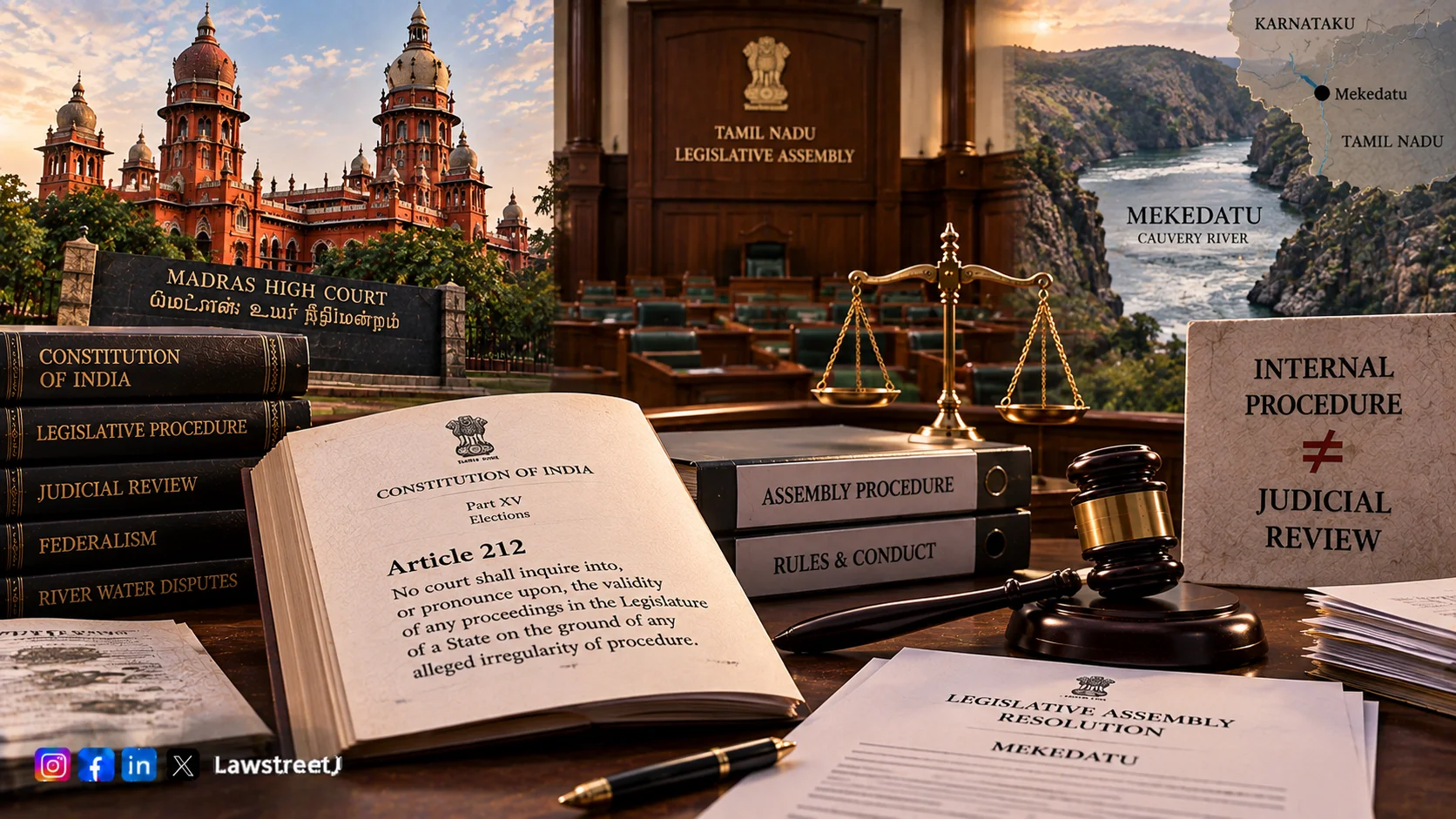
Madras: The Madras High Court has dismissed a writ petition filed by the AIADMK's Official Whip challenging the manner in which the Tamil Nadu Legislative Assembly's resolution on the Mekedatu Dam issue came to include a demand for a fresh tribunal, holding that the grievance was, in substance, a complaint about internal legislative procedure barred by Article 212 of the Constitution, and that it failed on merits as well.
A Division Bench of Chief Justice Sushrut Arvind Dharmadhikari and Justice G. Arul Murugan was hearing a writ petition filed by Agri S.S. Krishnamurthy, Official Whip of the AIADMK, seeking a writ of certiorarified mandamus calling for records relating to the Assembly Resolution communicated as passed on 19.6.2026 on the Mekedatu Dam issue, and to quash the portion urging the Union Government to constitute a fresh tribunal under Section 4 of the Inter-State River Water Disputes Act, 1956. The petitioner contended that this clause was never part of the Government Resolution circulated to members on 18.6.2026, but was raised during the debate by the Leader of the Opposition, accepted by the Chief Minister, and incorporated into the Resolution without being separately moved, seconded, debated or voted upon, contrary to Rule 104 of the Tamil Nadu Legislative Assembly Rules.
The Secretary of the Legislative Assembly, in response, raised a preliminary objection that the petition was barred by Article 212 of the Constitution, and set out the sequence of events: that the Leader of the Opposition's separate amendment notice under Rule 104 could not be taken up for want of time, that the Chief Minister, while replying to the debate, sought and was granted leave to add the tribunal clause, and that the amended Resolution was then put to a voice vote and declared carried unanimously without any member objecting, including when the very same grievance was raised on the floor of the House on 07.08.2026 and rejected by the Speaker.
Examining the law on legislative privilege, the Court relied on the Supreme Court's decisions in Pandit M.S.M. Sharma v. Dr. Shree Krishna Sinha and Ramadas Athawale v. Union of India, as well as the Bombay High Court's decision in Gopichand Kundalik Padalkar v. State of Maharashtra, to hold that Article 212 draws a settled distinction between complete want of jurisdiction and mere irregularity in the exercise of jurisdiction, and that courts will not examine complaints of the latter kind concerning a House's internal procedure. It distinguished the petitioner's reliance on Dr. Sunil Kumar Singh v. Bihar Legislative Council, noting that this decision concerned an administrative decision of expulsion affecting constitutional rights, and not, as here, a challenge to the internal proceedings and floor deliberations of the House itself.
The Court held that the petitioner's grievance, however framed, was a complaint about the sequence in which an amendment was incorporated into the Resolution, and did not go to the Assembly's power to pass such a resolution or to any want of jurisdiction, fraud, or bad faith. It rejected the petitioner's characterisation of the issue as one of “authenticity” rather than procedure, holding that the Speaker was empowered under Rule 286 of the Assembly Rules to decide questions of procedure, and that his acceptance of an oral amendment during the Chief Minister's reply, unopposed by the House, was not a matter open to judicial second-guessing.
On merits, the Court further held that members present in the House, who had every opportunity to object when the amended Resolution was read out and put to vote, could not later ask the Court to treat their own silence as a nullity, and that no case of the requisite gravity such as want of jurisdiction, substantive illegality, mala fides or breach of a constitutional limitation had been made out.
The writ petition was accordingly dismissed, with no order as to costs, and the connected interim applications closed.
Case Title: Agri S.S. Krishnamurthy vs. The Secretary, Tamil Nadu Legislative Assembly and Others, W.P. No. 29570 of 2026



![Madras High Court Directs Tamil Nadu Government to Ensure Quota for Transgenders in Local Body Elections [Read Order]](/secure/uploads/2023/08/lj_2507_7a03d113-08b1-4670-b6fb-9058aee481d0.jpg)
.jpeg)