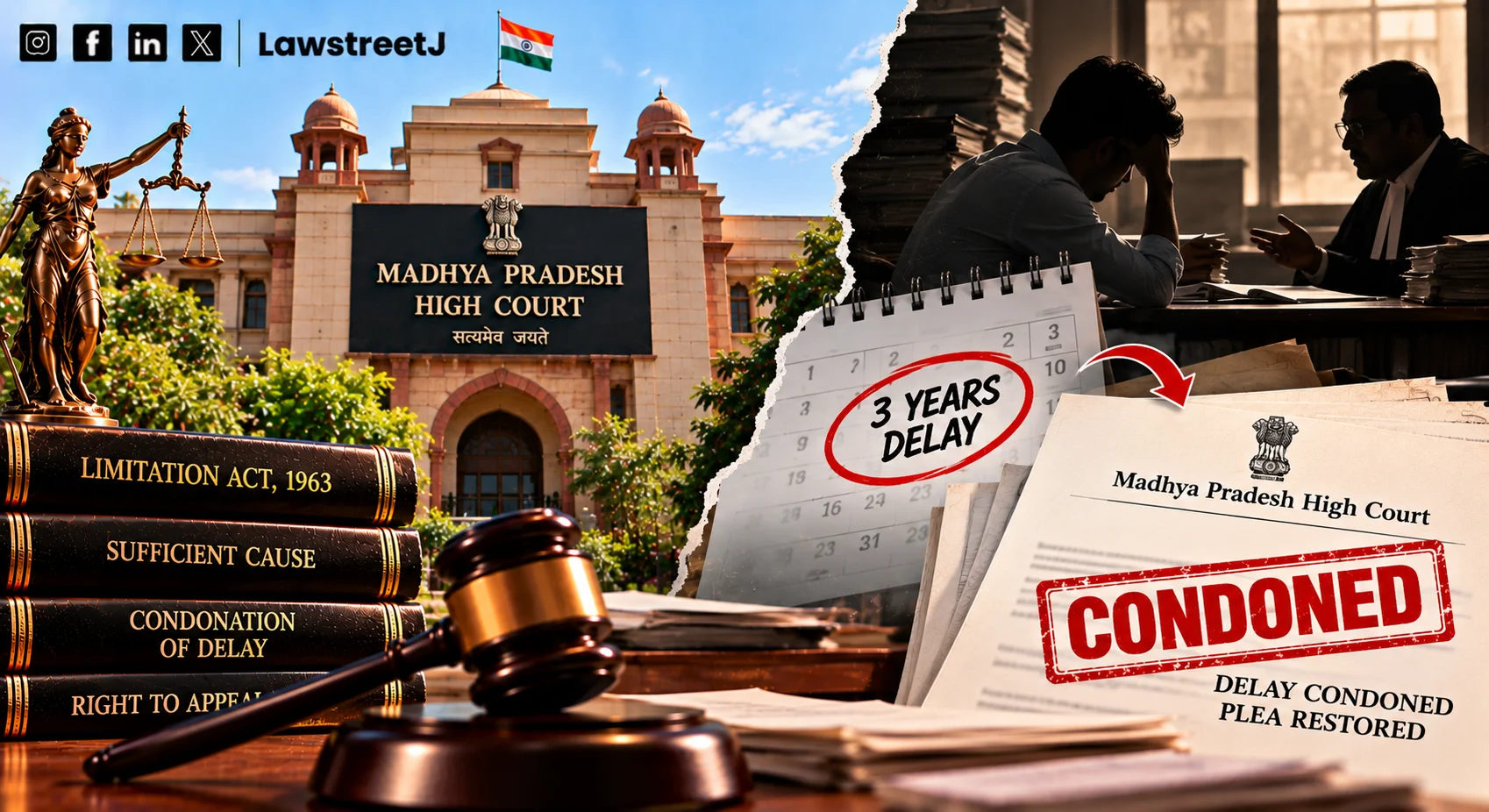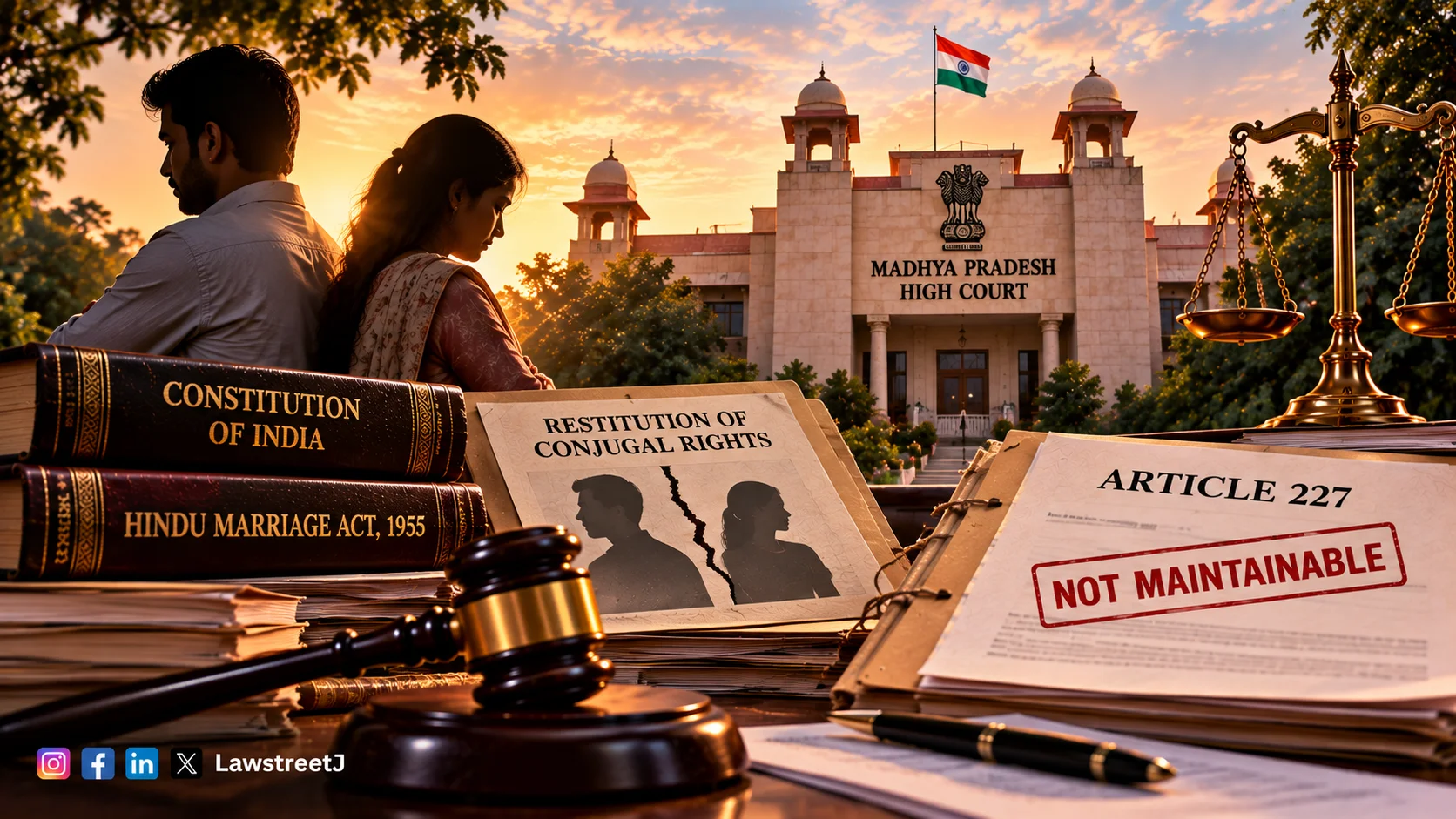
Gwalior: The High Court of Madhya Pradesh, Gwalior Bench, has held that the supervisory jurisdiction under Article 227 of the Constitution cannot be invoked to quash proceedings for restitution of conjugal rights under Section 9 of the Hindu Marriage Act, 1955 pending before a Family Court, and dismissed a husband's petition seeking quashment of his wife's application as not maintainable.
Justice Amit Seth was hearing a miscellaneous petition filed under Article 227 by the petitioner/husband seeking quashment of proceedings instituted by the respondent/wife under Section 9 of the Hindu Marriage Act, registered as Case No. 848A/2023 before the Family Court, Gwalior. The petitioner contended that the wife's proceedings amounted to a gross abuse of the process of law and were filed only to harass him, being a counter-blast to his own petition for divorce, the parties having allegedly remained separated since March 2007; he also pointed to an earlier application filed by him under Section 9 in 2018, which the wife had refused to accede to.
Learned counsel for the respondent/wife raised a preliminary objection to the maintainability of the petition, submitting that the supervisory power under Article 227 could not be invoked to supplant the original jurisdiction of a subordinate court or bypass statutory remedies. It was pointed out that an earlier Bench of the same Court had, by order dated 18.06.2025, allowed this very petition, but that order had since been recalled by a Coordinate Bench on 13.08.2025 in review proceedings, relying on the Supreme Court's decision in K. Valarmathi and Others v. Kumaresan, 2025 INSC 606, and that recall had attained finality between the parties.
The Court held that proceedings under Section 9 of the Hindu Marriage Act are civil proceedings, the Family Court being deemed a civil court under Section 10 of the Family Courts Act, 1984, and that decrees passed thereunder are appealable under Section 28 of the Act. Relying on the Supreme Court's decisions in Jacky v. Tiny alias Antony and Others, (2014) 6 SCC 508, and K. Valarmathi and Others v. Kumaresan, the Court held that the power under Articles 226 and 227 can be exercised to correct a jurisdictional error of a subordinate court but not to usurp its original jurisdiction and, in substance, reject or quash the underlying pleading.
“If a suit is not maintainable it was well within the jurisdiction of the High Court to decide the same in appropriate proceedings but in no case power under Articles 226 and 227 of the Constitution of India can be exercised to question a plaint.”
The Court further held that the petitioner's assertions that the wife's proceedings were a counter-blast intended to harass him were disputed questions of fact requiring evidence, which could not be adjudicated in supervisory jurisdiction, and that the judgments relied upon by the petitioner, including Surya Dev Rai v. Ram Chander Rai and Others, stood of no assistance, that decision having been partly overruled by Radhey Shyam and Another v. Chhabi Nath and Others, (2015) 5 SCC 423, which clarified that judicial orders of a civil court are not amenable to writ jurisdiction under Article 226.
Holding that the present petition was not maintainable, and that the earlier recall order passed inter se between the parties in the review proceedings was binding upon them, the Court dismissed the miscellaneous petition on the ground of maintainability, while reserving liberty to the petitioner to seek such remedy as may be permissible in law.
Appearances:
For the Petitioner/Husband: Mr. Shashank Sharma, Advocate, with Mr. Haush Sharma and Mr. Atif, Advocates.
For the Respondent/Wife: Mr. Madan Mohan Shrivastava, Advocate.
Case Title: D.Y. vs. G.Y., Miscellaneous Petition No. 2816 of 2024


![High Court Prohibits Compulsion of Hijab and Islamic Texts on Students of Different Faiths at Ganga Jamuna School [Watch Video]](/secure/uploads/2023/09/lj_5754_f71da9b5-c632-4d0b-94b8-6f36245eb157.jpg)
.jpeg)