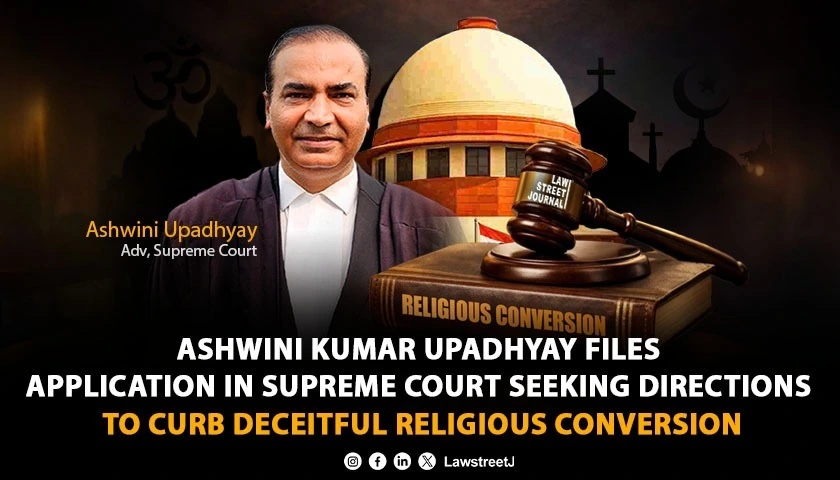
New Delhi: Advocate Ashwini Kumar Upadhyay has filed an application for direction before the Supreme Court of India in Writ Petition (Civil) No. 63 of 2022, seeking a slew of judicial directions and declarations to control what he terms “deceitful religious conversion,” a phenomenon he characterises as a grave threat to India’s sovereignty, secularism, democracy, and national integration.
The application has been drawn by the applicant himself and filed through Advocate Ashwani Kumar Dubey.
The applicant contends that approximately 1,000 girls are trapped through “love jihad” and converted into other religions every day, while around 1,500 families—particularly those from EWS, BPL, SC, ST, and OBC categories—are deceitfully converted on a daily basis. The applicant relies upon observations made by the Supreme Court on 14.11.2022, wherein the Court noted that the issue of alleged religious conversion, “if found to be correct and true, is a very serious issue which may ultimately affect the security of the nation and violate citizens’ right to freedom of conscience.”
The application makes extensive constitutional and jurisprudential arguments. The applicant submits that Article 25 of the Constitution, while guaranteeing freedom of conscience and the right to profess, practise, and propagate religion, does not confer an unqualified right to convert others through fraud, force, coercion, or inducement. The applicant draws a textual distinction between the “right freely to profess” and the “right to freely profess,” arguing that the former subjects the exercise of the right to reasonable restrictions, including public order, morality, and health.
The applicant relies on the Supreme Court’s five-judge Bench decision in Rev. Stainislaus v. State of M.P., (1977) 1 SCC 677, which held that the word “propagate” in Article 25 permits the transmission of one’s religion through exposition of its tenets but does not grant a fundamental right to convert another person, as such conversion would impinge on the freedom of conscience guaranteed to all citizens.
The application further characterises organised forced conversion as constituting “organised crime” under established criminal jurisprudence and argues that, when carried out through systematic, coercive, and violent means, such conversions satisfy all ingredients of a “terrorist act” as defined under Section 113 of the Bharatiya Nyaya Sanhita, 2023, as well as Section 15 of the Unlawful Activities (Prevention) Act. The applicant further submits that forced conversion campaigns employ violence, coercion, criminal force, intimidation, kidnapping, and abduction, and that the cumulative impact of such acts is the creation of an atmosphere of terror, insecurity, and communal polarisation amounting to an “internal disturbance” under Article 355 of the Constitution.
A significant portion of the application is devoted to the philosophical distinction between Dharma and religion, arguing that the Constitution of India is, in its foundational character, a “Dharmic document,” and that the English word “religion” cannot be treated as an accurate constitutional equivalent of the Sanskrit word “Dharma.” The applicant submits that where religious practice conflicts with Dharmic constitutional values of equality, dignity, liberty, and fraternity, those constitutional values must prevail.
The applicant also addresses the right to file public interest litigation in religious matters, contending that religious practices which threaten public order or the collective conscience are not private matters immune from PIL jurisdiction, and that citizens must be permitted to file PILs under Articles 32 and 226 when such practices violate the Directive Principles, Fundamental Duties, or Fundamental Rights guaranteed under Part III of the Constitution.
In terms of relief, the application prays that the Supreme Court:
- declare that deceitful religious conversion is a serious threat to sovereignty, secularism, democracy, liberty, fraternity, dignity, unity, and national integration;
- direct the Centre and States to take stringent steps to control religious conversion, which the applicant characterises as organised crime, an act of terrorism, indirect waging of war, and a serious threat to national security;
- direct the Centre and States to establish special courts to deal exclusively with religious conversion cases, and declare that sentences for deceitful religious conversion shall run consecutively and not concurrently; and
- pass such other orders as the Court may deem fit and proper in the circumstances.
The application is filed in the context of the pending Writ Petition (Civil) No. 63 of 2022, titled In Re: The Issue of Religious Conversion. The Enforcement Directorate has, according to the application, traced foreign funding allegedly violating the Foreign Contribution (Regulation) Act in several forced conversion cases, with money trails leading to accounts in the United Kingdom, United States, and the Middle East—indicating, the applicant argues, a well-organised syndicate operating with external financial support.