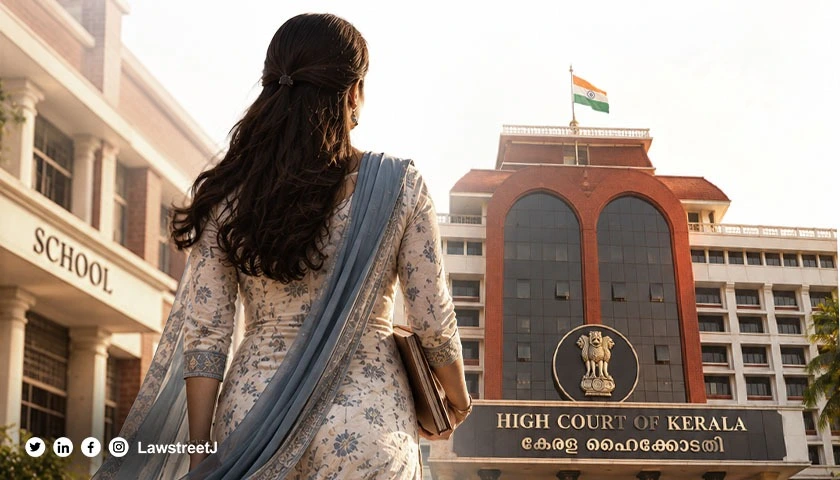
Ernakulam: The Kerala High Court has held that a citizen's attire is his or her own choice and that nobody can insist that it conform to society's customs, or dictate it, especially when no law backs it. The court was hearing a writ petition by a school Headmistress who alleged that the school Manager had threatened and tried to bar her from entering the school for wearing a churidar and not a saree.
A Single Judge Bench of Justice P.V. Kunhikrishnan delivered the judgment in WP(C) No. 6142 of 2026 on 05.10.2026.
According to the petitioner, on 03.02.2026 the Manager entered her office and threatened that she must not wear a churidar to school again. She alleged that he called a security guard in her presence and told him not to let her in if she wore one. On 04.02.2026, the guard stopped her at the gate and denied entry because she wore a churidar, and she was able to enter only after she complained to the Station House Officer. She relied on a circular of the Directorate of General Education dated 20.11.2015 (Ext.P1), which permits teachers to wear a churidar. An FIR was registered against the Manager on her complaint. She also alleged that the Manager has a history of harassing and threatening staff and relied on earlier judgments of the High Court.
She sought a writ directing the Government to disqualify the Manager, and a direction to the police to provide her protection for the rest of her service. By an interim order of 17.02.2026, the court directed the police to give her adequate and effective protection to enter the school and work as Headmistress without interference from the Manager.
The Government Pleader informed the court that the District Educational Officer visited the school on 04.02.2026 and 07.02.2026, conducted an enquiry and gave a prima facie report to the Deputy Director of Education to take disciplinary action against the Manager, and that the enquiry is continuing. The Manager filed a counter affidavit denying that he threatened her, imposed any dress code or stopped her entry, and alleging that the petition was fabricated to cover up her own dereliction of duty in disciplinary proceedings against her.
The judgment opens by saying that "What dress one wears is ordinarily a matter of personal choice of every citizen of this country," and that this is a part of the fundamental rights of every citizen. The court observed that the dispute is not a contest between a saree and a churidar, but a question of the dignity, autonomy and professional standing of an educated woman and the limits of managerial authority over her personal choice of dress.
The court said a saree may be a graceful and respectful attire for one individual, but its dignity cannot be converted into a compulsory uniform by force of individual preference. It added that a churidar, worn decently in a professional setting, does not diminish a Headmistress's competence, decorum or authority. It observed that clothes may express culture, comfort and choice but cannot ordinarily be a measure of a person's worth, and that "the Constitution does not make a woman's dignity contingent on her conformity with another person's preferred mode of attire." It held that no one can dictate a particular attire unless there is backing of law in connection with the dress code of an institution or establishment.
Since Ext.P1 allows teachers to wear a churidar, the Bench held that the Manager cannot interfere with the petitioner's choice of attire. On the disputed facts, it said that the alleged act of restraining the Headmistress from entering the school because she wore a churidar "cannot be accepted, if it happened," but it left the matter there as the enquiry is pending. It also made no observation on the Manager's allegations of dereliction of duty, leaving the authorities to act in accordance with law. The court also declined to consider the prayer to disqualify the Manager, as the educational authority has ordered an enquiry.
Disposing of the petition, the court declared that a citizen's attire is his or her choice, and that nobody can insist it conform to society's customs or be in a manner acceptable to society, especially when no law backs it. It added that if such a dictate is made, it is the duty of the law-enforcing authority to take appropriate steps in accordance with law forthwith.
The court further directed the Station House Officer to ensure that the petitioner enters the school freely, without obstruction by the Manager or others, for as long as she is in service. It clarified that the competent authorities are free to take appropriate steps in the pending enquiry against the Manager, after giving both sides sufficient opportunity of hearing.
Appearances:
For the Petitioner: Mr. Syam J. Sam and Mr. Daniel Mathews Koshy, Advocates.
For the Respondents: Mr. V.A. Muhammed and Mr. M. Sajjad, Advocates, and Smt. Shahina Hameed, Government Pleader.
Case Title: Sindhu S. Nair vs. Secretary, General Education Department & Ors., WP(C) No. 6142 of 2026 [2026:KER:76813]



![Kerala HC Quashes 498A Dowry Harassment Case Against Live-In Partner, Citing Lack of Relative Status [Read Order]](/secure/uploads/2023/08/lj_5693_1057c042-1e57-4e27-8c9e-25af0ec38ec4.jpg)
![Watching porn on mobile: Kerala HC highlights importance of mother cooked meals, outdoor sports [Read Order]](/secure/uploads/2023/09/lj_9155_Parental_supervision_of_mobile_phone_usage.jpg)
![Lakshadweep MP Mohammed Faizal Disqualified from Lok Sabha After Conviction Suspension Plea Rejected by Kerala High Court [Read Notice]](/secure/uploads/2023/10/lj_9640_87b5fd97-0e05-4ff8-9a99-3be1e4446192.jpg)