New Delhi: The Bar Council of India, by Circular No. BCID-4657/2026, has issued detailed guidelines governing the use of social media platforms by advocates enrolled with State Bar Councils, law students, and interns. The circular has been issued in exercise of powers conferred under the Advocates Act, 1961, and the Bar Council of India Rules, and is addressed to all State Bar Councils with a direction to disseminate it to all enrolled advocates and to law colleges within their respective jurisdictions.
The circular acknowledges that social media has become a significant medium through which the legal community engages with the public, discusses developments in law, and participates in broader civic discourse. At the same time, the Bar Council has expressed concern that the use of social media without adequate awareness of professional obligations has, in several instances, resulted in conduct that is incompatible with the dignity of the profession and the independence of the judiciary.
Background and Rationale
The Bar Council of India has noted that advocates occupy a unique position as officers of the court and as members of a regulated profession. The duties and responsibilities that flow from this position do not cease when an advocate steps outside the courtroom or logs on to a social media platform. The circular observes that several incidents have come to the notice of the Bar Council where advocates have made statements on social media that are scandalous, contemptuous, or prejudicial to pending proceedings, and that law students and interns have similarly made remarks that are inconsistent with the standards expected of persons aspiring to the legal profession.
The circular emphasises that the Bar Council of India Rules already impose obligations of conduct on advocates, and that the guidelines issued by the circular are intended to clarify how those existing obligations apply to social media, rather than to create fresh restrictions. The Bar Council has further stated that the guidelines are not intended to curtail legitimate academic commentary, criticism of law or policy, or participation in public discourse on matters of legal importance.
Key Prohibitions
- Contempt of court and scandalising the judiciary
The circular categorically prohibits advocates from making statements on social media that amount to contempt of court, whether civil or criminal. This includes sharing, publishing, or forwarding material that scandalises or tends to scandalise the authority or dignity of any court or judge, that prejudices or interferes with pending judicial proceedings, or that lowers the authority of the court in the estimation of the public. The circular notes that the fact that a statement is made on a personal social media account does not exempt it from the operation of the law of contempt or from the disciplinary jurisdiction of the Bar Council.
Advocates are specifically prohibited from making personal attacks on judges, including comments on their integrity, impartiality, or personal character, whether in relation to a specific case or otherwise. The circular draws a clear distinction between legitimate criticism of a judicial decision on legal or logical grounds, which is permissible, and contemptuous personal attacks on the judge who delivered it, which are not.
- Disclosure of confidential client information
The circular reiterates that advocates are bound by a duty of confidentiality towards their clients that is absolute in character and extends to all information received in the course of the professional relationship. Advocates are prohibited from disclosing, directly or indirectly, any information that is confidential to a client, including details of ongoing or concluded matters, communications exchanged with clients, or litigation strategy, through any social media platform. The prohibition applies regardless of whether the client has been identified by name, and extends to information that could identify the client even if the name is withheld.
- Misrepresentation of professional status
Advocates are prohibited from misrepresenting their professional qualifications, areas of practice, or experience on social media. The circular specifically prohibits the use of titles, designations, or descriptions that are misleading, including falsely claiming to be a Senior Advocate, describing oneself as a specialist in a field in which one has no genuine expertise, or implying an association with a law firm or institution that does not in fact exist.
- Advertising and solicitation
The circular reminds advocates that the Bar Council of India Rules continue to govern the extent to which advocates may advertise their professional services. While the Bar Council has in recent years relaxed certain restrictions on professional advertising, the circular makes clear that advocates must remain within the bounds of permissible advertising even on social media. Direct solicitation of clients, testimonials, and comparisons with other advocates remain impermissible.
- Political statements in professional capacity
Advocates are cautioned against making political statements in their capacity as advocates or on accounts or platforms presented as professional in nature. The circular clarifies that advocates, as citizens, retain their right to hold and express political opinions, but that they must be careful to ensure that political statements are not made in a manner that identifies or implicates them as advocates or that could embarrass the profession or the judiciary.
Obligations for Law Students and Interns
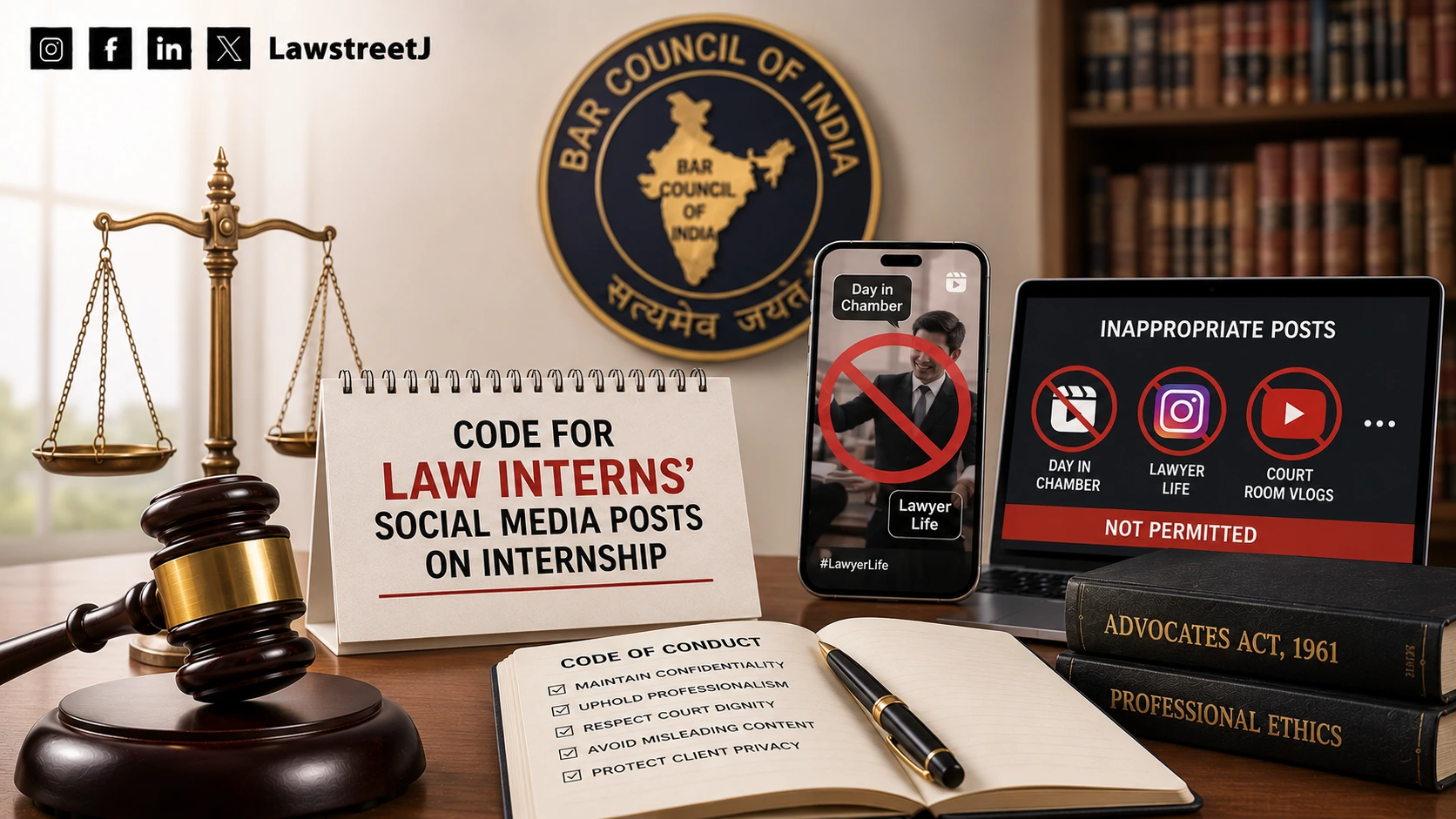
The circular extends its guidelines to law students enrolled in recognised law colleges and to interns working in law offices, chambers, or legal organisations. The Bar Council has noted that law students and interns are aspiring members of the profession and are expected to conduct themselves in a manner consistent with the standards of the profession even before they are formally enrolled.
Law students and interns are specifically prohibited from disclosing any information relating to matters on which they may have worked during the course of an internship, including the identity of clients, details of cases, or any confidential communications, whether or not they have signed a formal non-disclosure agreement. The circular notes that the duty of confidentiality in the professional context is not dependent on a contractual obligation and flows from the nature of the relationship itself.
Law students are also advised to refrain from making statements on social media that could be construed as legal advice, representing themselves as advocates or lawyers, or making contemptuous or scandalous remarks about the judiciary. The circular makes clear that disciplinary action under the Advocates Act may not directly extend to law students who are not yet enrolled, but that conduct on social media may be taken into account at the time of enrolment and may also attract consequences under applicable law including the law of contempt.
Permissible Conduct
The circular is careful to delineate what remains permissible. Advocates are free to use social media to share information about developments in law, to comment on legislation and legal policy, to participate in academic and professional discussions, and to engage in public education about legal rights and processes. Criticism of judgments on legal grounds, commentary on proposed legislation, and participation in debates about the administration of justice are all acknowledged as legitimate exercises that the profession has historically contributed to and should continue to contribute to.
The circular also recognises that advocates play an important role in the broader public discourse and that social media provides a valuable platform for this engagement. The Bar Council has explicitly stated that the guidelines are not intended to silence advocates or to prevent them from performing this function, but to ensure that when they do so, they do not cross the line into conduct that is unprofessional, contemptuous, or prejudicial to their clients or to the administration of justice.
Enforcement and Disciplinary Consequences
The circular states that violations of the guidelines will be treated as professional misconduct under the Advocates Act, 1961 and the Bar Council of India Rules. State Bar Councils are directed to take cognizance of complaints relating to social media conduct and to initiate disciplinary proceedings where warranted. The circular also directs State Bar Councils to constitute a committee or designate an existing committee to examine complaints relating to social media conduct and to report to the Bar Council of India.
The circular notes that the Bar Council of India may, on its own motion, take cognizance of social media conduct that comes to its notice and that is of a sufficiently serious character to warrant disciplinary action at the national level. Advocates found guilty of misconduct in relation to social media conduct may face penalties including reprimand, suspension, or removal from the rolls, depending on the gravity of the conduct.
Dissemination and Implementation
State Bar Councils have been directed to circulate the guidelines to all advocates enrolled with them within a period of thirty days from the date of the circular. Law colleges affiliated with Bar Council of India-recognised universities have been directed to bring the circular to the attention of all enrolled students and to include awareness of professional ethics on social media as part of the professional ethics curriculum. State Bar Councils have also been requested to hold awareness programmes and workshops on the subject.
The circular requests all State Bar Councils to acknowledge receipt and confirm the steps taken for dissemination within the stipulated period.
Circular Reference: Bar Council of India, Circular No. BCID-4657/2026 (Guidelines on Use of Social Media by Advocates, Law Students and Interns.)


![Supreme Court upholds order to bar Advocate from practice for running taxi service [Read Order]](/secure/uploads/2023/09/lj_8175_practicing_law_as_an_advocate_texi.jpg)