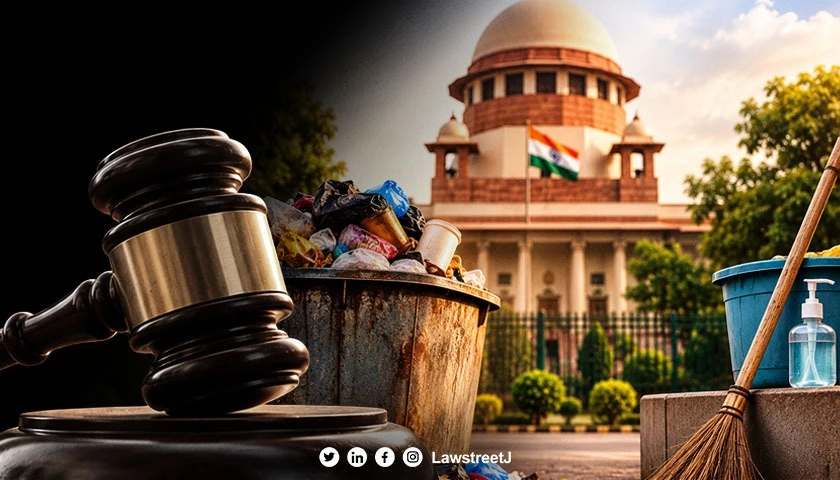
New Delhi: The Supreme Court has observed that “Bharat is now a rich country but has poor sanitation performance”, and has directed the Supreme Court Monitoring Committee (SCMC) to obtain geotagged and timestamped photographs from every District Collector of the status of waste facilities in local bodies as on 21 November 2026 and 1 January 2027, in its continuing monitoring of the Solid Waste Management Rules, 2026.
A Bench of Justice S.V.N. Bhatti and Justice N.V. Anjaria passed the order on 17 November 2026 in Civil Appeal No. 6174 of 2023 (Bhopal Municipal Corporation v. Dr. Subhash C. Pandey and others), and listed the matters as part heard on 12 January 2027.
The Court examined the SCMC’s 48-page Short-Term Report, with annexures running to 387 pages, and noted that the first two phases, namely kickstarting and putting in place the administrative mechanism for monitoring the SWM Rules, 2026, are in place. Officers of the Ministries of Environment, Panchayati Raj, Jal Shakti, Housing and Urban Affairs and Rural Development and of the Central Pollution Control Board, who sit on the SCMC, participated in the hearing, and the Court heard the Additional Solicitor General, Ms. Aishwarya Bhati, and Senior Counsel Mr. Gaurav Agarwal.
The Court recorded the achievements reported: that 755 of 784 District Collectors are on the CPCB Portal, that special cells exist in 59% of districts, that 4,958 of 5,049 urban local bodies and 699 of 701 district panchayats are onboarded, that special Gram Sabhas have been convened in 89,102 Gram Panchayats, and that 4,592 interception systems have been installed, with 21,324.69 metric tonnes of waste removed from banks and water bodies and 778 river stretches under restoration or substantially restored.
The Court noted, however, that the milestones are “still far from realisation”. About 400 districts have yet to set up special cells to assist the Collectors, only 9 of 28 States comply with the urban bylaw target, 16 States do not report on rural bylaws and 18 States do not report on four-way segregation of rural solid waste.
Recalling its 1980 decision in Municipal Council, Ratlam v. Vardhichand, which refused to accept financial inability as a ground for local bodies to avoid basic amenities, the Court said that a plea that failed in 1980 will not work now, given India’s economic growth. It said that the growth in other fields is negated by poor sanitation, which it described as a “manageable dereliction by all the stakeholders”, and that each organ of the State has been working on “its own wheel”.
The Court said that the SCMC is not a “fifth wheel” trying to drive the other four, that its efforts will eventually sunset into self-regulation by the contributors, and that, as noted earlier, “it is now or never”. It said that it has reposed trust in the SCMC and the District Collectors, who must reinvent strategies to suit local needs, and that failure in the ongoing efforts would make the situation worse and remediless.
The Court listed deficiencies for action, including that the report is silent on notices served to unorganised residential, commercial and business sectors and on temporary disconnection of water or electricity for non-compliance; that public-private participation and the statutory framework for CSR contributions are not spelt out; that the report says nothing on biogas and waste-to-energy plants; and that State Governments have not responded adequately on involving children as volunteers despite reminders.
It noted that the Railways have mapped only 630 of 8,809 stations to local bodies and segregated only 510 premises, and directed full compliance within eight weeks. It added that the report includes no reply from the Ministry of Defence, and that the Registrars General of the High Courts have sent neither a status report nor a reply, the Lucknow Bench of the Central Administrative Tribunal being the only exception. The Court said that the Judiciary should be first and foremost in implementing the Fundamental Duty under Article 51A(g).
The directions include that the Chief Secretaries instruct Collectors to upload geotagged and timestamped photographs of the facilities as on 21.11.2026 and 01.01.2027; that the SCMC collate this and place a district-wise status report on verifiable parameters; that Collectors report category-wise on private and bulk-waste-generator establishments, deficiencies and notices issued; that Collectors use drone surveys and video-call inspections; and that State Education Departments comply with earlier orders without delay. The Court also reproduced its 5 May 2026 direction that the Secretaries examine channelling CSR contributions into compressed biogas and waste-to-energy plants, and said it was to be implemented in letter and spirit.
Appearances: For the Appellant: Ms. Vanshaja Shukla, AOR, with Ms. Gunjan Chowksey, Ms. Ankeeta Appanna and Mr. Siddhant Yadav, Advocates. For the Respondents: Mr. Harshvardhan Pandey, Mr. Raghavendra Pratap Singh, AOR, Mr. Mahendra Pratap Singh, Ms. Akanksha Singh and others. For the Union of India: Ms. Aishwarya Bhati, Additional Solicitor General. Mr. Gaurav Agarwal, Senior Advocate, assisted the Court.
Case Title: Bhopal Municipal Corporation v. Dr. Subhash C. Pandey and Others, Civil Appeal No. 6174 of 2023, with Civil Appeal No. 7728 of 2023