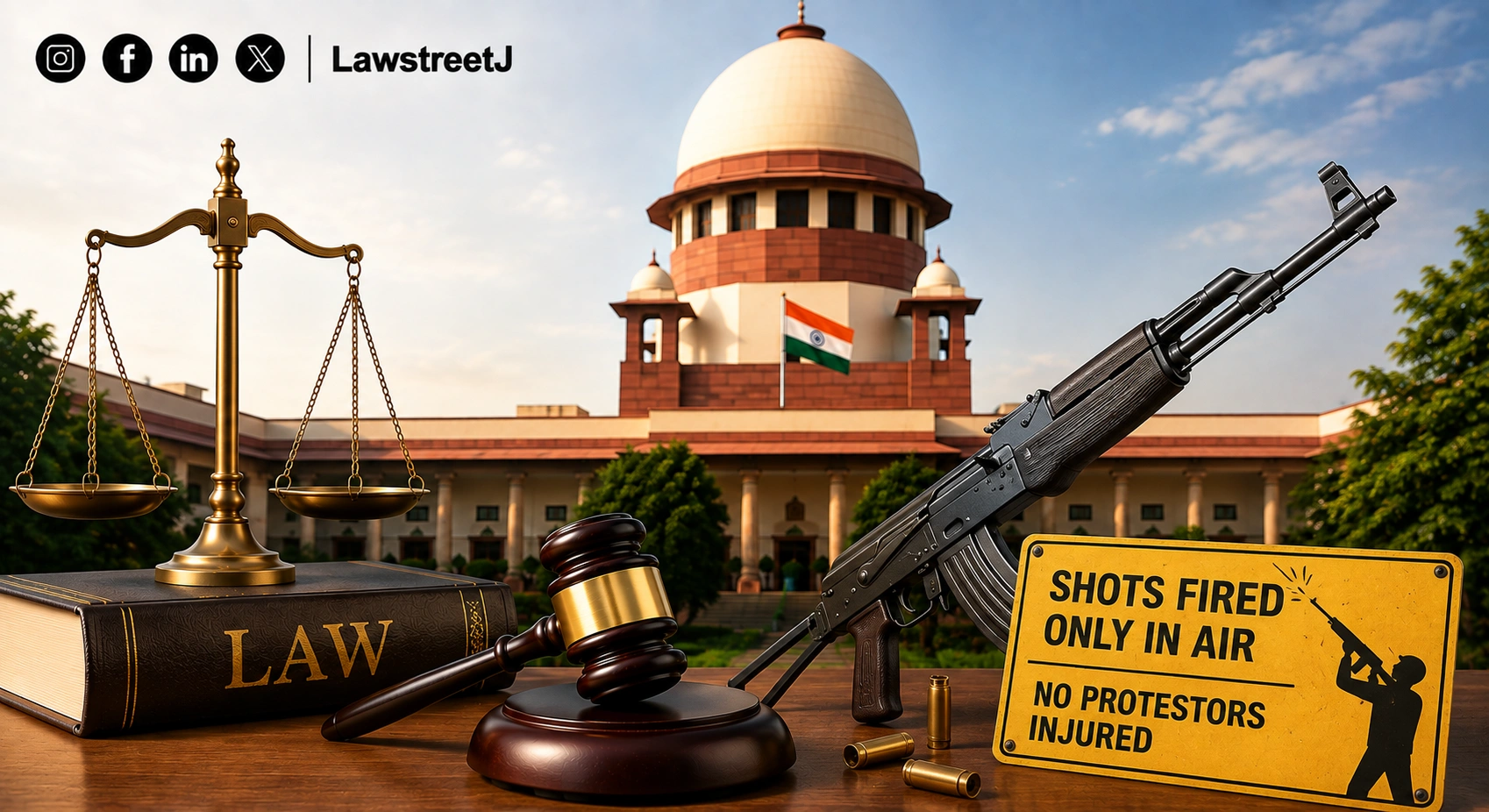
New Delhi: The Bihar government has submitted a comprehensive counter-affidavit before the Supreme Court of India, denying allegations of police brutality and the use of excessive or disproportionate force during student-led protests. The state's response specifically addresses a controversial incident in Siwan district, where video footage of a police officer discharging an automatic weapon went viral, prompting public concern and subsequent legal challenges.
In its submission, the state government clarified that during the statewide demonstrations on 25 July 2026 over NEET-UG examination irregularities, a police constable fired four rounds from his AK-47 rifle. The state contended that the constable, identified as Abhishek Kumar Patel, did not fire into the crowd but discharged the weapon strictly into the air. This aerial firing, the government asserted, was a last-resort action taken after the constable became isolated and trapped by a violent mob near JP Chowk.
Crucially, the counter-affidavit maintains that no individuals were injured or struck by the bullets fired from the AK-47 rifle. The state addressed reports of gunshot wounds by explaining that three protestors did indeed suffer minor firearm injuries during the clashes, but these occurred near Hathi Chowk. According to the submission, those injuries were caused when an Assistant Sub-Inspector fired two rounds from a 9-mm pistol in an attempt to disperse an attacking mob. The state emphasized that these three injured individuals were not present at the location where the AK-47 was used, nor were they affected by it.
To resolve any disputes regarding the nature of the weapons used, the state informed the bench that an ongoing ballistic and thorough examination is being conducted. This investigation aims to scientifically determine the exact types of weapons discharged during the protest, the distance of fire, and the precise angle of the shots.
The Bihar government also detailed the administrative actions taken immediately following the incident. The constable who discharged the AK-47 was suspended from his duties for undesired conduct, and formal departmental proceedings have been initiated against him. Local administrative heads, including the Siwan District Magistrate and Superintendent of Police, had previously noted that there were no official orders authorizing any form of firing, including aerial warning shots, during the demonstrations.
In its affidavit, the state explicitly conceded that the AK-47 is classified as a platoon-level weapon intended solely for special operations, counter-insurgency, and addressing serious crimes, rather than standard civilian crowd control. Acknowledging the procedural deviation, the state highlighted that the Director General of Police has since reissued weapon-use guidelines. These instructions formally restrict the deployment and carrying of sophisticated assault rifles, including the AK-47, INSAS, and SLR, during normal policing, protests, and general law-and-order duties.
Defending the broader policing measures, the state's submission highlighted that the protests grew increasingly violent across multiple districts, including Patna, Chapra, and Jehanabad. The state alleged that "anti-social elements" merged with peaceful student crowds to deliberately attack public property and security forces. According to the government's records, approximately 157 police personnel and seven public servants suffered injuries during the unrest, with some officials sustaining life-threatening head and eye wounds.
Finally, the state updated the Court on its compliance with recent judicial directives. The government reported that out of 500 total arrests made, 222 student protestors with no prior criminal antecedents have been released on bail. Additionally, all minor children under the age of 18 without criminal records, including 75 children under the purview of the Juvenile Justice Board, have been released. The state also confirmed that senior police leadership has been directed to preserve all CCTV and drone footage, and that the personal or digital data of the student protestors is strictly barred from public or social media disclosure.
Case title: Shailendra Mani Tripathi v. Union of India (with Public Interest Litigations including those filed by Manoj Kumar Jha).