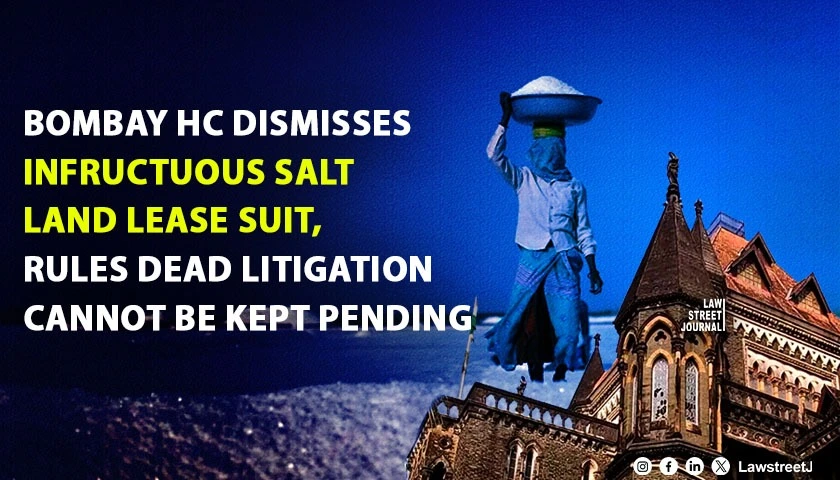
Mumbai: The Bombay High Court has allowed a Civil Revision Application filed by the Union of India and directed the dismissal of a long-pending civil suit that had been rendered infructuous following the natural expiry of the lease tenure in question.
Justice Sandeep V. Marne, in a judgment pronounced on March 17, 2026, set aside an order dated November 11, 2022, passed by the City Civil Court, Mumbai, which had refused to dismiss the suit despite the cause of action having come to an end.
The dispute traces its origin to two large tracts of land in Village Kanjur, then forming part of the Bombay Suburban District, known as Arthur Salt Works and Jenkins Salt Works. These lands, admeasuring approximately 251 acres and 21 gunthas and 249 acres and 10 gunthas respectively, were leased to the plaintiff for a period of 99 years commencing from October 15, 1917, for the purpose of salt manufacture. The Union of India, acting through the Deputy Salt Commissioner, terminated both leases by orders dated November 2, 2004.
Aggrieved by the termination orders, the plaintiff instituted Suit No. 1173 of 2005 in the Bombay High Court, seeking a declaration that the lease agreements remained valid, subsisting, and binding upon the defendants. The suit was subsequently transferred to the City Civil Court on account of a change in the High Court’s pecuniary jurisdiction and renumbered as Civil Suit No. 6256 of 2005. During the pendency of the suit, the 99-year tenure of the leases expired naturally on October 14, 2016.
Upon expiry of the lease tenure, the Union of India took out Notice of Motion No. 3788 of 2016 in the pending suit, seeking its dismissal on the ground that the cause of action had come to an end and requesting that the plaintiff be directed to hand over possession of the suit land. The plaintiff resisted the motion by filing an affidavit in reply. The City Civil Court dismissed the Notice of Motion by the impugned order dated November 11, 2022, prompting the Union of India to prefer the present Civil Revision Application before the High Court.
Before the High Court, Mr. Anil Singh, Additional Solicitor General appearing for the Union of India, contended that the entire cause of action for filing the suit had ceased to exist upon the expiry of the lease tenure on October 14, 2016. He submitted that there was no longer any necessity to adjudicate the validity of the 2004 termination orders, as the plaintiff’s right to occupy the leased lands had independently ended by efflux of time. He relied upon the Supreme Court’s judgment in Shipping Corporation of India Ltd. v. Machado Brothers and Others (2004) 11 SCC 168, which affirmed a court’s power under Section 151 of the Code of Civil Procedure, 1908, to dismiss infructuous suits. He also placed reliance on the Bombay High Court’s own decision in Vikas Kamalakar Walawalkar v. Deputy Salt Commissioner and Another, wherein a similar suit by a lessee of adjoining salt land was dismissed.
Mr. Aditya Bapat, appearing for the respondent-plaintiff, opposed the revision application and contended that the City Civil Court had rightly declined to dismiss the suit, as the Civil Procedure Code does not contemplate dismissal of a suit merely because its cause of action has come to an end during pendency. He argued that the Code provides for specific remedies such as rejection of plaints under Order VII Rule 11, and that Section 151 of the Code cannot be invoked when other remedies are available in law or when the same result can be achieved through express provisions. He relied upon the Supreme Court judgments in National Institute of Mental Health and Neuro Sciences v. C. Parameshwar (2005) 2 SCC 256 and My Palace Mutually Aided Co-operative Society v. B. Mahesh and Others (2022) 19 SCC 806. He further submitted that the cause of action in the suit had not entirely come to an end, as the plaintiff’s claim for renewal of the lease remained dependent on a determination of the validity of the 2004 termination orders, and that the plaintiff had already applied for amendment of the plaint to incorporate a prayer for renewal.
The High Court examined the scope and applicability of Section 151 of the Code in the context of a suit rendered infructuous by supervening events. Justice Marne noted that Order VII Rule 11 of the Code, which empowers a court to reject a plaint for non-disclosure of a cause of action, had no application in the present case since the plaint had disclosed a valid cause of action when it was originally filed. The suit had become infructuous only during its pendency, on account of the natural expiry of the lease tenure. The Court therefore held that the appropriate power to dismiss such infructuous litigation had to be traced to the inherent jurisdiction of the court under Section 151 of the Code.
Extensively relying upon Shipping Corporation of India Ltd. (supra), the Court reiterated the settled principle that when a subsequent event renders the original proceeding infructuous, it is the duty of the court, ex debito justitiae, to take whatever action is necessary in the interests of justice, including disposing of the infructuous litigation. The Court further held that the mere possibility of an interim order coming to an end upon dismissal of the suit cannot be a ground for keeping an otherwise dead suit pending on the court’s file. Interlocutory orders are made in aid of final orders and not vice versa, and no interim order survives after the original proceeding comes to an end.
Distinguishing the judgments relied upon by the respondent, the Court held that the ratio in National Institute of Mental Health and Neuro Sciences had no application to the present facts, as that case had dealt with the invocation of Section 151 read with Section 10 of the Code for staying a civil suit in circumstances where the expression Section 10 itself was inapplicable. Similarly, the decision in My Palace Mutually Aided Co-operative Society was distinguished on the ground that, in that case, the party invoking Section 151 had an available alternate remedy of filing an appeal under Section 96 of the Code. In the present case, no alternate remedy existed for the applicants to seek dismissal of a suit rendered infructuous by a supervening event, since Order VII Rule 11 was inapplicable to such situations.
On the respondent’s contention that the cause of action survived on account of plans to seek amendment of the plaint for incorporating a renewal prayer, the Court declined to accept the argument. It noted that despite being fully aware since 2016 of the application for dismissal of the suit, the plaintiff had not taken any steps to incorporate a prayer for renewal of the lease until June 30, 2025, nearly three years after the impugned order was passed. The Court held that the question of whether the pleaded cause of action has come to an end cannot be decided on the basis of a plaintiff’s future plans, and that a dead suit cannot be kept indefinitely pending to enable the plaintiff to espouse a fresh cause of action.
The Court also took note of the Division Bench judgment of the Bombay High Court in Maheshkumar Gordhandas Garodia v. The State of Maharashtra and Others (Writ Petition No. 5362 of 2024, decided on February 16, 2026), arising from related proceedings in which the same plaintiff had challenged orders directing transfer of portions of the leased land to MMRDA. The Division Bench, while dismissing those petitions, had specifically observed that the renewal clause under the lease did not survive the termination of the lease on November 2, 2004, and might not revive even upon a civil court finding that the termination was illegal. The High Court held that these observations further reinforced the conclusion that retaining the present suit solely on the basis of a proposed renewal prayer was not justified.
Accordingly, the Civil Revision Application was allowed. The impugned order dated November 11, 2022, of the City Civil Court was set aside, Notice of Motion No. 3788 of 2016 was made absolute, and Civil Suit No. 6256 of 2005 was directed to be dismissed. There was no order as to costs. A post-judgment prayer by the respondent’s counsel for a four-week stay of the judgment was opposed by the Additional Solicitor General and was rejected by the Court, having regard to the nature of the findings recorded.
Appearances:
For the Applicants: Mr. Anil Singh, Additional Solicitor General with Mr. Aditya Thakkar, Mr. D.P. Singh, Mr. Adarsh Vyas, Ms. Rama Gupta, Mr. Dhaval Shetia and Ms. Rupali Srivastav, Advocates.
For the Respondent: Mr. Aditya Bapat with Mr. S.A.K. Najam-es-sani i/b. Maneksha & Sethna.
Case Title: Union of India & Ors. v. Maheshkumar Gordhandas Garodia



![Husband Can Also Claim Alimony/Maintenance From Wife: Bombay High Court Orders Woman To Pay Alimony To Ex-Husband [Read Order]](/secure/uploads/2022/04/lj_2823_Divorce.jpg)