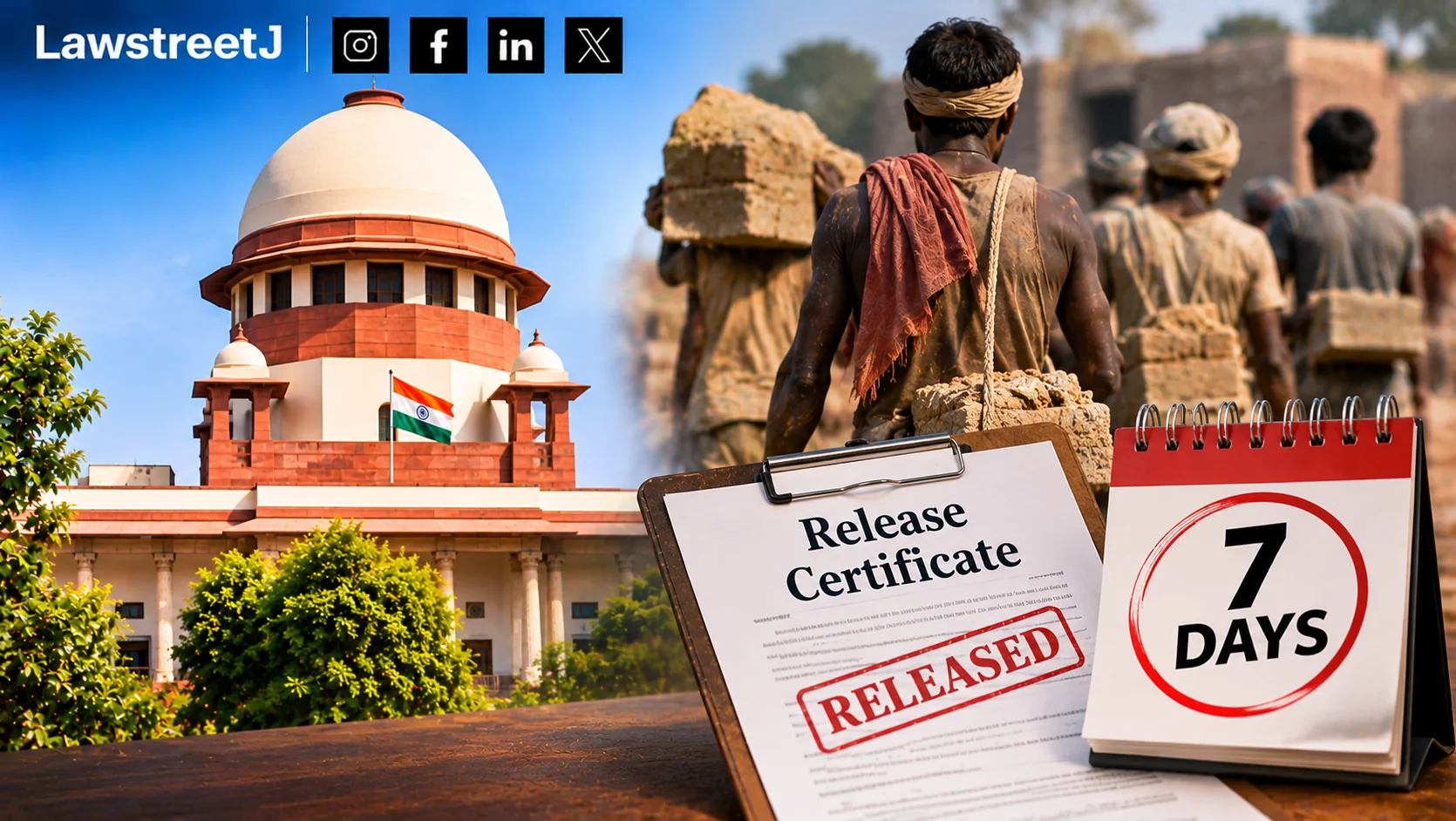
New Delhi: The Supreme Court has issued nationwide directions on the rescue and rehabilitation of bonded labourers, requiring that immediate financial assistance be paid ordinarily within seven days of a release certificate and that an individual rehabilitation plan be started within 90 days of rescue.
A Bench of Justice Vikram Nath and Justice Aparesh Kumar Singh passed the order on 2 November 2026 (2026 INSC 1185) and kept the petitions pending for monitoring, listing them again after seven months.
The Court was hearing Writ Petition (Civil) No. 511 of 2022 filed by Surendra Manjhi, himself a survivor of bonded labour, and Bachpan Bachao Andolan, along with Writ Petition (C) Diary No. 32325 of 2026 filed by the National Campaign Committee for the Eradication of Bonded Labour and others. Mr. Manjhi was rescued on 28.02.2019, with others, from a brick kiln in Shahjahanpur, Uttar Pradesh, after being taken there from Bihar on the pretext of repaying a bonded debt, and received immediate assistance only in 2022, nearly three years after the rescue.
The Court noted the allegation that, of 42 labourers who were issued release certificates, only 25 had received the ₹20,000 immediate assistance and 17 were still waiting. It also noted that Bihar had pointed out that release certificates issued by Uttar Pradesh were not in the prescribed format, which hampered the processing of assistance.
The Court held that the main concern is not the absence of a statutory framework but the difficulty in implementing it. It observed that identification, release and rehabilitation are interconnected stages of a continuing constitutional responsibility under Articles 21 and 23, relying on Bandhua Mukti Morcha v. Union of India and Neeraja Chaudhary v. State of Madhya Pradesh. It said that “rehabilitation delayed may, in substance, amount to rehabilitation denied”.
The Court directed the Union of India to ensure uniform implementation of its revised Standard Operating Procedure dated 14.05.2026, and all States and Union Territories to implement it within six months. The Union is to issue supplementary guidelines in consultation with the National Human Rights Commission within three months. Complaints are to be verified ordinarily within 24 hours, and release certificates ordinarily issued within 24 hours of identification, in a uniform format recognised by all States, with statements recorded with safeguards and information given in a language the labourers understand.
On financial assistance, the Court held that it should not be withheld merely because investigation or criminal proceedings are pending, where the scheme’s requirements are otherwise satisfied. It directed the Union to decide within three months on proposed revisions to the Rehabilitation Scheme, including higher immediate assistance, simpler procedures and interim subsistence assistance where benefits are delayed.
For inter-State cases, the rescuing State must ensure timely issuance and transmission of release certificates, and the receiving State must facilitate verification and rehabilitation. Every State and Union Territory must designate a nodal officer within six months, and no dispute between States is to delay payment to an eligible beneficiary.
On the 17 unpaid labourers, Uttar Pradesh and Bihar must jointly verify their status within one month, and pay any assistance found due, preferably within three months and in any event within six months.
The Court also directed that Vigilance Committees be constituted and functioning at the district and sub-divisional levels, and that district-level rehabilitation funds be available. The NAVJIVAN Portal is to be operated effectively, with State-level Monitoring Committees reviewing implementation monthly, cases pending over a year getting particular attention, and a district grievance officer resolving complaints ordinarily within 30 days.
It further directed child-sensitive rehabilitation including education, medical care and counselling, regular training of officers, prompt recovery of unpaid wages, and facilitation by District Magistrates of livelihood opportunities, with District Vigilance Committees to review rehabilitation for at least one year after release.
The Union of India must file a compliance affidavit within four months. States and Union Territories must comply within six months and file their affidavits within two weeks thereafter, and the Union must place a consolidated status report on record. Both petitions remain pending for monitoring.
Appearances: For the Union of India: Mr. R. Venkatramani, Attorney General for India. For the Petitioners: Mr. Abhishek Jebaraj and Ms. Sanjana Grace Thomas, Advocates.
Case Title: Surendra Manjhi and Another v. Union of India and Others, Writ Petition (Civil) No. 511 of 2022, with Writ Petition (C) Diary No. 32325 of 2026