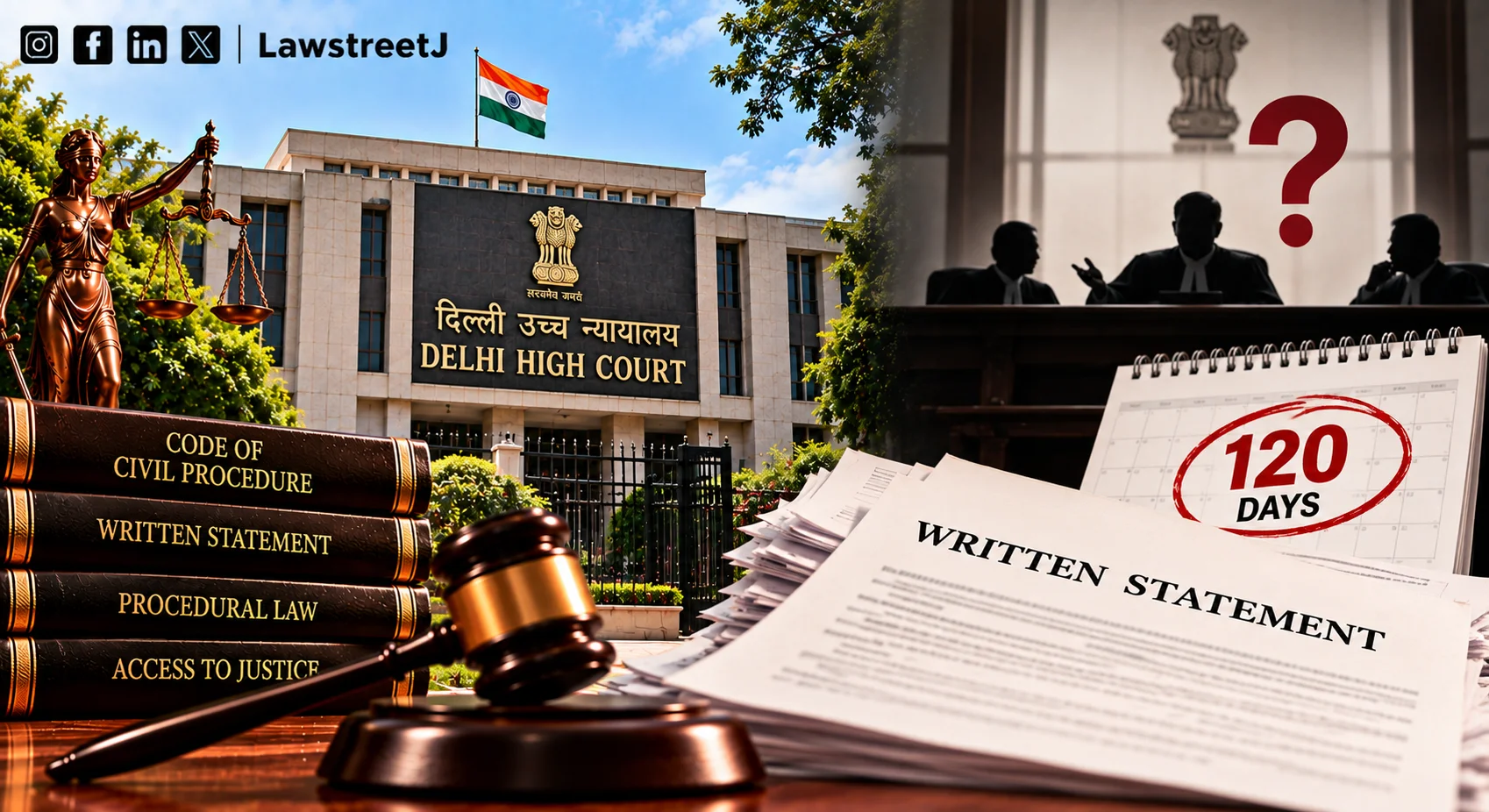
New Delhi: The Supreme Court has acquitted a former Talati-cum-Mantri and a Peon of a Gujarat Grampanchayat convicted under the Prevention of Corruption Act, 1988 for allegedly demanding and accepting a bribe of ₹120 for issuing an Income Certificate, holding that the prosecution had failed to prove the demand of bribe beyond reasonable doubt and that the statutory presumption under Section 20 of the Act could not be invoked in the absence of such proof.
The appeals arose out of a common judgment of a Single Judge of the Gujarat High Court dated 22.01.2015, which had upheld the conviction of the appellants, Rafikmiya Ahmedmiya Malek and Sirajbhai Rasulbhai Vora, under Sections 7, 12 and 13(1)(d) of the Act, sentencing them to rigorous imprisonment for one year with fine of ₹2,000. An appeal by the State of Gujarat seeking enhancement of sentence had been dismissed by the High Court.
As per the prosecution's case, the complainant, who was seeking an Income Certificate for educational concessions, had approached the Talati-cum-Mantri of Village Bechri on 07.02.1996, who allegedly demanded ₹120, of which ₹100 was to be retained by him and ₹20 paid to the Peon. On the complainant reporting the matter to the Anti-Corruption Bureau, a trap was laid on 19.02.1996, during which the complainant handed a currency note of ₹20 to the Peon after collecting the certificate. The trial court had convicted both accused under Section 7 read with Section 13(1)(d) of the Act, while acquitting them of criminal conspiracy under Section 120B of the Indian Penal Code, 1860, a finding not disturbed by the High Court.
Appearing for the appellants, Mr. Divyesh Pratap Singh submitted that the sanction for prosecuting the Talati-cum-Mantri was invalid, having been granted by the Deputy District Development Officer rather than the District Development Officer, who alone was competent to remove him from office. He further contended that no amount was ever recovered from or offered to the Talati-cum-Mantri, that the alleged demand made by the Peon had been found doubtful by both courts below, and that in the absence of proof of demand, the presumption under Section 20 of the Act could not arise, relying on N. Vijayakumar vs. State of Tamil Nadu and State of Lokayuktha Police, Davanagere vs. C.B. Nagaraj.
Opposing the appeals, Mr. Prashant Bhagwati, appearing for the State of Gujarat, submitted that the concurrent findings of both courts on demand and acceptance of bribe, coupled with the successful trap, warranted no interference.
The Bench of Justice Ujjal Bhuyan and Justice Atul S. Chandurkar, examining the complainant's deposition, found that his version of the amount demanded was at variance with his own deposition in an earlier criminal case filed by him against the accused for threats, where he had stated that an initial demand of ₹200 was later settled at ₹120 a version conspicuously absent from his testimony in the present case. The Court also noted that although the complainant had been instructed by the Anti-Corruption Bureau to hand over the entire demanded amount upon demand, he gave only ₹20 to the Peon, who did not question why the balance was not paid despite standing barely a couple of feet from the Talati-cum-Mantri when the demand was allegedly made.
The Court observed "...the prosecution evidence is insufficient to hold that demand of ₹120/- by A1 was proved beyond reasonable doubt."
The Bench further held that the amount of ₹20 was handed over only after the Income Certificate had already been prepared and delivered to the complainant, a circumstance that, following State of Lokayuktha Police, Davanagere vs. C.B. Nagaraj, could not by itself be assumed to be pursuant to a demand. It held that the presumption under Section 20 of the Act of 1988 could arise only once the initial demand stood proved beyond reasonable doubt, and that mere recovery of the currency note from the Peon could not resurrect the prosecution's case where the demand itself was doubtful, applying the three-judge bench decision in N. Vijayakumar vs. State of Tamil Nadu.
On the question of sanction, the Court held that since the Talati-cum-Mantri was holding a substantive post at the time sanction was sought, only the District Development Officer, and not the Deputy District Development Officer, was competent under the Gujarat Panchayats Act, 1961 to grant sanction for his prosecution under Section 19(1)(c) of the Act of 1988, rendering the sanction order invalid. The Court, however, clarified that it was not setting aside the conviction on this ground alone, having independently found the evidence insufficient to establish the charge beyond reasonable doubt.
Accepting that the accused Peon's defence that the amount was given to him on account of the Eid festival falling the next day was also probable, and noting that no conspiracy between the two accused had been established, the Court set aside the concurrent findings of the courts below and acquitted both appellants, directing that their bail bonds stand cancelled.
Case Title: Rafikmiya Ahmedmiya Malek vs. State of Gujarat, with Sirajbhai Rasulbhai Vora vs. State of Gujarat [Criminal Appeal Nos. 1177 and 1183 of 2015]