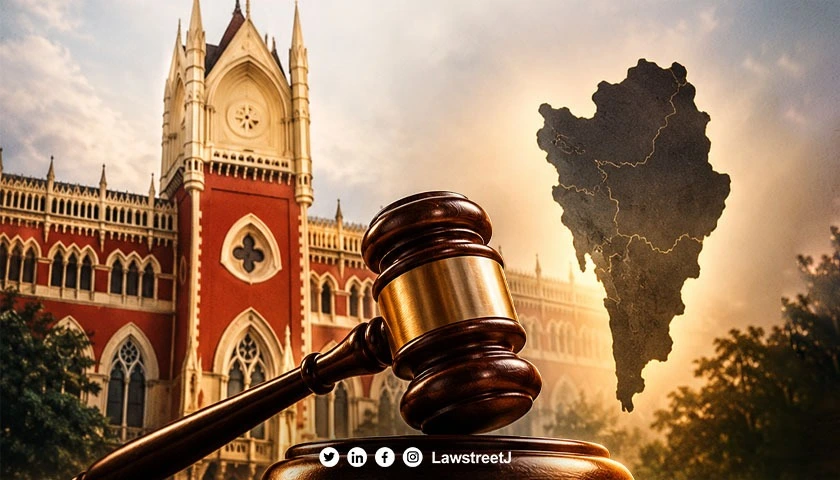
Kolkata: The Calcutta High Court has upheld a Single Judge’s order directing the State of Mizoram to execute a sale deed of the old Mizoram House land at Ballygunge, Kolkata, in favour of the highest bidder in an e-auction, holding that the new Government’s cancellation of the tender after a change of regime was “unfair, unjust, arbitrary” and violative of Article 14, and a “clear case of regime revenge”.
A Division Bench of Justice Arijit Banerjee and Justice Apurba Sinha Ray dismissed the State’s appeal (FMA 772 of 2024) on 13 November 2026, with no order as to costs, and extended the time for compliance by eight weeks.
The respondent, Excel Vincom Private Limited, had been directed by the Single Judge’s judgment of 2 April 2024 in WPA No. 1344 of 2024 to be given a sale deed of the land at 24, Ashutosh Chowdhury Avenue, Ballygunge, within six weeks. The land was bought by the Government of Mizoram in 1973, and a guest house, the only Mizoram House in Kolkata until 1998, stood on it until it was demolished in 2020. In May 2023, the General Administration Department floated an e-tender-cum-e-auction for selling it, in which the respondent emerged as the highest bidder, and an unregistered agreement for sale was executed on 6 October 2023.
The State said that, after the election was announced and the new Government took charge on 8 December 2023, there was public resentment in Mizoram, and Kolkata-based Mizo organisations submitted representations on 22 and 27 December 2023 saying that the land has historical and heritage significance. The new Government cancelled the e-tender on 4 January 2024 under Clause 3.1.11 of the bid document and refunded the money paid, saying that there were anomalies in the decision-making, such as non-compliance with Rule 309 of the GFR, 2017 and the lack of in-principle approval of the Council of Ministers.
The State argued that Clause 3.1.11 allowed it to cancel the tender at any stage before the sale deed, that ownership passes only on execution of the sale deed under Clause 6.2, that no right had been created by an unregistered agreement for sale, that the writ petitioner had an alternative remedy of arbitration and was really seeking specific performance, and that promissory estoppel did not apply. The respondent’s Senior Counsel, Mr. S.N. Mookherjee, said that the full consideration had been paid and received without reservation, that only the conveyance remained, and that the cancellation was prompted by the change of Government.
The Division Bench examined the correspondence and noted that the respondent had paid the entire consideration and the applicable penalty, which the State received without any reservation, and that the agreement for sale was executed after detailed deliberation on its clauses. It noted that, with the election imminent, the Government had told the respondent that execution of the conveyance would be deferred until after the election, and that the new Government cancelled the process without any dialogue with the respondent.
The Court held that the power under Clause 3.1.11 to cancel the tender could not be exercised arbitrarily, and that, where a vested right had been created in favour of the highest bidder, the State, which must act fairly even in commercial dealings, could not cancel it without demonstrating a real public interest. It found that the representations of Mizo organisations did not disclose any public interest, much less overwhelming public interest, that the land was not in use, and that the State had not even argued that cancellation was necessary in the interest of public revenue.
On the State’s objections, the Court held that the writ petition was maintainable despite the arbitration clause, as the State’s action was arbitrary and violated Article 14, and that the petitioners were not challenging the tender process but wanted it carried to its conclusion, so the cases on participants in tenders did not apply. It said that the cases on promissory estoppel and public equity relied on by the State had no application, and that the Rule 309 GFR objection had not been established.
The Court concluded that the Mizo Government had taken a conscious decision to dispose of the property, that the writ petitioners participated and performed their part, and that the new Government’s unilateral cancellation was flagrantly violative of Article 14, with no demonstrated public interest. Describing it as “a clear case of regime revenge”, the Court saw no reason to interfere with the Single Judge’s order, dismissed the appeal and gave the State eight weeks from the date of the judgment to carry out the directions.
Appearances: For the Appellants (State of Mizoram and Others): Mr. Biswajit Deb, Advocate General, Mizoram, with Mr. Sayan Dev Kumar, Ms. Priyakshi Banerjee, Mr. Sourav Ghosh and Ms. Priyanka Ghosh, Advocates. For the Respondents: Mr. S.N. Mookherjee, Senior Advocate, with Mr. Rajarshi Dutta, Mr. Shaunak Mukhopadhyay, Mr. Shubrajyoti Mukherjee, Mr. Neelesh Choudhury and Ms. Anuradha Poddar, Advocates.
Case Title: State of Mizoram and Others v. Excel Vincom Private Limited and Another, FMA 772 of 2024