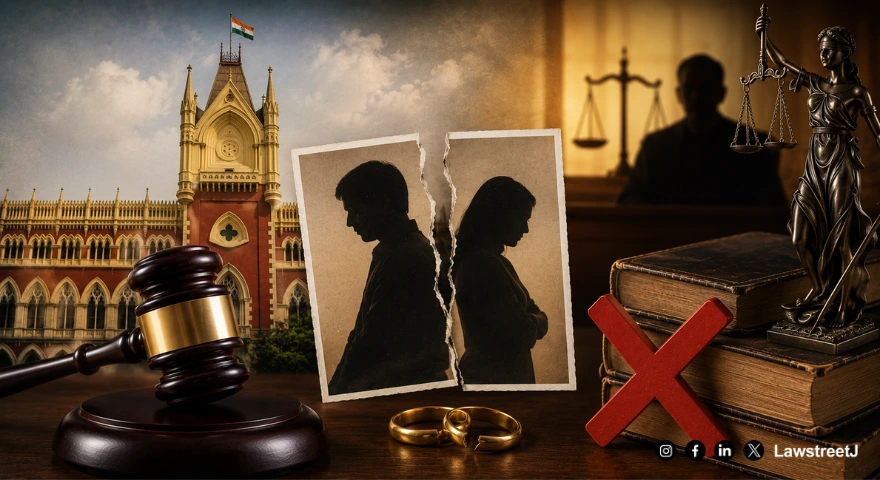
Kolkata: The Calcutta High Court has set aside a trial court order that dismissed a joint petition for divorce by mutual consent and simultaneously directed registration of a criminal case under the Protection of Children from Sexual Offences Act, 2012, holding that the direction was passed wholly outside the scope of proceedings under Section 13B of the Hindu Marriage Act, 1955.
A Division Bench of Justice Sabyasachi Bhattacharyya and Justice Supratim Bhattacharya was hearing an appeal against the order of the Additional District Judge, First Court at Contai, District Purba Medinipur, which had dismissed a Section 13B petition filed by Goyram Barman and Madhumita Barman on the ground that their marriage had been solemnized in violation of the Prohibition of Child Marriage Act, 2006.
The Trial Judge had gone further, directing that a copy of the order be sent to the Officer-in-Charge of Bhagwanpur Police Station to be treated as information under Section 19 of the POCSO Act, with instructions to register a case and take appropriate action.
Counsel for the appellant argued that it was "entirely beyond the jurisdiction of the Trial Court to pass such directions while sitting over an application for mutual consent divorce under Section 13B of the Hindu Marriage Act," and that no offence under the POCSO Act had in fact been made out. Counsel for the respondent adopted these arguments and agreed that the impugned judgment be set aside for fresh adjudication on merits.
Examining the scope of Section 13B proceedings, the Court observed, "Within such limited conspectus, the learned Trial Judge acted de hors jurisdiction in passing the directions regarding registration of a criminal case under the POCSO Act against the appellant/husband."
The Bench held that the Hindu Marriage Act, 1955 contains no provision permitting a court to declare an under-age marriage void or voidable, and that such adjudication fell outside the four corners of the statute under which the petition was filed.
On the merits of the child marriage question, the Court noted that under Section 3 of the Prohibition of Child Marriage Act, 2006, a child marriage is only voidable at the option of the party who was a minor, and that no such declaration had been sought by either party. The Court stated that since both parties had instead sought a divorce, they had "implicitly admitted that there was a valid marriage," and the marriage could not even be treated as voidable.
The Court also found that the Section 13B petition itself contained no allegation resembling an offence under the POCSO Act, and that the Trial Judge had therefore erred in treating himself as "any person" obligated to report an offence under Section 19(1) of the POCSO Act.
Significantly, the Bench recorded the joint submission of counsel for both parties that the Trial Judge himself functioned as the POCSO Court for the district. The Court held that this meant the Trial Judge's own direction would have made him the complainant in a case that would eventually come before him for adjudication, which it found violated the principle that no person can be a judge in their own cause. The Court remarked that in such a situation, "the judge himself would be acting as judge, jury, executioner, all rolled into one."
Allowing the appeal on consent, the Court set aside the impugned order and judgment dated December 23, 2025 passed in Matrimonial Suit No. 117 of 2025, and remanded the Section 13B application for fresh adjudication on merits, directing the Trial Judge to adhere to the statutory timelines under Section 13B.
The Court further directed that any action already taken pursuant to the impugned judgment, including registration of a case or complaint, stood revoked and was to be reversed by the concerned authorities on the basis of the server copy of the judgment, without insisting on production of a certified copy. No order as to costs was passed.
Mr. Sounak Bhattacharya, Mr. Sounak Mondal, Mr. Abhirup Halder and Ms. Bipasha Bhattacharyya appeared for the appellant, while Mr. Rudranil Das and Mr. Souvik Das appeared for the respondent.
Case Title: Goyram Barman vs. Madhumita Barman


![Calcutta High Court conducts late-evening hearing, orders release of lawyer arrested inside court [Read Order]](/secure/uploads/2023/12/lj_4146_Court_lawyers_arrest.jpg)
![Indian Courts this Week: Law Street Journal's Weekly Round-Up of SC & HCs [Jan 1 - Jan 6]](/secure/uploads/2024/01/lj_9050_WhatsApp_Image_2024-01-06_at_12.07.10_PM.jpeg)
.jpeg)