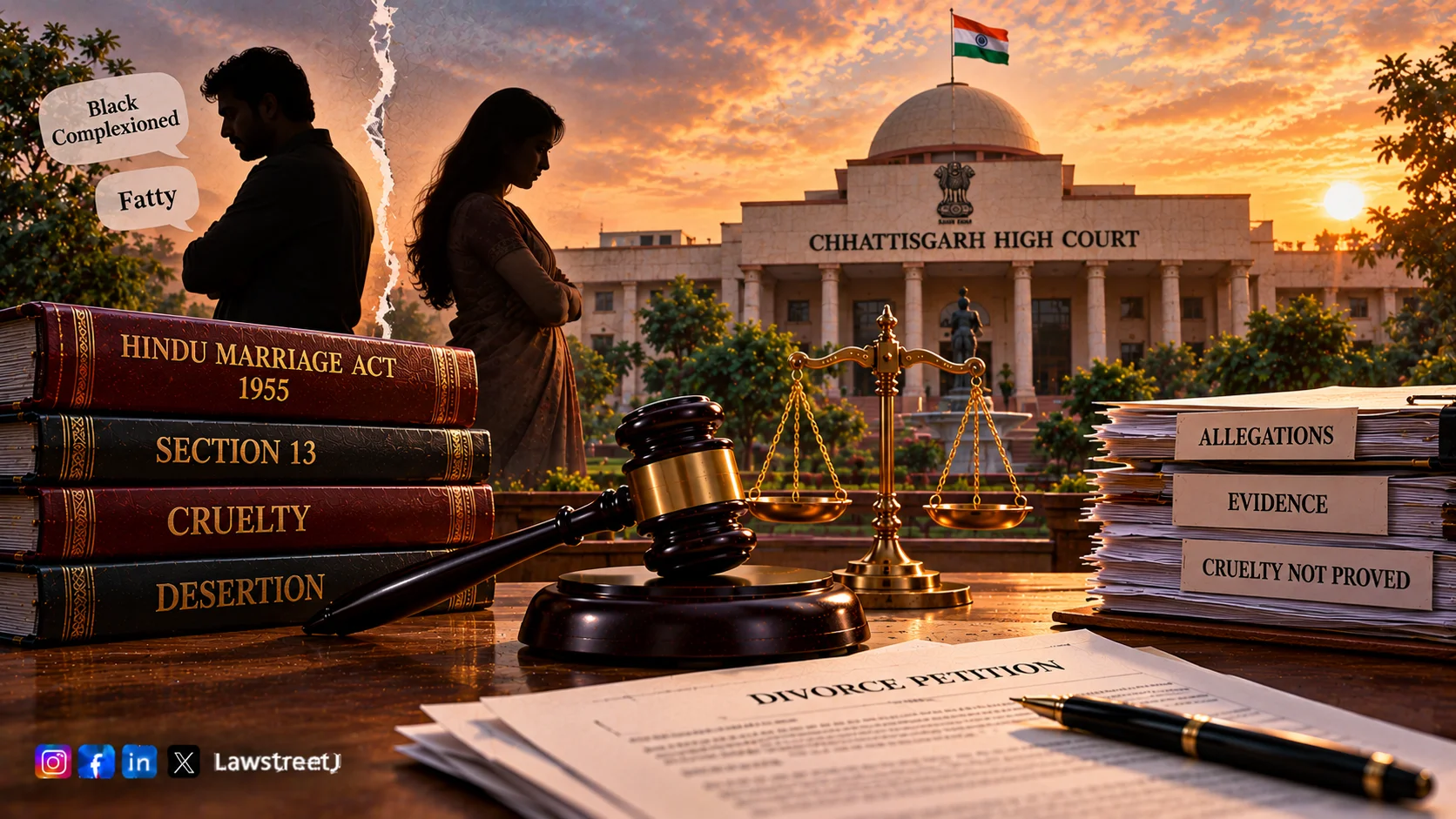
Bilaspur: The High Court of Chhattisgarh has dismissed a husband's appeal against the rejection of his divorce petition, holding that mere allegations of cruelty and desertion, unsupported by cogent evidence, cannot form the basis for a decree of divorce under the Hindu Marriage Act, 1955.
Justice Sachin Singh Rajput, delivering the judgment for the Division Bench also comprising Justice Parth Prateem Sahu, was hearing an appeal filed under Section 19(1) of the Family Courts Act, 1984 by the appellant/husband, Akash Ghosh, against the judgment and decree dated 28.08.2024 of the Family Court, Janjgir, which had dismissed his application under Section 13 of the Hindu Marriage Act, 1955 seeking divorce, and had allowed the application filed by the respondent/wife, Smt. Pooja Seet, under Section 27 of the Act directing return of the stridhan given by her parents.
The marriage between the parties was solemnized in March 2019. According to the appellant/husband, the respondent/wife treated him with hostility, threatened to implicate him in false cases, visited Rajasthan without his consent, and, after suffering a miscarriage, was taken away by her mother to Raigarh and thereafter refused to return despite his repeated efforts, including a visit to a counselling centre and a subsequent attempt accompanied by members of his community. He also cited the wife's pending Domestic Violence Act proceedings against him as indicative of her hostile conduct. The respondent/wife, in her written statement, denied these allegations and instead alleged that the appellant/husband had an illicit relationship with another woman, had taken to alcohol, and had neglected to provide her proper care and medical treatment during her pregnancy.
The Family Court had framed issues on cruelty and desertion, found both not proved, and dismissed the husband's divorce petition. Before the High Court, learned counsel for the appellant/husband submitted that the Family Court had failed to appreciate the evidence in its proper perspective, and that the wife had been living separately since December 2019 without sufficient reason despite his willingness to resume cohabitation. Learned counsel for the respondent/wife supported the impugned judgment as based on a just and proper appreciation of the evidence.
On an appraisal of the record, the Court found that the wife's version was consistent and corroborated by her mother's testimony, including that she had gone to Rajasthan along with the appellant/husband and mother-in-law themselves, that she had informed the appellant/husband of her illness and been taken by him for treatment, and that it was the appellant's own family members who had sent her with her mother following her miscarriage. The Court noted that the various allegations made by the appellant/husband, including of being taunted over his complexion or physique, remained wholly unsubstantiated by any cogent evidence.
Referring to the Supreme Court's decision in Samar Ghosh v. Jaya Ghosh, (2007) 4 SCC 511, on the illustrative instances of mental cruelty in matrimonial cases, the Court held that nothing on record brought the wife's conduct within the sweep of cruelty as explained therein.
On the question of desertion, the Court observed: “the appellant/husband has failed to prove the requisite animus deserendi on the part of the respondent/wife.”
Holding that the Family Court's approach in rejecting the plea for dissolution of marriage could not be faulted, and that the impugned judgment was based on a just and proper appreciation of the evidence, the Court found the appeal devoid of merit and dismissed it, without any order as to costs.
Appearances:
For the Appellant: Mr. Parasmani Shriwas, Advocate.
For the Respondent: Mr. Punit Ruparel, Advocate.
Case Title: Akash Ghosh vs. Smt. Pooja Seet, FA(MAT) No. 325 of 2024


![Abduction of minor not automatically an offence under section 366 IPC; intent must be proven: Chhatisgarh HC [Read Judgment]](/secure/uploads/2024/08/lj_9406_hc.webp)
![SC holds M/s Hindustan Motors liable for compensation in accident during test drive [Read Judgment]](/secure/uploads/2024/09/lj_8185_Accident_driving_test.webp)
![Chhattisgarh HC rules rape of dead body not punishable under existing rape laws, emphasises need for legislative change [Read Judgment]](/secure/uploads/2024/12/lj_5168_Rape_of_dead_body_not_punishable_under_law_Chhattisgarh_HC.jpg)
![Chhattisgarh High Court Rules Pension is a “Property” Right Protected Under Constitution [Read Order]](/secure/uploads/2025/04/lj_4673_Pension_Is_a_Property_Right.webp)