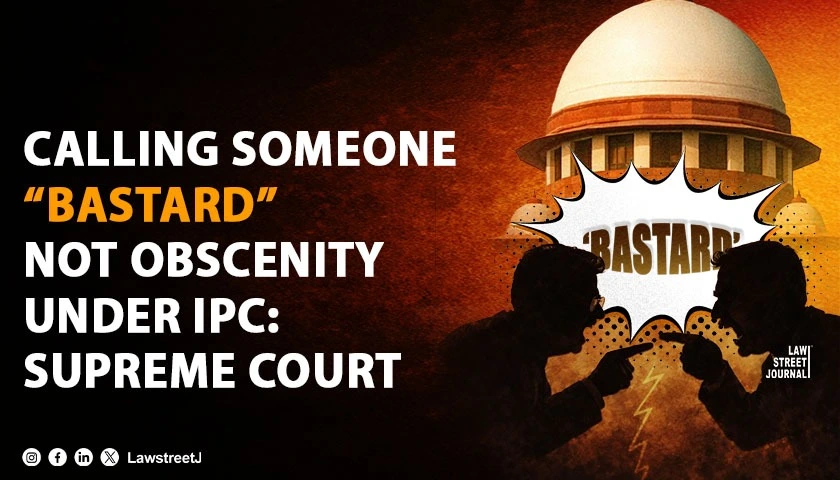
New Delhi: The Supreme Court of India has held that the mere use of abusive or vulgar language during a heated argument, without any element capable of arousing prurient or sexual interest, does not constitute the offence of obscenity under Section 294(b) of the Indian Penal Code. Setting aside the conviction of two accused persons on this count, the Court clarified that vulgarity and obscenity are not the same in the eyes of the law.
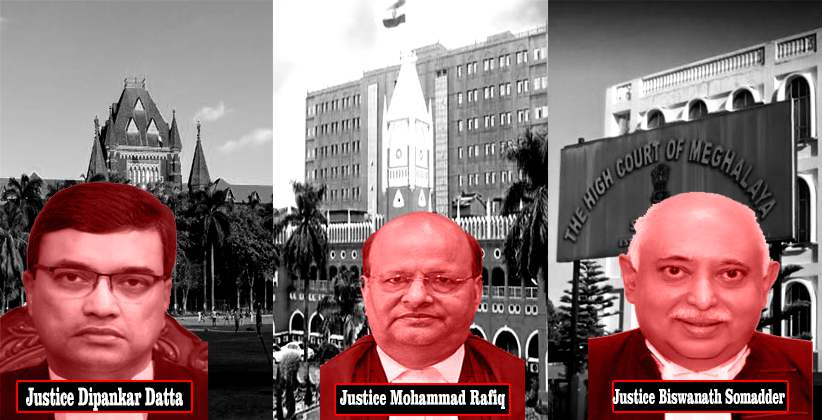
The judgment was delivered on 06.04.2026 by a Bench comprising Justice Pamidighantam Sri Narasimha and Justice Manoj Misra in Criminal Appeal Nos. 1807 of 2019 and 677 of 2020.
The case arose from a boundary dispute between two branches of the same family in Thiruvidaimaruthur, Tamil Nadu. On 20.09.2014, when the deceased, Kaliyamurthy, was fencing the boundary of his property, his nephew Senthil (A-1) and the latter’s brother-in-law Sivakumar (A-2) objected. An altercation broke out, during which A-1 picked up an aruval, a sickle-like agricultural tool, and swung it at the deceased. The deceased’s brother, Kalaivanan, intervened and received the blow on his shoulder and toe instead. When the deceased moved forward to assist his brother, A-2 picked up a log lying nearby and struck a single forceful blow on the deceased’s head. The deceased fell unconscious and died shortly thereafter in hospital due to a depressed skull fracture with blood clots in the brain.
The trial court convicted A-1 for causing hurt by a dangerous weapon under Section 324 IPC and A-2 for grievous hurt under Section 325 IPC, while acquitting both of the charge of murder. The widow of the deceased appealed against the acquittals, while the accused challenged their convictions. The Madras High Court partly allowed the widow’s appeal and altered the convictions of both A-1 and A-2 to culpable homicide not amounting to murder under Section 304 Part II IPC, sentencing each to five years’ rigorous imprisonment. The High Court also convicted them under Section 294(b) IPC for abusing the deceased by calling him a “bastard” during the altercation.
Before the Supreme Court, the key issues were whether calling someone a “bastard” during a heated argument constitutes an obscene act under Section 294(b) IPC, whether A-1 shared a common intention with A-2 to cause fatal injury, and whether the sentence imposed on A-2 was proportionate.
On the issue of obscenity, the Court relied on its earlier decision in Apoorva Arora v. State (Govt. of NCT of Delhi), (2024) 6 SCC 181, which held that obscenity must involve a tendency to arouse prurient or sexual interest, and that vulgarity and profanity do not per se amount to obscenity. The Court observed that calling someone a “bastard,” though offensive, does not evoke sexual or lustful thoughts but may at most cause disgust or shock. It further noted that such language is commonly used in contemporary discourse during heated exchanges. Accordingly, the conviction of both accused under Section 294(b) IPC was set aside.
On the question of common intention, the Court found that A-1 had attacked the deceased’s brother and not the deceased himself, that the fatal blow was inflicted solely by A-2, and that A-1 neither exhorted nor encouraged A-2 to strike the deceased. The alleged statement that “all problems were because of the deceased and it was better that he died” was attributed only to A-2. The Court held that it would be unsafe to attribute common intention under Section 34 IPC to A-1 and, accordingly, set aside his conviction under Section 304 Part II IPC. However, his conviction under Section 324 IPC was upheld.
With respect to A-2, the Court found no infirmity in the High Court’s reasoning. A-2 had struck a forceful blow on a vital part of the body, accompanied by words indicating intent. The resulting injuries clearly established knowledge that such an act was likely to cause death. Accordingly, his conviction under Section 304 Part II IPC was affirmed.
On sentencing, the Court noted that the incident arose out of a family dispute, that the weapons used were not premeditated, and that only a single blow was inflicted in the heat of the moment. Taking these factors into account, the Court reduced A-2’s sentence from five years to three years’ rigorous imprisonment.
As regards A-1, whose conviction stood limited to Section 324 IPC, the Court noted that he had already undergone nearly two months of imprisonment. His sentence was modified to the period already undergone.
For the Appellants: Mr. S. Nagamuthu, Senior Advocate
For the Respondent-State: Mr. Sabarish Subramanian, Advocate
Case Title: Sivakumar v. State rep. by the Inspector of Police and Senthil @ Janakiram v. State rep. by the Inspector of Police, Criminal Appeal Nos. 1807 of 2019 and 677 of 2020, 2026 INSC 318