New Delhi: The Supreme Court has quashed an FIR registered under Sections 304B, 323, 498A and 504 IPC and the Dowry Prohibition Act against a man whose wife died by suicide in Toronto, Canada, holding that the allegations of dowry demand and cruelty were vague, unsupported and had no nexus with her death.
A Bench of Justice B.V. Nagarathna and Justice Manmohan set aside the Bombay High Court’s refusal to quash the proceedings and held that continuing them would be an abuse of the process of law. The judgment (2026 INSC 1183) was delivered on 2 November 2026.
The appellant, Piyush S/o Deepak Narlawar, married the daughter of the complainant (respondent No. 2) on 03.01.2021. After living in Chandrapur with his family, the couple moved to Toronto on 28.02.2022. The wife died by suicide on 11.06.2023, and a handwritten note was recovered from the apartment, which, as recorded by the Court, spoke of her distress over not finding a job and her feelings of failure.
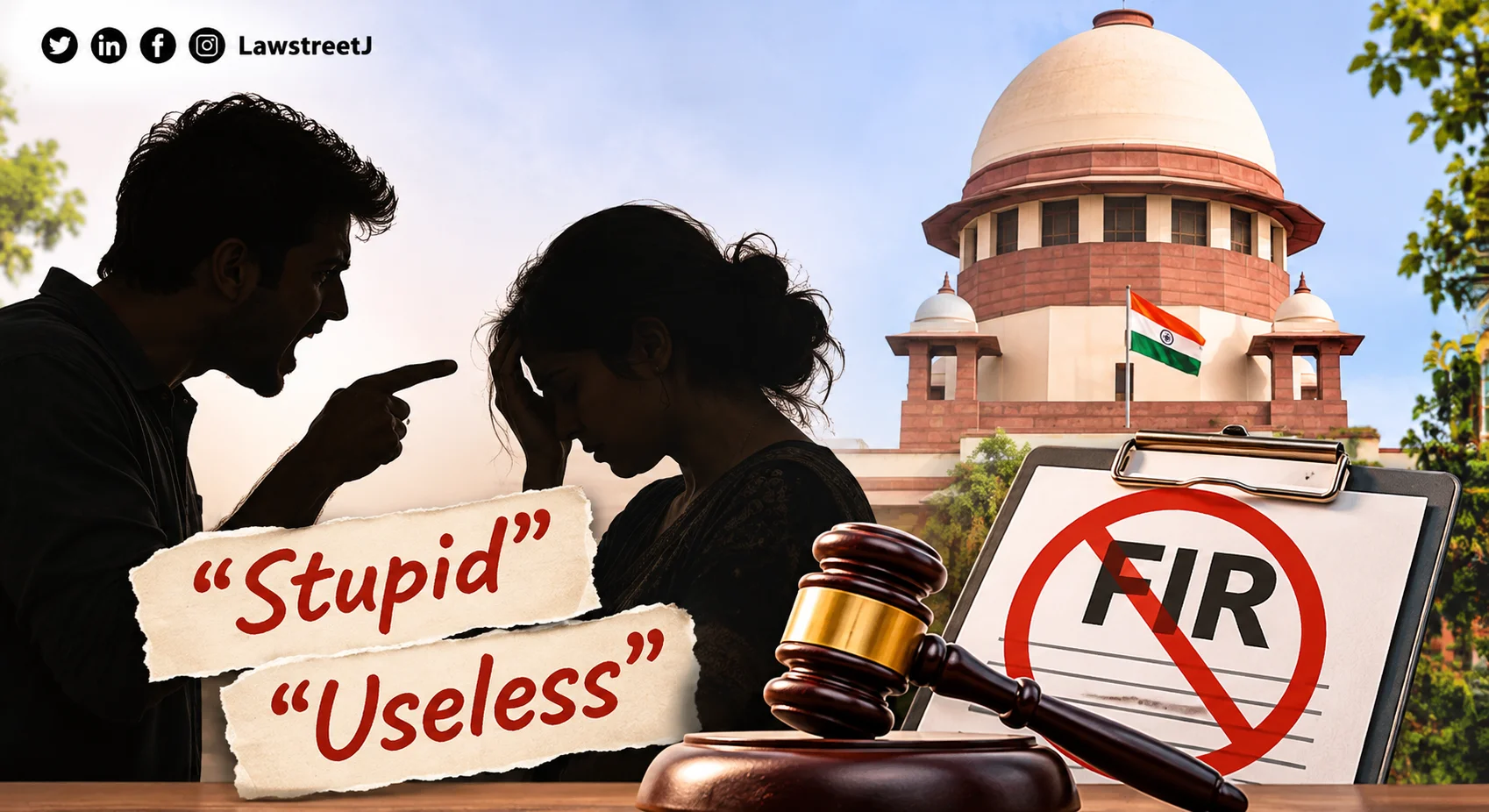
On 30.06.2023, her father lodged FIR No. 212/2023 at Satara Police Station, District Aurangabad Town, against the appellant and his family members. He alleged that the family had made unlawful dowry demands, including 15 tolas of gold before marriage, a gold ring at Diwali and three tolas of gold in September 2022, and that the appellant called the deceased names such as “stupid and useless” and slapped her once.
A coroner’s statement dated 12.10.2023 and the post-mortem report attributed the death to a fall from height, and recorded no prior police interaction between the couple. The Toronto Police closed its investigation on 08.01.2024, finding that the handwriting in the note matched the deceased’s, that there were no signs of struggle, and that CCTV footage showed the appellant was not at home at the time.
The appellant, along with his parents and sister, sought quashing of the FIR under Section 482 CrPC. The High Court, Aurangabad Bench, quashed the proceedings against the family members, as the deceased was not living with them soon before her death, but refused relief to the appellant. A chargesheet followed, non-bailable warrants were issued on 04.02.2025, and the Supreme Court on 11.08.2025 directed that no coercive steps be taken against him.
The appellant argued that the allegations were general, that there was no allegation of dowry demand from the start of the marriage until the death, and that the Coroner’s report and Toronto Police report exonerated him. He also pointed to money transfers to the deceased and her family and to his nominating her in his investments. The State opposed the appeal, citing the need for custodial interrogation and unexplained transactions, and the complainant argued that the Canadian reports could not treat the incident as a dowry death under Section 304B, which Canadian law does not recognise.
The Court noted that the allegations of dowry demands related to 2021 and 2022, but there was “not even a whiff” of any complaint until the death, and that the FIR was lodged only afterwards. It also noted that the complainant had taken no tangible action on the alleged demands, and that the suicide note made no mention of the appellant or his family, or of any dowry demand or cruelty.
On the gifts, the Court held that the 15 tolas of gold, given to both the appellant and his daughter, appeared to be a wedding gift out of love and affection, which cannot be construed as dowry. The Diwali exchange was a customary one, and such isolated gifts could not be linked with the suicide that occurred nearly a year later. The ₹1,00,000 transferred by the deceased’s brother came around the time the appellant booked her flight tickets to India, and the bank statements showed multiple transactions, so no single transaction could be seen as dowry.
The Bench held that, without evidence of a dowry demand having a reasonable nexus to the suicide, Section 304B IPC could not be attracted, and that prosecuting the appellant for it “would be nothing but an abuse of the process of law”. It also held that calling the deceased “stupid” and “useless”, even if accepted, does not amount to cruelty or criminal intimidation, as, in the Court’s words, it “at best, it reflects on the temperament of the husband”. The allegations under Sections 323, 498A and 504 were vague and omnibus, with no specific instance of harassment.
Citing State of Haryana v. Bhajan Lal, the Court held that clauses (1), (2), (3), (5) and (7) of paragraph 102 squarely applied. It cautioned that courts must be extremely careful in matrimonial cases to prevent abuse of process, and observed that the proceedings reflected a grieving father searching for a reason for his daughter’s death. Allowing the appeal, it set aside the High Court’s order and quashed FIR No. 212/2023 and all consequent proceedings.
Case Title: Piyush S/o Deepak Narlawar v. State of Maharashtra and Others, Criminal Appeal arising out of SLP (Crl.) No. 12158 of 2025