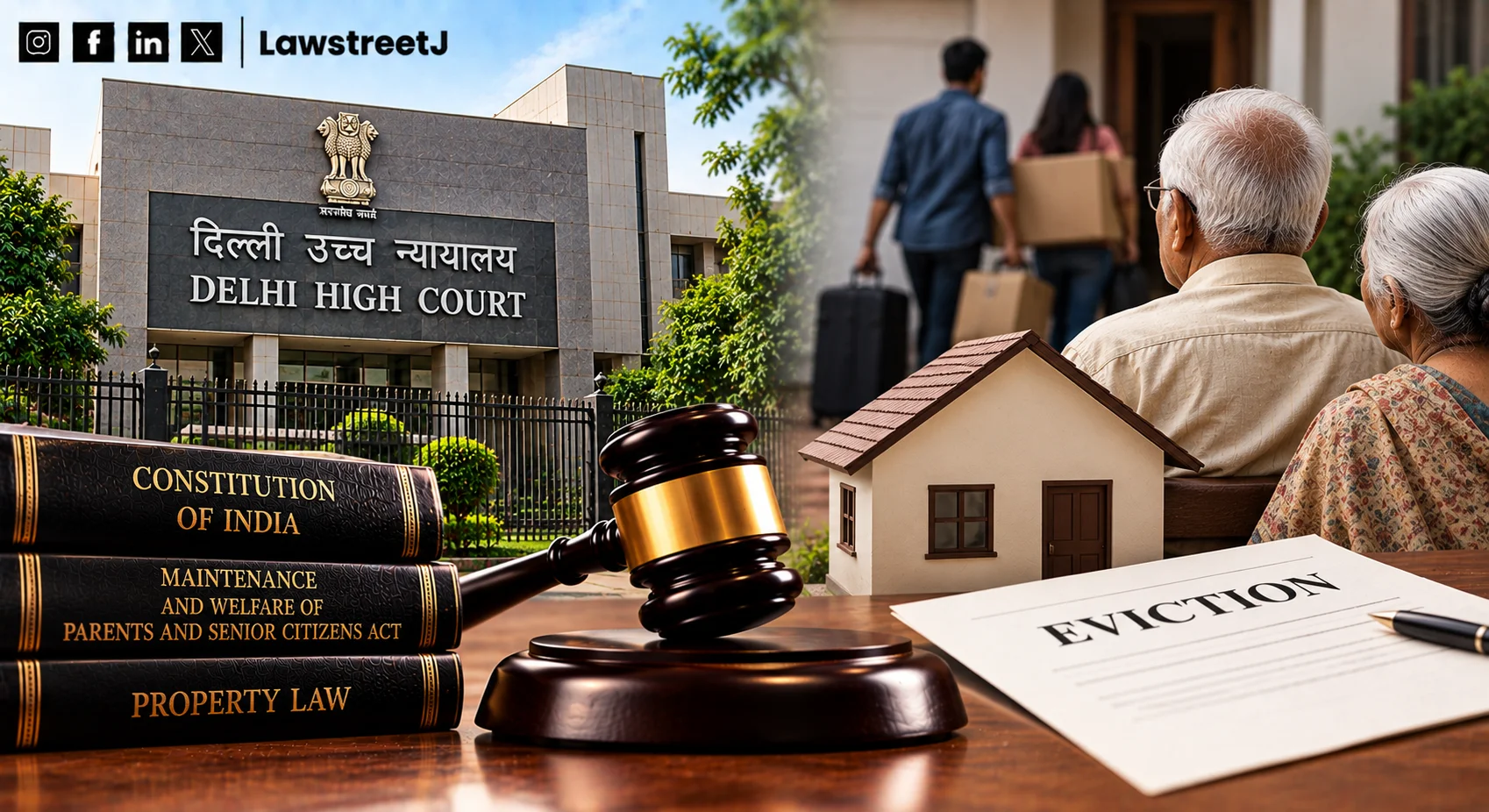
New Delhi: The Delhi High Court has upheld an order directing a daughter-in-law to vacate her in-laws' house under the Delhi Maintenance and Welfare of Parents and Senior Citizens Rules, 2009, rejecting her challenge that the eviction provision is ultra vires the parent Act and violates her right to reside in a shared household under the Domestic Violence Act.
A Bench of Chief Justice Devendra Kumar Upadhyaya and Justice Tejas Karia, was examining a challenge to an order of the Divisional Commissioner that had reversed the District Magistrate's refusal to evict the petitioner from a house belonging to her mother-in-law, respondent no. 2, and directed her to vacate the property.
The petitioner, whose marriage to respondent no. 2's son had run into matrimonial discord, had a Domestic Violence Act complaint pending seeking a residence order over the same property, and contended that Rule 22(3)(1)(i) and (iv) of the 2009 Rules exceeded the State's rule-making power and was “violative of Article 14, 15 and 21 of the Constitution.”
Rejecting the ultra vires challenge, the Court held that Section 22 of the Maintenance and Welfare of Parents and Senior Citizens Act, 2007 empowers the State to prescribe a “comprehensive action plan for providing protection of life and property of the senior citizens,” and that Rule 22(3)(1) was “not only referable to the rule making power . . . under Section 32” but also to Section 22 itself.
Addressing the conflict between the two statutes' non-obstante clauses, the Court relied on the Supreme Court's ruling in S. Vanitha v. Deputy Commissioner, Bengaluru Urban District, holding that the Senior Citizens Act and the Domestic Violence Act “have to be harmoniously construed,” and that eviction under the former remains available but “can be granted only after adverting to the competing claims in the dispute.”
Rejecting the contention that Rule 22(3)(1) excludes a daughter-in-law, the Court held, following its earlier rulings in Shadab Khairi v. State and Darshna v. Govt. of NCT of Delhi, that the expression “son, daughter or legal heirs” in the beneficial Rules “must take within its sweep the families of the daughter/son of a senior citizen,” and that a daughter-in-law can indeed be an heir in certain circumstances.
The Court also held that eviction proceedings under Rule 22(3)(1) are independent of maintenance proceedings before the Tribunal, so that an application for eviction can proceed “irrespective of the fact whether maintenance is claimed or not.”
On the facts, the Court noted that the petitioner was employed as a Post Graduate Teacher earning a “decent salary” and had a separate house of her own, so that her claim to reside in the shared household, “not being indefeasible,” had to yield to the senior citizen's right to live a normal and peaceful life.
Finding no infirmity in the Divisional Commissioner's order, the Court dismissed the writ petition, with no order as to costs.
Appearances: Ms. Meera Kaura Patel, Ms. Ritika Saini, Ms. Zainab Hussain, Mr. Varun Mudgil and Mr. Sarthak Malawaliya, Advocates, appeared for the petitioner. Mr. Sameer Vashisht, Standing Counsel (Civil), GNCTD, with Ms. Vaishali Gupta, Panel Counsel, appeared for the respondents, along with Ms. Aakanksha Kaul, Mr. Aman Sahani, Ms. Simran Khorana, Ms. Manisha Agrawal Narain, Ms. Aditi Singh, Mr. Shiven Varma and Mr. Rishabh Mistry, Advocates, for Respondent No. 2.
Case Title: Punam vs. Divisional Commissioner, GNCT of Delhi & Ors.


![Delhi High Court Sets Aside Arbitral Tribunal's Award Against NHAI in Highway Project Delay Case [Read Judgment]](/secure/uploads/2023/07/lj_9605_23374c2e-392c-4491-a2fe-f2f12fc5272f.jpg)
![Delhi Court Rejects Stay Request in Defamation Case Against Rajasthan CM Ashok Gehlot [Read Order]](/secure/uploads/2023/08/lj_5208_80de1ddc-d76a-4f7f-b180-408e3ae14fb4.jpg)