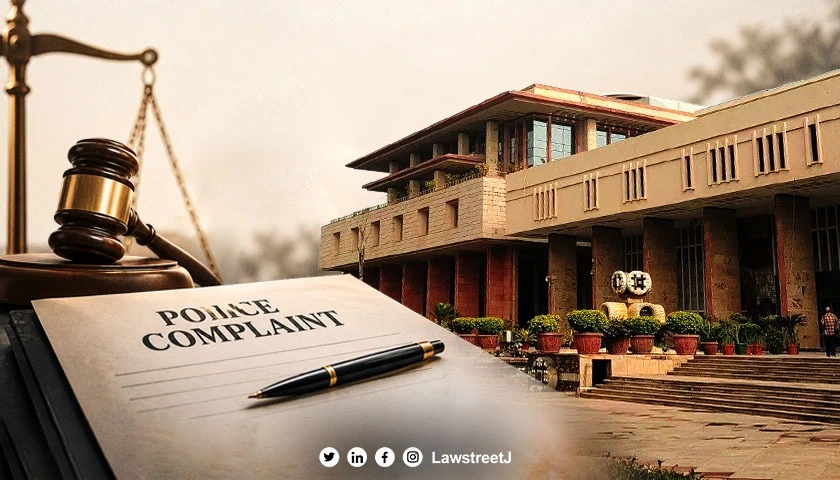
New Delhi: The Delhi High Court has dismissed a Regular First Appeal by an advocate whose ₹10 lakh defamation suit was rejected under Order VII Rule 11 CPC, holding that a statement made in a police complaint, read in the context of the complaint as a whole, was not defamatory per se and was not “publication”, an essential ingredient of civil defamation.
Justice Neena Bansal Krishna was hearing RFA 56/2025 filed by Jai Gupta against the order of 16.08.2024 of the District Judge rejecting CS No. 91/2023, his suit for damages against fellow advocate Sunil Kumar Roy. Both practise at the Patiala House Courts, New Delhi.
Gupta’s case was that he had lent ₹2,00,000 to Roy in May 2017 against a post-dated cheque, and that on 03.03.2022, when he refused to waive the loan, Roy assaulted and threatened him. Roy then lodged a complaint at Police Station Tilak Marg (DD No. 60A), which Gupta alleged was false and contained a defamatory sentence that “this man is very influencing & have roots in the goons & bad elements of the society”. Roy’s version was that the parties had agreed to a sale of a chamber, for which he paid ₹1,00,000 in cash and gave a cheque, that Gupta backed out, and that Gupta abused and manhandled him on 03.03.2022. Gupta also lodged a counter-complaint (DD No. 63) the same day, and the parties have other proceedings pending between them, including a summary suit for recovery of the loan.
Challenging the rejection, Gupta argued that the District Judge relied on facts outside the plaint, that the imputation was per se defamatory and irrelevant to the other allegations in the complaint, and that the coordinate Bench decision in Rakesh Bhardwaj v. Jai Gupta (CM(M) 931/2018), in which a defamation suit based on a police complaint was held maintainable, was wrongly distinguished. Roy contended that the suit rested on a solitary sentence, with no averment of publication or of any person whose estimation of Gupta was lowered.
The Court set out the essential elements of civil defamation: a defamatory statement, its publication, an intention or knowledge or reason to believe that it will harm reputation, and a tendency to lower the reputation of the person in the eyes of society. It then examined the long line of authority on complaints to the police, including Bapalal and Co. and K. Ramadass (Madras), Golap Jan and Madhab Chandra Ghosh (Calcutta), Bira Garari v. Dulhin Somaria (Patna, Division Bench), Prof. Imtiaz Ahmad v. Durdana Zamir and Vijay Gulati v. Radhika (Delhi) and Mahavir Singh v. Surinder Singh (Punjab and Haryana). It noted that Majju v. Lachman Prasad (Allahabad Full Bench) had distinguished complaints leading to judicial proceedings from those that did not, and that Prof. Imtiaz Ahmad had held that a complaint before lawful authorities is not publicising defamatory averments and that, until a competent court holds the complaint to be false, no cause of action arises.
The Court noted that Rakesh Bhardwaj had taken a contrary view, but summarised the position as follows:
“The aforesaid judgments indicate that mere filing of a complaint with the Police does not, by itself, constitute defamation. The nature and context of the alleged imputation, the question of publication, and the applicability of privilege must also be considered.”
Applying this, the Court held on merits that the impugned sentence was made in the context of Roy fearing for his life, since the complaint recorded that Gupta had threatened “agar dobara paise mange to jaan se maar dunga”, and could not be isolated from that context. The statement could not be considered defamatory per se, as it did not fit the definition of an imputation tending to lower a person in the estimation of right-thinking members of society.
The Court further held that the statement in the complaint could not be termed publication, and that there was not a single averment in the plaint that others had heard it or that the plaintiff’s estimation had been lowered, nor was any person named. It found nothing to show harm to reputation, and observed that the statement appeared to have been made in good faith to protect Roy’s own life from a perceived threat. The District Judge was therefore right in holding that the plaint disclosed no cause of action, and the appeal was dismissed.
Appearances:
For the Appellant/Plaintiff: Ms. Arunima Gupta, Advocate.
For the Respondent/Defendant: Mr. Ankur Dhall, Advocate.
Case Title: Jai Gupta vs. Sunil Kumar Roy, RFA 56/2025