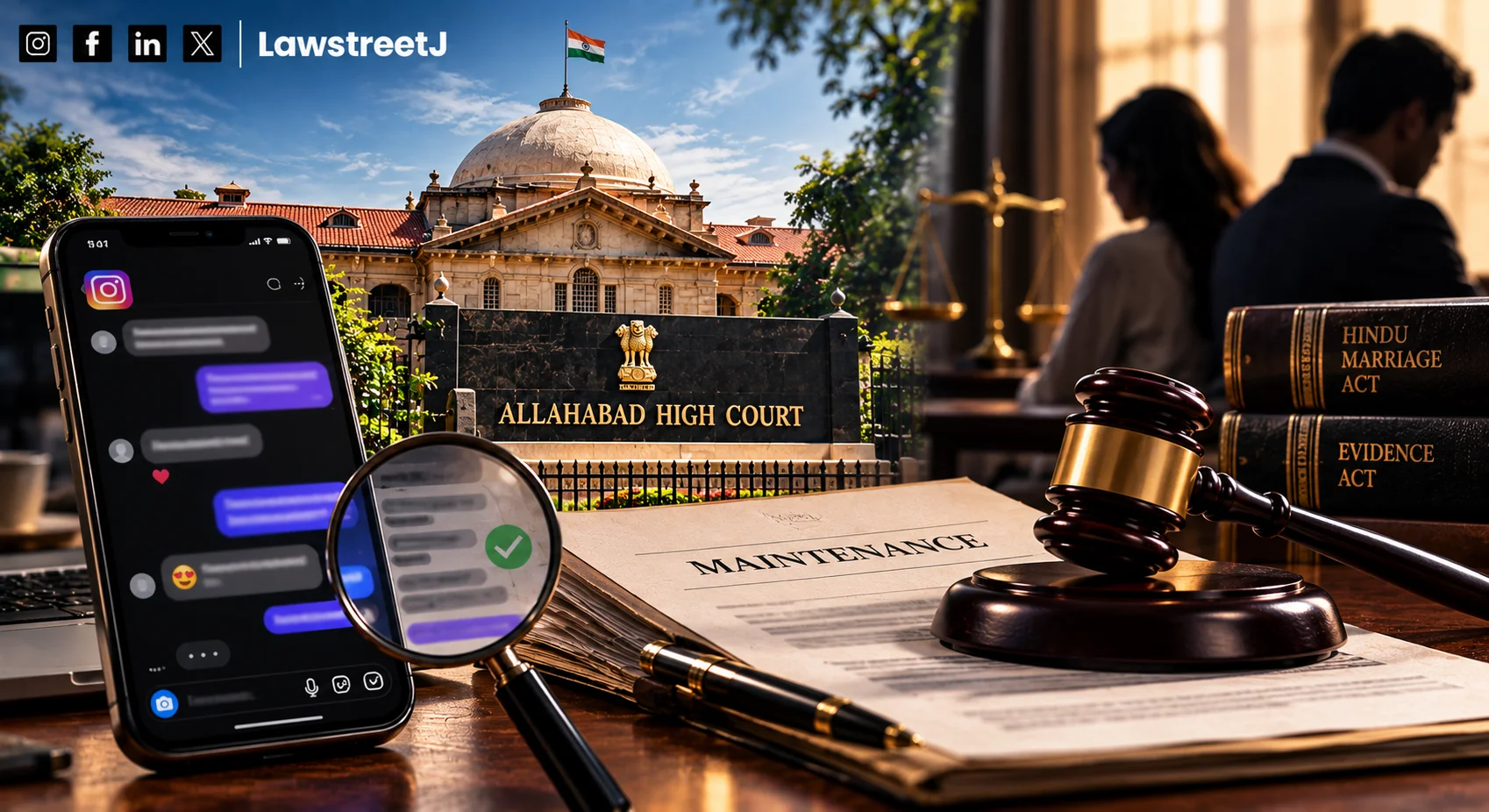
Prayagraj: The Allahabad High Court has dismissed a criminal revision filed by a husband challenging a Family Court order granting maintenance to his wife, holding that printouts of Instagram chats not supported by the mandatory certificate under Section 65-B of the Indian Evidence Act, 1872, are inadmissible and, in any case, insufficient to establish that the wife was "living in adultery".
Justice Jai Krishna Upadhyay was hearing a revision under Sections 438 and 442 of the Bharatiya Nagarik Suraksha Sanhita, 2023, challenging the order passed by the Principal Judge, Family Court, Sambhal at Chandausi, in Case No. 924 of 2024, by which the wife's application for maintenance had been allowed.
The revisionist's counsel contended that the wife had left the matrimonial home without sufficient or justifiable ground and, more importantly, that she was living in adultery with an advocate, which barred her claim to maintenance under the statute. To support this allegation, he relied on printouts of Instagram chats allegedly exchanged between the wife and the advocate.
The learned Additional Government Advocate for the State and counsel for the wife opposed the revision, submitting that the maintenance provision is a beneficent, social-welfare measure designed to prevent vagrancy, that "living in adultery" implies a continuous course of conduct rather than isolated interactions or unsubstantiated suspicion, and that the unverified chats, lacking the statutory certification under the evidence law, were inadmissible.
The court noted that maintenance proceedings are summary and intended to be speedy, and, relying on the Supreme Court's decisions in Dukhtar Jahan v. Mohd. Farooq and Rajnesh v. Neha, reiterated that such provisions must be interpreted liberally in keeping with their beneficent goal. While the standard of proof is not beyond reasonable doubt, the burden of establishing a statutory disqualification rests entirely on the party alleging it.
Examining the phrase "living in adultery", the court held that the words denote a "continuous, ongoing, and habitual course of adulterous conduct", which cannot be inferred from a single lapse, mere conversational interactions, professional associations or unsubstantiated suspicions, and that a husband seeking to defeat the claim at the threshold must produce clear and cogent evidence.
On the electronic evidence, the court relied on the Supreme Court's rulings in Arjun Panditrao Khotkar v. Kailash Kushanrao Gorantyal and Anvar P.V. v. P.K. Basheer to reiterate that the certificate under Section 65-B is a mandatory condition precedent to the admissibility of an electronic record. Finding that the Instagram chats produced by the revisionist carried no such certificate, the court held that it would be incorrect in law to treat them as admissible.
The court added that, even if the chats were perused, mere text messages on a social media platform, without corroborative evidence of physical intimacy or cohabitation, were thoroughly insufficient to establish that the wife was continuously living in adultery, and that the revisionist had failed to discharge the burden resting on him.
Holding that the Family Court had rightly evaluated the material on record and that the impugned order suffered from no jurisdictional error, material irregularity or perversity warranting interference in revisional jurisdiction, the court dismissed the revision and affirmed the order dated 01.10.2025.
A copy of the order was directed to be sent to the trial court for compliance. The judgment was delivered on September 29, 2026, after being reserved.
Appearances:
For the Revisionist: Mr. Devdeep Malviya, Advocate.
For the Opposite Parties: Mr. Ashutosh Upadhyay (for Opposite Party No. 2), Mr. Sujeet Kumar, Advocates, and the learned Additional Government Advocate for the State.
Case Title: S.K. vs. State of U.P. and Another, Criminal Revision No. 7800 of 2025


!["No Loudspeakers For Azan, No Fundamental Right To Create Noise," Says Allahabad HC To Two Mosques [Read Judgment]](/secure/uploads/2020/01/lj_4995_Allahabad_HC_AZAN.jpg)