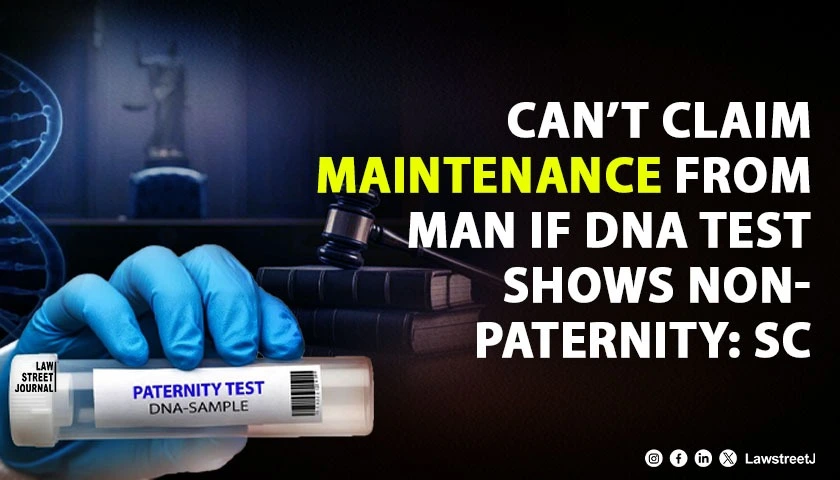
New Delhi: The Supreme Court of India has held that where a DNA test has been conducted, its result has attained finality, and the man has been conclusively found not to be the biological father of the child, the presumption of legitimacy under Section 112 of the Indian Evidence Act, 1872 must yield to the scientific finding. In such circumstances, the man cannot be directed to pay maintenance for the child, even though the child was born during the subsistence of a valid marriage between the parties.
The judgment was pronounced by a Bench of Justice Sanjay Karol and Justice Nongmeikapam Kotiswar Singh on April 21, 2026, dismissing a criminal appeal preferred by the mother against the Delhi High Court’s judgment dated 17.10.2023, which had upheld the denial of maintenance to her daughter.
The appellant, Nikhat Parveen @ Khusboo Khatoon, had been employed as domestic help in the residence of the respondent, Rafique @ Shillu, for a period of three years. The parties eventually married, and a child was born. After some time, the matrimonial relationship soured, and the appellant filed a complaint under Section 12 of the Protection of Women from Domestic Violence Act, 2005, seeking interim maintenance of ₹25,000 per month, a protection order, and restoration of her stridhan articles.
In response, the respondent denied all allegations of domestic violence and sought a direction for a DNA test to establish paternity. The Trial Court allowed this prayer, and the DNA report concluded that the respondent was not the biological father of the child. On this basis, and on account of the appellant’s alleged concealment of her source of income, the Trial Court rejected the application for interim maintenance. The First Appellate Court affirmed this, also noting that the prayer for the child’s maintenance was no longer pressed.
The Delhi High Court, in the impugned order, remanded the question of the appellant’s own maintenance to the Trial Court for fresh consideration, but upheld the denial of maintenance to the child on the basis that the DNA report had attained finality and was on record.
Before the Supreme Court, the main ground of challenge was the applicability of Section 112 of the Indian Evidence Act, 1872 (now Section 116 of the Bharatiya Sakshya Adhiniyam, 2023), which provides that the birth of a person during the continuance of a valid marriage between his mother and any man shall be conclusive proof of that man’s paternity, unless it can be shown that the parties had no access to each other at the time when the child could have been begotten.
Tracing the evolution of judicial opinion on this provision, the Court noted that in Dukhtar Jahan v. Mohd. Farooq, (1987) 1 SCC 624, it had held that the rule of law, based on the dictates of justice, has always made courts incline towards upholding the legitimacy of a child, and that courts must desist from lightly rendering a verdict that would brand a child as illegitimate. In Goutam Kundu v. State of West Bengal, (1993) 3 SCC 418, the Court held that orders for blood tests cannot be made as a matter of course, that a strong prima facie case of non-access must be established before the presumption is displaced, and that no one can be compelled to give a blood sample.
In Nandlal Wasudeo Badwaik v. Lata Nandlal Badwaik, (2014) 2 SCC 576, the Court held that where scientific truth is established through a DNA test, there is no room for presumption, and that when there is a conflict between a conclusive proof envisaged under law and proof based on scientific advancement accepted by the global community, the latter must prevail.
The Court also relied on Aparna Ajinkya Firodia v. Ajinkya Arun Firodia, (2024) 7 SCC 773, wherein it was held that even a genuine DNA test result cannot override the conclusiveness of the presumption under Section 112 in the absence of proof of non-access, and that such a test may establish adultery, but not illegitimacy. In Ivan Rathinam v. Milan Joseph, 2025 SCC OnLine SC 175, the Court adopted a balanced approach, weighing the stigma of illegitimacy against the child’s right to know their biological father, and held that a DNA test should be ordered only where existing evidence is insufficient and such a balance justifies it.
The Supreme Court, after considering this line of authority, identified the common thread as a consistent judicial hesitation to order or endorse DNA testing. While agreeing with this position, the Court distinguished the present case from Aparna Ajinkya Firodia, noting that here the DNA test had already been conducted with the appellant’s consent, had not been disputed, and had attained finality.
In these circumstances, the Court held that the position in Badwaik directly applied: when a court-directed DNA test report is available on record and conflicts with the presumption of legitimacy, it cannot be ignored. The appeal was accordingly dismissed, and the High Court’s decision denying maintenance to the child was upheld as free from error.
Expressing concern for the child’s welfare, the Court directed the Secretary, Women and Child Development, Government of NCT of Delhi, to depute a person of considerable experience to ascertain the appellant’s living conditions and assess the child’s well-being in terms of education, nutrition, health, and access to basic necessities. The Department was further directed to take remedial measures wherever deficiencies were found.
Case Title: Nikhat Parveen @ Khusboo Khatoon v. Rafique @ Shillu, Criminal Appeal arising out of SLP (Crl.) No. 15256 of 2023, 2026 INSC 399