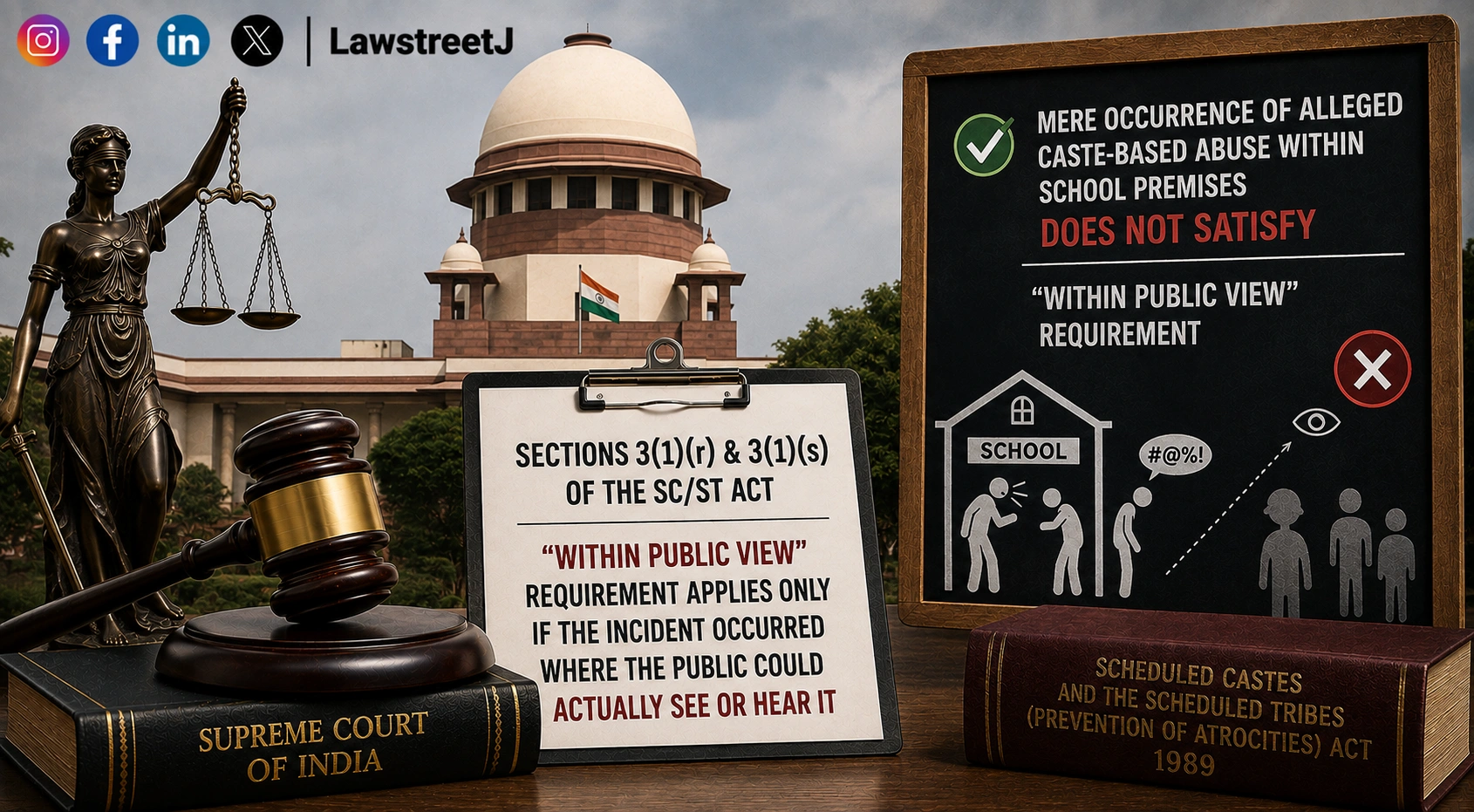
New Delhi: The Supreme Court has held that the mere occurrence of alleged caste-based abuse within school premises does not by itself satisfy the statutory requirement of “public view” under the Scheduled Castes and the Scheduled Tribes (Prevention of Atrocities) Act, 1989, while allowing an appeal filed by a school manager from Uttar Pradesh and quashing the charges of caste-based insult and intimidation framed against him.
A Bench of Justice Vikram Nath and Justice Sandeep Mehta set aside a judgment dated 10th April, 2023 of the Allahabad High Court, which had dismissed the appellant’s appeal under Section 14A(1) of the SC/ST Act and declined to interfere with a summoning order dated 8th August, 2022 passed by the Special Judge, SC/ST Act, taking cognizance of offences under Sections 3(1)(r) and 3(1)(s) of the Act, besides other offences under the Indian Penal Code, in Sessions Case No. 642 of 2022.
According to the prosecution case, the sons of the complainant, Respondent No. 2, were studying in a school where the appellant was the Manager. On 24th January, 2020, one of the sons suffered injuries in a quarrel with other students, following which the complainant approached the appellant. It was alleged that the appellant abused and assaulted the complainant with lathis, sticks and fists, along with the school staff, and used caste-based abuses against him. FIR No. 37 of 2020 was accordingly registered on 25th January, 2020 for offences under Sections 147, 323, 342 and 504 of the IPC and Sections 3(1)(r)(s) of the SC/ST Act, and a chargesheet was filed on 17th March, 2020. The Special Judge took cognizance of the offences by order dated 8th August, 2022, registering Sessions Case No. 642 of 2022.
It was also noted that a separate FIR No. 39 of 2020 had been lodged the same day by the appellant’s wife against the complainant, alleging that he had abused and assaulted her in the school office, following which the appellant intervened and was himself assaulted. A chargesheet was filed against the complainant in that matter on 27th April, 2020, and cognizance was taken on 3rd December, 2020.
Counsel for the appellant contended before the Supreme Court that the High Court erred in holding that the incident took place within public view, even though the site plan dated 25th February, 2020, prepared by the Investigating Officer, showed the occurrence took place inside room “A” of the school, which was enclosed and had no window or public access. It was submitted that the statements of witnesses did not establish their presence inside the room at the time of the incident, and that the FIR contained no specific allegation attributing any caste-based words to the appellant. It was further submitted that the appellant had no prior acquaintance with the complainant and no material suggested he knew his caste or intended to humiliate him on that ground.
Counsel for the Respondent-State supported the High Court’s judgment, submitting that the incident had occurred within public view and that, at the stage of taking cognizance, the material on record the FIR, chargesheet and investigation material was sufficient to establish a prima facie case.
Examining the ingredients of Sections 3(1)(r) and 3(1)(s) of the SC/ST Act, the Court reiterated its earlier rulings in Karuppudayar v. State and Hitesh Verma v. State of Uttarakhand, holding that for a place to be “within public view”, members of the public must be able to witness or hear the utterance, and that an occurrence within the four corners of a wall, without members of the public present, would not meet this requirement.
The Court noted that the FIR and the site plan placed the occurrence inside the enclosed room, and that statements of four teachers examined during investigation described a quarrel and scuffle in the school office but did not state that they were present when any caste-based words were allegedly uttered, or that they heard such words. “If the alleged offence takes place within the four corners of the wall where members of the public are not present, then it cannot be said that it has taken place at a place within public view,” the Court observed, holding that mere presence of witnesses within the school premises did not establish that the alleged utterance was made within public view, and that counsel for the State could not demonstrate anything to the contrary.
The Court also observed that neither the FIR nor the complainant’s statement attributed any specific caste-based words or slurs to the appellant, and that the allegation of caste-based abuse remained general in nature, with the material at the highest disclosing only a quarrel and scuffle between the parties. It held that while a meticulous appreciation of evidence is not required at the stage of cognizance, the essential ingredients of the offence must still emerge from the material on record, which was not the case here.
Holding that the offences under Sections 3(1)(r) and 3(1)(s) of the SC/ST Act were not prima facie made out, the Court set aside the High Court’s judgment and quashed the proceedings arising from FIR No. 37 of 2020 to the extent they related to those offences.
It clarified that the proceedings would continue in respect of the remaining offences under the Indian Penal Code.
Case Title: Ramkrishna Chauhan vs. State of U.P. & Anr., Criminal Appeal (Arising out of SLP (Criminal) No. 5113 of 2023)