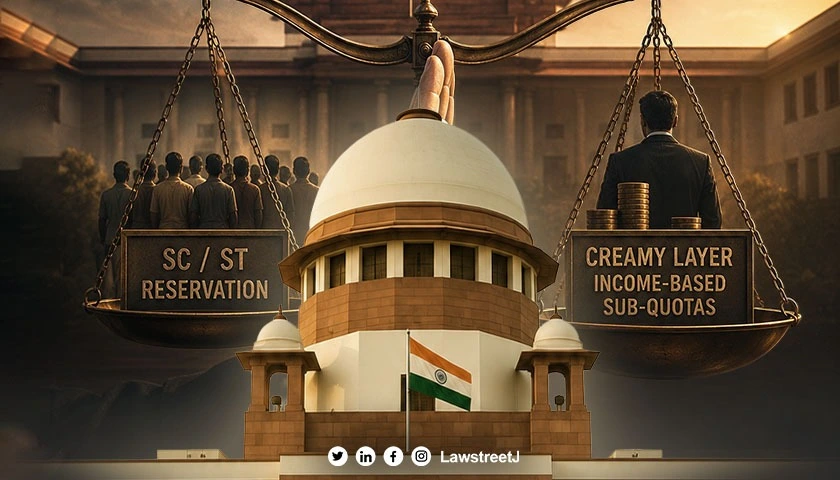
New Delhi: The Central Government has opposed Public Interest Litigations (PILs) in the Supreme Court seeking an income-based sub-quota within reserved categories and the "creamy layer" exclusion for Scheduled Castes (SCs) and Scheduled Tribes (STs).
In its counter-affidavit, the Ministry of Social Justice and Empowerment argued that reservation benefits for SCs, STs, and Other Backward Classes (OBCs) are fundamentally rooted in historical and social backwardness rather than mere economic status. The government asserted that the petitions are legally misconceived and urged the apex court to dismiss them on the grounds of maintainability.
The Centre submitted that criteria for inclusion in SC and ST lists are established through historical disadvantage and social marginalisation. Scheduled Castes face deep-seated historical disadvantages from untouchability, while Scheduled Tribes exhibit distinct cultures and geographical isolation. The government emphasised that social discrimination does not occur on the basis of economic conditions alone, and financial advancement does not automatically erase the historical stigma suffered by these communities. Thus, introducing an economic filter within the reservation scheme would undermine the core constitutional goal of achieving social equality.
Opposing the extension of the "creamy layer" principle to SCs and STs, the Centre relied on major judicial precedents to reject the idea. The affidavit cited the landmark Indra Sawhney ruling, pointing out that the discussion on excluding socially advanced sections was explicitly confined to OBCs and held no relevance for SCs and STs. The Centre further referred to the judgment in Ashoka Kumar Thakur v. Union of India, which clarified that the principles of the creamy layer are not applicable to SC and ST reservations. Additionally, the government submitted that the Supreme Court's observations in the M. Nagaraj case regarding the creamy layer were general remarks and did not constitute a specific holding applicable to SCs and STs.
The constitutional division of powers was also underlined by the Centre, which asserted that any modification to the lists of SCs and STs remains the exclusive domain of Parliament. Relying on E.V. Chinnaiah v. State of Andhra Pradesh, the affidavit stated that any modification to the Presidentially notified SC/ST lists can only be enacted by Parliament under Articles 341 and 342 of the Constitution. State governments, courts, and tribunals lack the power to alter or amend these lists. Consequently, the court cannot direct the executive to frame reservation policies, as policy formulation lies strictly within the domain of the executive and legislature.
The government further contended that any potential modification of the reservation framework, especially the introduction of income-based preferences, would require a thorough, holistic review. This shift must be preceded by a comprehensive empirical study backed by extensive socio-economic data of the beneficiaries of reserved categories. The Centre noted that while a "means test" is already integrated into a majority of welfare and development schemes, reservations in public services and educational institutions stand on an entirely different footing. It argued that the reliefs sought in the petitions are vague, generalised, and completely lack empirical proof.
The legal battle stems from two major petitions filed in the Supreme Court. The petition by Ramashankar Prajapati sought a merit-cum-means approach to establish an income-based preference within reserved categories to ensure equitable benefits. The second petition, filed by advocate Ashwini Upadhyay, sought the court to implement the "creamy layer" principle for SCs and STs, arguing that children of individuals who have already attained senior government or constitutional posts should be barred from continuing to claim reservation benefits.
The Supreme Court had previously issued notices on these PILs, with the bench of Justices Surya Kant and Joymalya Bagchi noting their wide ramifications. The petitioners relied on State of Punjab v. Davinder Singh, delivered on August 1, 2024, which permitted the sub-classification of SCs and STs and where a majority of judges favoured excluding the creamy layer within these communities. However, the Centre maintains that the Constitution does not provide for a creamy layer within SC/ST reservations, and that courts should not direct policy framing.
Case title: Ramashankar Prajapati & Anr. v. Union of India & Ors. (W.P.(C) No. 682/2025) and Ashwini Upadhyay v. Union of India & Ors.