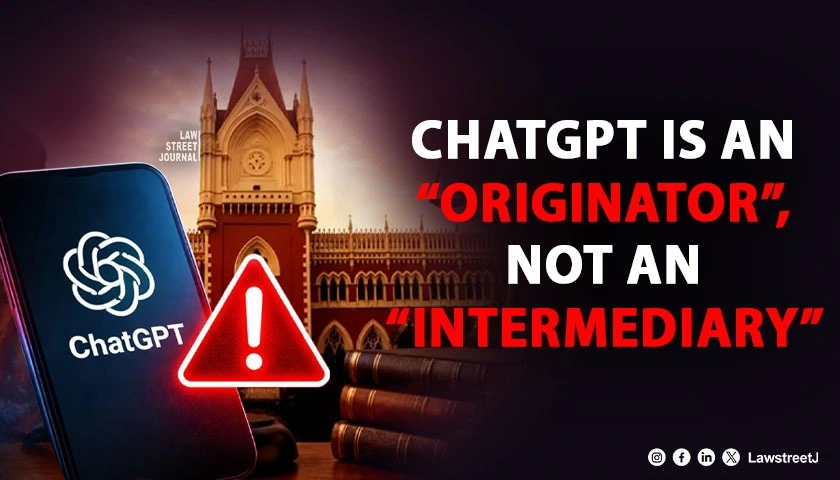
Kolkatta: The Calcutta High Court has held that ChatGPT ought to be treated as an “originator” rather than an “intermediary” under the Information Technology Act, 2000, while dismissing an application for interim relief filed by IndiaMart InterMesh Limited against OpenAI Inc. and others.
Justice Ravi Krishan Kapur delivered the judgment on 20 May 2026 in a suit filed by IndiaMart, the B2B internet marketplace, which alleged that ChatGPT was deliberately excluding its platform from search results while providing accessible links to rival platforms. IndiaMart contended that when users queried ChatGPT specifically for results from its platform, the AI tool would bypass its website links and instead direct users to individual sellers’ own websites, whereas queries concerning other similar platforms yielded direct links to those platforms. The petitioner alleged that this amounted to dilution of its trademark, disparagement, unfair trade practices, and a violation of its fundamental rights under Articles 14, 19, and 21 of the Constitution.
IndiaMart further argued that OpenAI’s reliance on the United States Trade Representative’s Review of Notorious Markets List 2024 (USTR List) as the basis for excluding it was impermissible, since that document carries no statutory force in India. It pointed out that other platforms also featured on the USTR List, such as DHGate, Pinduoduo, Shopee, and Taobao, continued to appear freely in ChatGPT’s responses, making its exclusion discriminatory. The petitioner also invoked Section 79 read with Rule 3(1)(n) of the IT Rules, 2021, arguing that ChatGPT, being an intermediary, was obliged not to discriminate against any user or platform.
OpenAI resisted the petition on multiple grounds. It submitted that the petitioner had no legally cognisable right to visibility on a private platform, that no contract, statute, or constitutional provision created such an entitlement, and that granting the relief sought would amount to compelling specific performance on a continuous basis, making it impossible to monitor. It further argued that ChatGPT is not an intermediary but an originator, as it does not merely host or transmit third-party content but independently generates synthesised responses using a Large Language Model (LLM).
The Court examined in detail the distinction between an “intermediary” under Section 2(1)(w) and an “originator” under Section 2(1)(za) of the IT Act, acknowledging that this was a complicated and vexed question of law and fact that could only be finally determined after technical and expert evidence was led at trial. Nevertheless, on a prima facie basis, the Court found that ChatGPT’s generative qualities placed it closer to an originator. Unlike a traditional search engine, which crawls the internet and ranks existing webpages, an LLM scours vast amounts of data, applies algorithms, and produces direct, synthesised responses. ChatGPT is also capable of generating poems, research projects, and images — functions that require going beyond existing electronic records. Its responses carry an element of newness, uniqueness, and originality, and it acts as an active participant rather than a passive conduit.
The Court did acknowledge the competing argument that ChatGPT’s output is always dependent on a user prompt and that, without human instruction, the platform generates nothing. On this view, the user supplies the intent, the platform executes it, and AI is merely the resource. However, the Court was not persuaded that this was sufficient to bring ChatGPT within the definition of an intermediary, at least at the prima facie stage.
On the substantive merits, the Court held that even if ChatGPT were treated as an intermediary, IndiaMart had failed to demonstrate any breach of a positive legal obligation owed to it. The petitioner’s complaint was ultimately one of pure economic loss arising from reduced user traffic, and there is no rule of law that obliges one private party to promote the business of another on its own platform. The Court cited the Delhi High Court’s decision in Google LLC vs. DRS Logistics (P) Ltd. (2023) for the proposition that no third party can compel a service provider to reflect its link in the service provider’s responses.
The Court also rejected the claims of trademark dilution, disparagement, and copyright infringement. On dilution under Section 29(4) of the Trade Marks Act, 1999, it held that mere referential use of the IndiaMart name does not satisfy the ingredient of use in the course of trade. On disparagement, it noted that there was no publication by the respondents, which is an essential requirement for any action in trade libel or injurious falsehood. On copyright, it found that no specific infringing work had been identified in the plaint or in the petition.
Addressing the broader regulatory question, the Court observed that the IT Act was drafted before the advent of generative AI and that its definitions reflect a world in which only humans or legal entities could originate messages. Bringing AI systems within this framework would ultimately require legislative intervention, not merely executive advisories, to create distinct liability for AI platforms and distribute responsibility across developers and users in proportion to their control over the system.
Finding no prima facie case in favour of the petitioner, and holding that the balance of convenience and the question of irreparable injury were also against the grant of relief, the Court dismissed the application. The parties were directed to take steps for the expeditious hearing of the suit on its merits.
Case Title: IndiaMart InterMesh Limited vs. OpenAI Inc. and Ors. (IA No. GA-COM/1/2025 in IP-COM/57/2025)



![Calcutta High Court conducts late-evening hearing, orders release of lawyer arrested inside court [Read Order]](/secure/uploads/2023/12/lj_4146_Court_lawyers_arrest.jpg)
![Indian Courts this Week: Law Street Journal's Weekly Round-Up of SC & HCs [Jan 1 - Jan 6]](/secure/uploads/2024/01/lj_9050_WhatsApp_Image_2024-01-06_at_12.07.10_PM.jpeg)