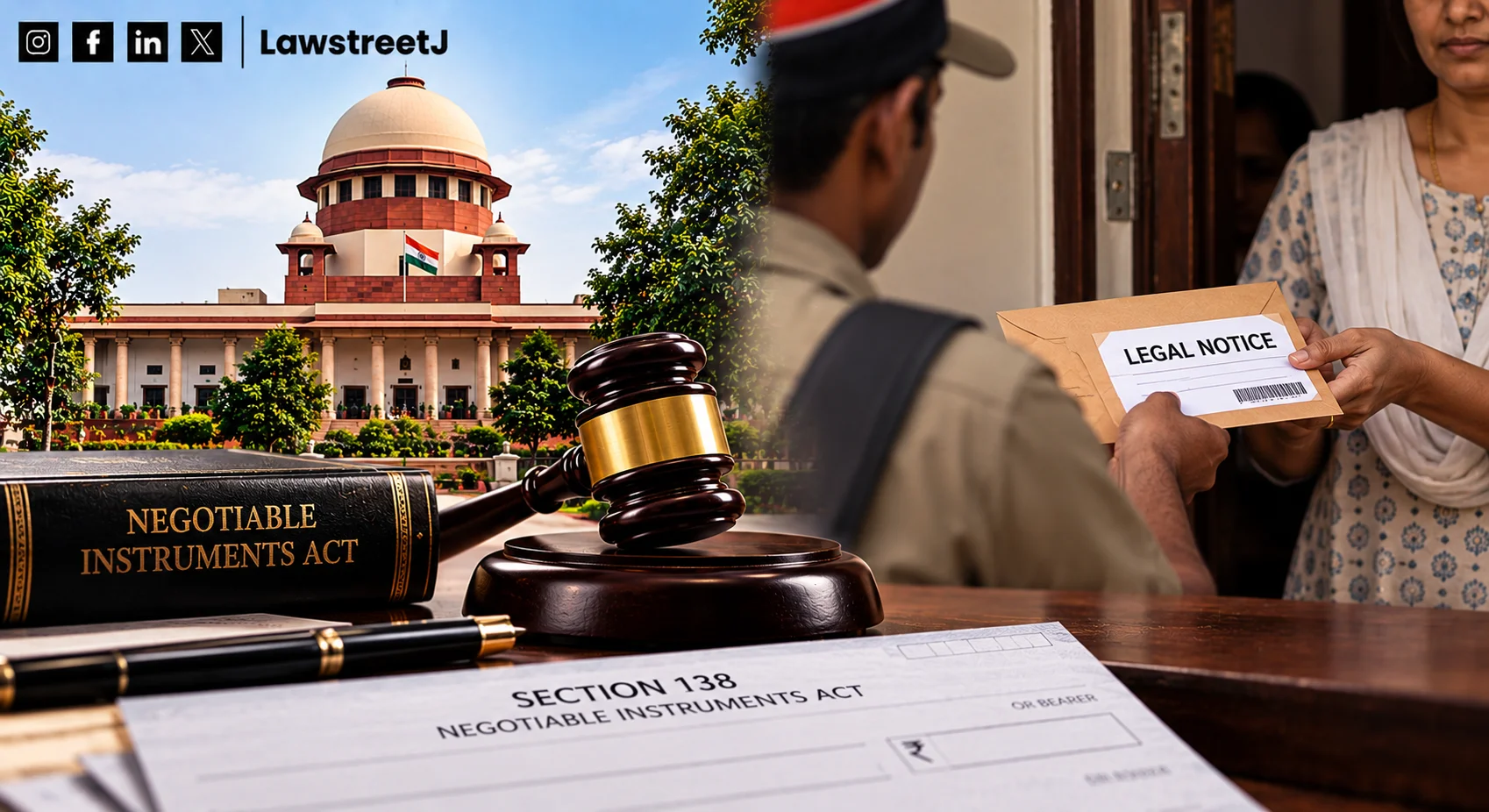
New Delhi: The Supreme Court has restored a trial court's conviction under Section 138 of the Negotiable Instruments Act, 1881, holding that a statutory demand notice delivered to the drawer's mother at his correct address amounts to valid service, and declaring a Kerala High Court Division Bench ruling to the contrary to be per incuriam.
A Bench of Justice Ahsanuddin Amanullah and Justice Manmohan, was examining a challenge to a Kerala High Court order that had set aside the concurrent conviction and sentence of the second respondent solely because the demand notice, though sent to his correct address, had been received by his mother rather than by him personally.
Tracing the settled position through K. Bhaskaran v. Sankaran Vaidhyan Balan, D. Vinod Shivappa and C.C. Alavi Haji, the Court reiterated that once a notice is dispatched to the correct address by registered post, service is deemed effected under Section 27 of the General Clauses Act, 1897, and “the presumption in his favour cannot be defeated by circumstances beyond his control.”
Examining the Division Bench ruling in M.D. Thomas v. P.S. Jaleel, which had held that delivery to a family member does not amount to service on the drawer, the Court held that it was “rendered . . . without reference to binding precedents of this Court,” had “erroneously treated the wife of the drawer as equivalent to an unrelated third party,” and would produce the “anomalous” result of denying a complainant the presumption of service in cases of actual delivery while granting it where a notice was never delivered at all.
The Court accordingly held that M.D. Thomas “is per incuriam and cannot be treated as binding precedent under Article 141 of the Constitution,” warning that allowing it to stand would let “unscrupulous drawers . . . evade liability on specious pleas.”
On the facts, the Court noted that the respondent had used the very same address in his vakalatnama, his appeal and his revision petition, and had never disputed the address or claimed an inimical relationship with his mother, so the presumption of service stood unrebutted.
It held that the High Court had “erred in reversing the concurrent findings of the Trial Court solely on the ground that the notice was not personally delivered” and had “wrongly shifted the burden from the accused-drawer to the complainant.”
Allowing the appeal, the Court set aside the High Court's judgment and restored the Trial Court's sentence of six months' simple imprisonment along with a fine of ₹3,00,000, with a default stipulation of further imprisonment.
Case Title: Sainaba vs. State of Kerala & Anr.