


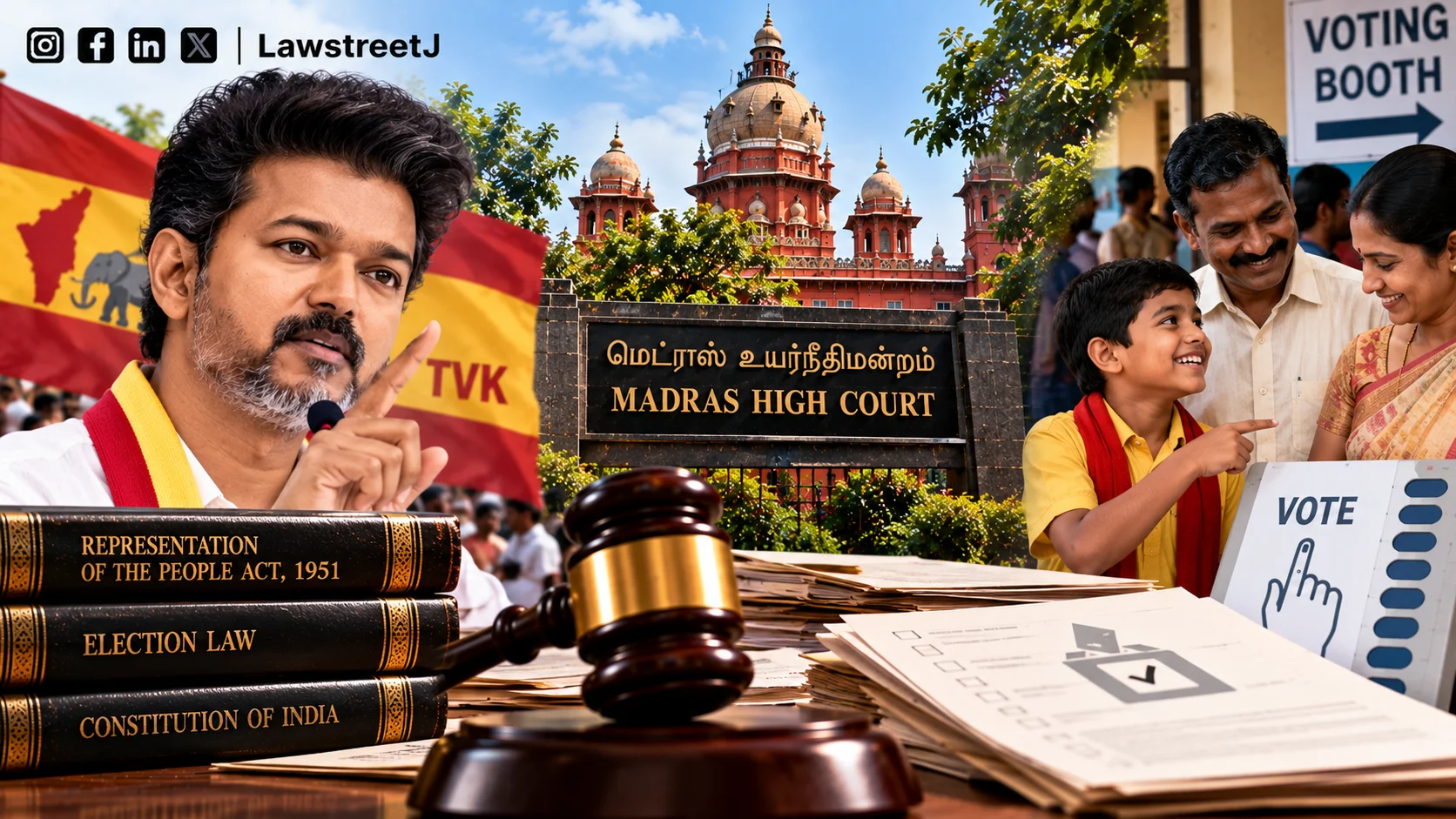
Chennai: The Madras High Court has rejected an election petition challenging the victory of Rajendran R. of the Tamizhaga Vetri Kazhagam (TVK) from the Salem North Assembly Constituency, holding that a political leader's appeal to children to urge their parents to vote for the party, and the children's resulting conduct, does not disclose a triable issue of undue influence.
Justice D. Bharatha Chakravarthy was hearing an application filed by the returned candidate under Order VII Rule 11 of the Code of Civil Procedure, read with Sections 81 and 86(1) of the Representation of the People Act, 1951, seeking rejection of E.L.P. No. 46 of 2026, filed by K. Sivakumar of the Dravida Munnetra Kazhagam (DMK). The returned candidate had polled 85,710 votes in the 2026 Tamil Nadu Assembly elections, while the election petitioner secured 71,676 votes, a margin of 14,034.
The election petition was founded on two grounds. First, it alleged that children were used in campaigning for the returned candidate, in violation of the Election Commission of India's circular dated 05.02.2024, and relied on a complaint and videos, as well as Crime No. 84 of 2026, registered on a complaint by the head of the Video Surveillance Team. Second, it alleged that TVK President Joseph Vijay, in a speech on 21.04.2026, urged children to pester their parents to vote for the party's Whistle symbol, following which social media reels depicted children pressuring or threatening family members to vote for TVK. This was pleaded to be undue influence, a corrupt practice under Section 123(2) of the Act.
For the returned candidate, Mr. G. Murugendran argued that the circular is not a rule or order made under the Act, that violation of the Model Code of Conduct does not automatically invalidate an election, and that there was no pleading on how the result was “materially affected.” He added that the alleged corrupt practice was not committed by the candidate, his agent or anyone with his consent, and that mere persuasion without compulsion or coercion is not undue influence. Senior Counsel N.R. Elango, for the election petitioner, argued that Election Commission directions under Article 324 carry the force of law, that material facts were fully pleaded, and that a mini-trial could not be conducted at the rejection stage.
On the first question, the Court held that the rejection application is maintainable even though it was filed after the written statement. Citing Hari Shanker Jain v. Sonia Gandhi, it observed that the Court has a duty to examine an election petition irrespective of any written statement and reject it if it discloses no cause of action, adding that election petitions must be tested strictly at the threshold.
On the Election Commission's circular, the Court traced its origin to the Bombay High Court's proceedings in Chetan Ramlal Bhutada v. State of Maharashtra and noted that it directs political parties not to use children in campaigns or rallies in any form. However, relying on Jitu Patnaik v. Sanatan Mohakud and Kanimozhi Karunanidhi v. A. Santhana Kumar, the Court held that Section 100(1)(d)(iv) applies only to non-compliance with the Constitution, the Act, or rules or orders made under the Act. Though the circular has statutory character under Article 324, it cannot be treated as an order under the Act, and its breach carries other consequences, such as action against parties under the Election Symbols Order, but is not a ground to void an election.
On the speech, the Court noted that undue influence under Section 123(2) must be committed by the candidate, his agent or another person with the candidate's or election agent's consent. The appeal made by the party President, it held, cannot be said to have been made by the candidate or his agent or with their consent, and neither Section 123(2) nor Section 100(1)(d)(ii) treats campaigning by a party president as a corrupt practice. Even if the speech violated the Commission's directives, it would invite separate action rather than a declaration that the election is void.
The Court then considered whether the children's conduct itself amounted to undue influence. While acknowledging that children carry great influence in Indian families, particularly in Tamil Nadu, it relied on Shiv Kirpal Singh v. V.V. Giri and Krishnamoorthy v. Shivakumar to hold that persuasion or canvassing becomes undue influence only when it amounts to “tyranny over the mind overpowering the volition without convincing the judgment.”
The Court noted that the children shown in the videos were of tender age, did not possess mobile phones and could not make reels, and that adults had shown them the leader's appeal, made them perform the acts and circulated the content. It observed that this could not be seen as the children's sole act of overpowering adults' will, and at best was an attempt to convince adults to vote. Strongly disapproving the practice, the Court said that “The entire act of involving tender children is in bad taste” and reflected poor parenting, but left it to Parliament to consider whether to prohibit it or make it a ground for setting aside an election.
Holding that familial bond and emotion, even if exploited, cannot be elevated to a status where adults' free will is overpowered, the Court added that if adults used children's pestering as an excuse to make a particular choice, that was their own volition. Accordingly, even assuming the allegations were true and uncontroverted, no cause of action was disclosed.
The application was allowed and E.L.P. No. 46 of 2026 was rejected, with no order as to costs. The Court directed that the security deposit paid by the election petitioner be refunded to him.
Appearances:
For the Returned Candidate (Applicant): Mr. G. Murugendran, Advocate.
For the Election Petitioner: Mr. N.R. Elango, Senior Counsel, for Mr. A.S. Aswin Prasanna.
For the Returning Officer (R14): Mr. Niranjan Rajagopalan, Advocate.
Case Title: K. Sivakumar vs. Rajendran R. and Others, O.A. No. 890 of 2026 in E.L.P. No. 46 of 2026



![Madras High Court Directs Tamil Nadu Government to Ensure Quota for Transgenders in Local Body Elections [Read Order]](/secure/uploads/2023/08/lj_2507_7a03d113-08b1-4670-b6fb-9058aee481d0.jpg)

.jpeg)
.jpeg)

